Sunday, 14 July 2019

Buckler's Hard to Hythe (Solent Way 3)

Buckler's Hard

We resume the Solent Way at Buckler's Hard, a very picturesque 18th century shipbuilding village. It now mainly consists of two rows of buildings facing each other across a wide expanse of grass, with a footpath down the middle. We walk down and turn left at the waterside - the Beaulieu River.

We follow the bank for a while and then the path diverges from the bank and goes through woodland. The sun through the pine trees is quite atmospheric. Later the path continues across open land.


On reaching Beaulieu we skirted the Abbey Ruins and  Place House, having already explored this on a visit in 2016. The gatehouse remained worthy of a picture though, with Place House in the background.


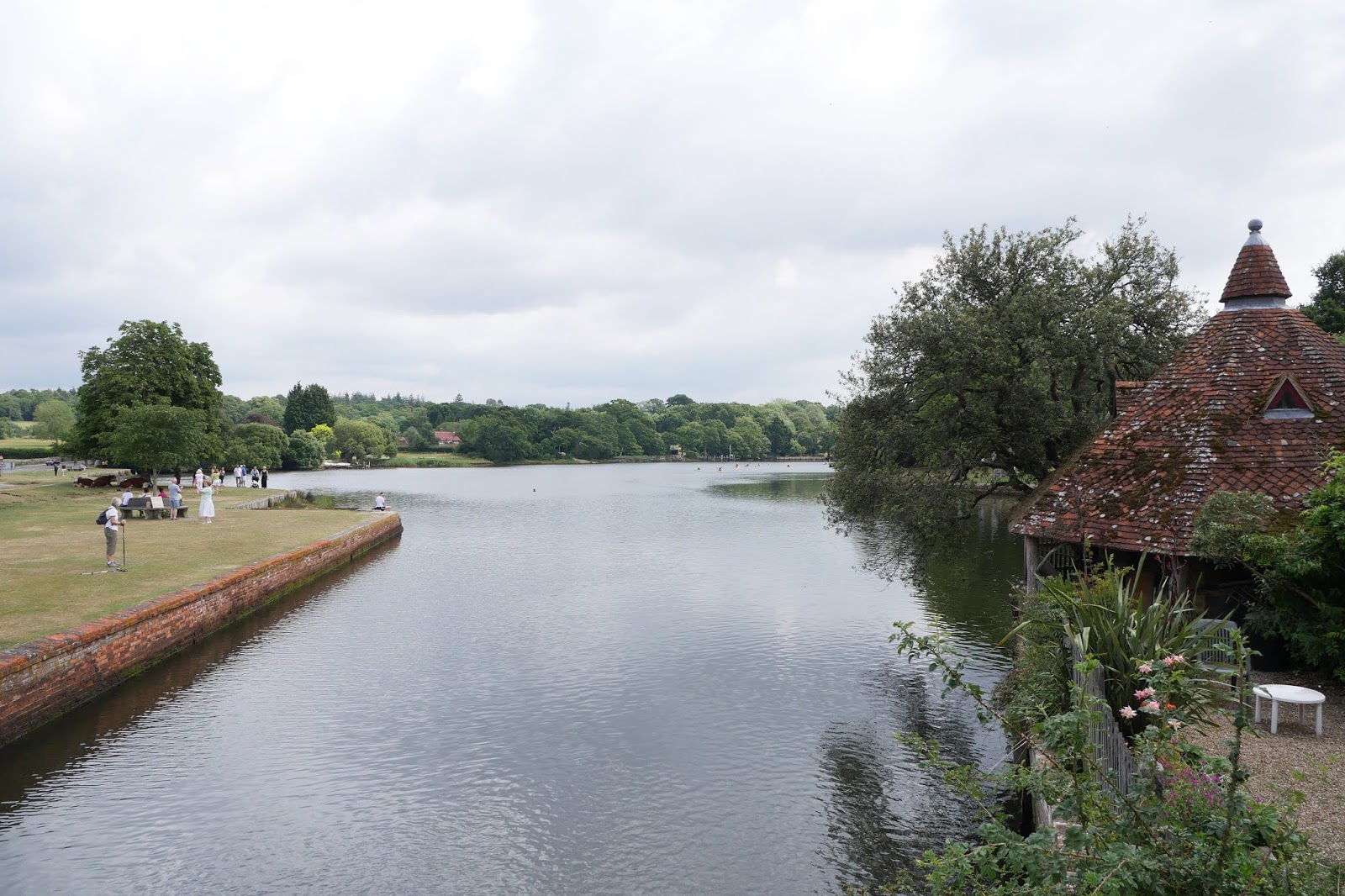
Looking in the opposite direction, there is what looks like a lake, but is in fact the dammed end of the Beaulieu River.

Now we followed the road towards Hythe. It was quite busy and not very rewarding. It brought us to Beaulieu Heath, a part of the the New Forest. Our first view of the Heath was not too inspiring: some of the traditional horses and beyond them the massive Fawleu Oil Refinery.


We continued to follow the line of the road (B3054) but now we could walk on heathland beside the road's edge, rather than right on it. One excellent discovery was the first Gatekeeper butterflies of the year. This one had especially clear double white spots (which distinguish it from other brown and orange species) in its "eyes".


The heath was quite agreeable to walk on with a few other butterflies and some flowers - we were of course at the eastern extremes of the New Forest, so perhaps this wasn't one of the best bits.

Where the road joined the Hythe By Pass, our route turned sharply south east, still within the New Forest, with Fawley Enclosure on our right. After a mile or so, we left the forest and crossed the By Pass to soon find a wonderful path which initially passed various works but soon, much to our surprise, became a woodland track. The oil refineries were still there but were at least hidden by the trees.

We passed a nice looking pub and crossed the railway to emerge on the side of Southampton Water. As the picture shows, we were some way from the water's edge.


We were now on the outskirts of Hythe, but the first thing we noticed was Netley Castle on the far side of the Water. It looked most imposing. It seems to be privately owned, but we will be interested to see something of it when we pass by on the next leg of the Solent Way. There also seem to be the ruins of Netley Abbey behind it.


We saw this wonderful hotel we we came into the town.


Hythe's main claim to fame seems to be its astonishingly long ferry jetty which stretches 700 yards into Southampton Water.


 A tram service runs along the pier, although there is also a walkway. The carriages look suitably old-fashioned.

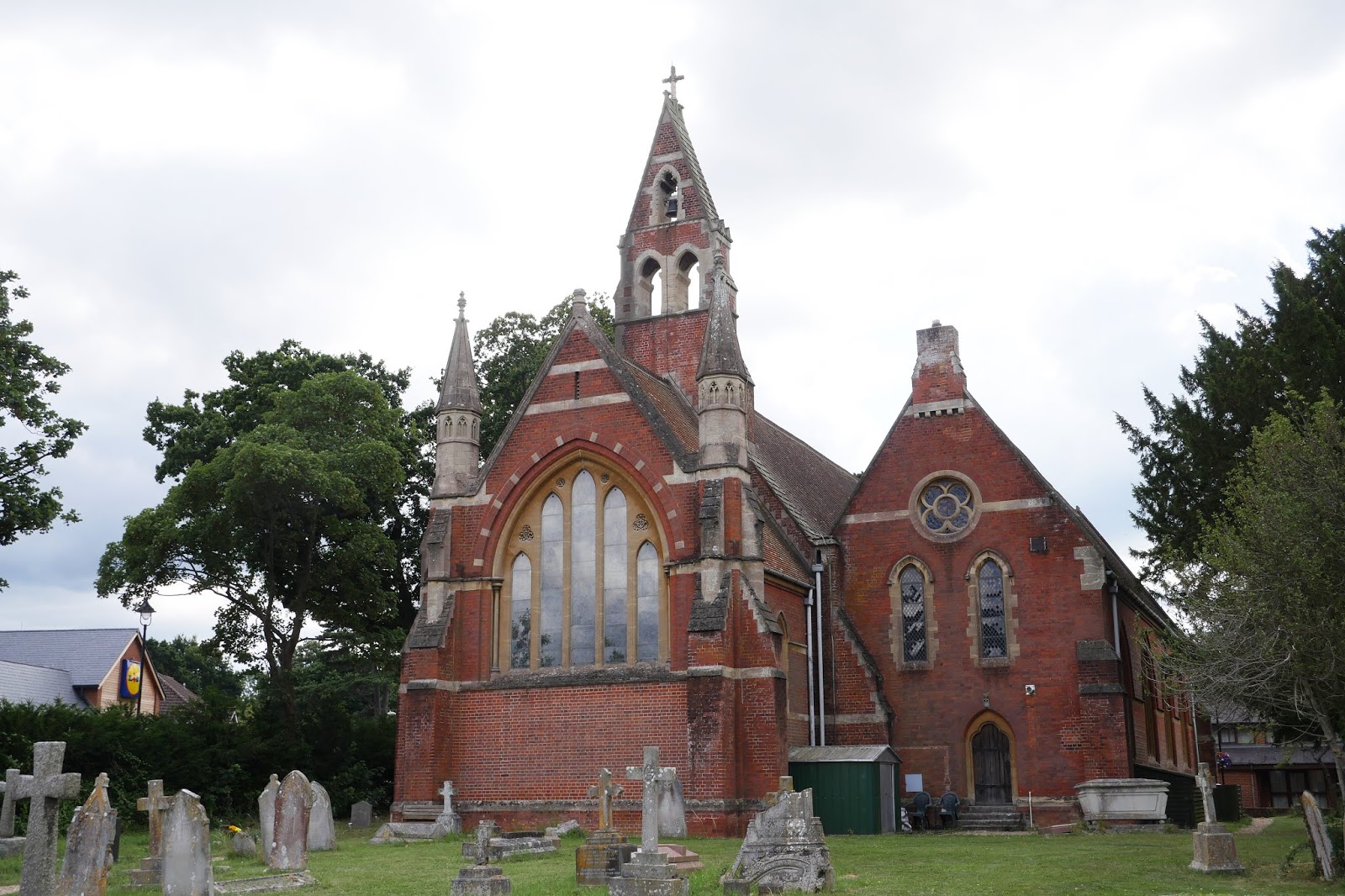
To complete the walk we returned to where we had parked the car near St John's church, with the adjoining St Anne's tacked onto it. It made rather an interesting ensemble.
Conditions: warm and sunny.

Map: Explorer OL 22 (New Forest).

Distance: about 8 miles.

Rating: three and a half stars.

Saturday, 6 July 2019

Kelmscott Manor and Buscot

Kelmscott Manor

I have long been fascinated by William Morris and today we made a long-overdue visit to Kelmscott Manor near Lechlade, a house dating from about 1600 which was leased by Morris and Dante Gabriel Rossetti as a country retreat in 1871. The lease continued long after Morris's death (in 1896) and the house was eventually bought by his widow, Jane, in 1913. Morris's daughter May lived there until her death in 1938. The property was bought by the Society of Antiquaries in 1962 (I don't know what happened in between). It is open to visitors only on Wednesday and Saturday - and closes for restoration work on 31 August 2019.

The car park is some way away from the house, but it means that you start with a pleasant and interesting walk through the village. You first pass the Morris Memorial Hall (1934) commissioned by May Morris, Morris's elder daughter and designed by the Arts & crafts architect Ernest Gimson, but completed fourteen years after his death.


You pass the inviting Plough Inn to pass Memorial Cottages, commissioned by Jane Morris in memory of her husband.


In the centre of the facade is a lovely carved stone panel of Morris, possibly sitting in the garden of the Red House, by George Jack.


After passing a second set of cottages, commissioned by May Morris, but less interesting and harder to see, you reach the complex of buildings around Kelmscott Manor. A very helpful Room Guide, given to all visitors, helps you find your way round. I was surprised by how many interesting items there were to see, starting with the famous hooded settle designed by Phil Webb for the Red House, which Webb also designed for Morris and Jane when they married in 1859.


In the next room, the White Room, were lovely portraits by Rossetti of Jenny and May Morris aged 10 and 9 respectively.


Upstairs William Morris's bedroom had a bedspread designed by May Morris in about 1910 and made by Jane and Augusta de Morgan (sister of William de Morgan, the great tile maker).


After a very enjoyable tour we continued with the second part of our plan: to walk along the Thames to Buscot. This was our first look at the river, rather wider than we expected so near to its source. We were delighted to see a heron fly from one bank to the other.


We followed the riverside path to pass the first of several war time pill boxes.


At a small marina we saw a swan with no less than eight cygnets.


After a couple of miles or so we reached Buscot Lock, spotting as we approached our first Painted Lady of the year (at least in England - we saw extraordinary numbers of them on our recent holiday in Greece).


After crossing the bridge and lock we took a right turn to Buscot Church, following a sign which greatly overstated the distance: it claimed to be half a mile, but seemed to less than half that. The church dates from the 13th century with 15th century additions and 18th century alterations; it was then restored in 1854.


During the 19th century beautiful stained glass designed by Philip Webb for Morris and Co was installed behind in the chancel and elsewhere. This is the Good Shepherd.


Returning to Buscot weir we mistook our way slightly and ended up in Buscot village, which did at least enable us to see its delightful Village Hall of 1897. Behind it is what once was a well and now houses a water fountain.


We walked along the busy A417 for a short way and turned left on to a path which led across several large fields to bring us back to the Thames at the small marina mentioned above.

We completed our walk by visiting the St George's church on the edge Kelmscott where we saw the gravestone of Morris and his family, Jane, Jenny and May.


Conditions: warm, but rather grey.

Distance: about six miles all told.

Rating: four and a half stars. A delightful outing and an ambition fulfilled.

Friday, 28 June 2019

Greece: Butterflies of Mount Chelmos and the Northern Peloponnese

This post illustrates some of the new species we saw on the second part of our wonderful butterfly holiday in Greece with Greenwings.

 Southern White Admiral (Limenitis reducta)

 Great Banded Grayling (Kanetida circe)

Spotted Fritillary (Meliteae didyma)

Ripart's Anomalous Blue (Agrodiaetus ripartii)

Berger's Clouded Yellow (Colias alphcariensis)

C
Chelmos Blue (Agrodiaetus iphigenia)

Lesser Fiery Copper (Lycaena thersamon)

Anomalous Blue (Agrodiaetus admetus)


Odd-spot Blue (F) (Turanana endymion)

Mealeager's Blue (Meleageria daphnis)

Lang's Short-tailed Blue (Leptotes pirithous)

Mallow Skipper (Carcharodus lavatherae)

Thursday, 27 June 2019

Greece: Olympia

The Stadium

We are still on our butterfly spotting holiday, but today we have abandoned the rest of the gang to made a side trip to Olympia, the one major site that we haven't yet seen. We got there by a high speed taxi ride over the mountains which took a while to recover from. Olympia is rather different from Delphi as it is much larger and on a flat site. The site plan indicates that the recommended route for exploration is an anti-clockwise loop, starting with the Gymnasium on the right.


Olympia is primarily about the Olympic games and so the Gymnasium, used for practicing races, javelin and discus seems a reasonable place to start. It dates from the 2nd century BC. There is not much left however, so considerable imagination is required.


Further along is the Palaestra (3rd century BC), a square building with a central courtyard surrounded by a colonnade. It was principally a training area for wrestling, boxing and jumping.


Next we passed a rather different style of building, with not a column in sight. This was once the workshop of Pheidias and later an early Christina basilica. The zone at the rear of the site has a number of buildings which have Roman origins.


A little further along was the curiously named SW Building, a complex of baths dating from the 1st-3rd century AD.


This marked the furthest point from the entrance and we now headed across the rear of the site, delighted by these unusually coloured Oleanders.


Now we came to the South portico (4th century BC) which marked the southern boundary of the site. It consisted of a interior Doric colonnade and and an outer Corinthian one. The capitals of the Corinthian columns give some idea of what it might have been like.


Beyond this, in the far corner, is the so-called Octagon, or Nero's House. It was altered in the 3rd century and occupied briefly by the Roman Emperor Nero when he attended the games


Heading now towards the front of the site, we rather ignored the Temple of Zeus on our left and passed the remains of the Echo Stoa (an covered colonade which was 100m long)  which once had two tall Ionic columns topped by statues of Ptoleny and Arsinoe. One of these remains, albeit without its statue


Now we came the passageway which marks the entrance to the Stadium which was laid out in the 5th century BC. The Stadium is said to have been able to accommodate 45,000 spectators (see the photo at the head of this post).


Just along from the Stadium entrance is the Nymphaion, a monumental fountain of a kind found in Renaissance Italy, and in front of it the Altar of Hera.


The Altar has been used to light the Olympic flame ever since the Berlin Olympics in 1936.


Immediately adjacent is the Temple of Hera. Dating from the end of the 7th century BC, it is the oldest temple on the site. There were originally 6 columns across the front and rear and 16 along the sides.

Finally, we come to the circular temple called the Philippeion, restored in 2005. It was started by Philip of Macedon some time after 338 BC to mark his victory over the Greeks at Chaeronia


To complete our visit we had a quick look round the excellent Museum, whose colonaded courtyard offered a nod to Classical antiquity.


Among many interesting exhibits we especially admired this sculpture of Zeus and Ganymede. In Greel mythology Ganymede was a beautufl Trojan boy who Zeus fell in love with his and abducted him in the form of an eagle to serve as cup-bearer to the Gods.


I also found this collection of Greek helmets very striking.


Conditions: sunny and very hot.

Rating: five stars.