Showing posts with label Merseyside. Show all posts

Friday, 27 August 2010

Liverpool: Albert Dock to Liverpool Cathedral

Liverpool (Anglican) Cathedral

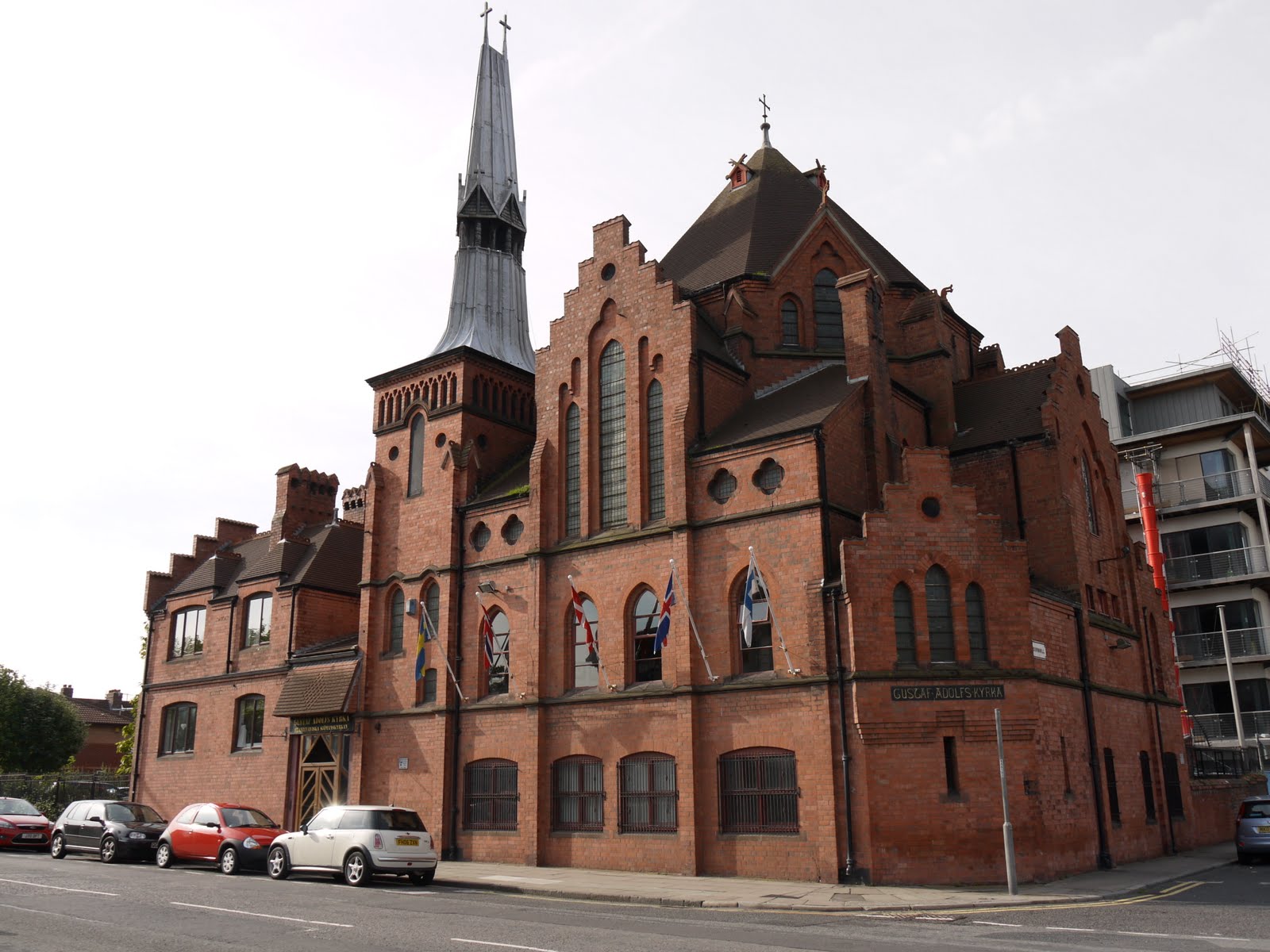
In Liverpool on a family visit, we improvised this excellent city walk. We started at Albert Dock, where we were staying, and set off in the broad direction of the Cathedral. We walked along Park Lane and came on the fantastic Swedish Seamen's Church (Gustav Adolfs Kyrke) of 1883-34 by WD Caroe.


A bit further up is the Catholic church of St Vincent de Paul (1856-7) by Edward Welby Pugin (son of the much more famous AWN Pugin of Houses of Parliament fame). The wooden bellcote is noteworthy and the red brick Presbytery, around the corner, tucked in beside the church has trefoil heads over every window.
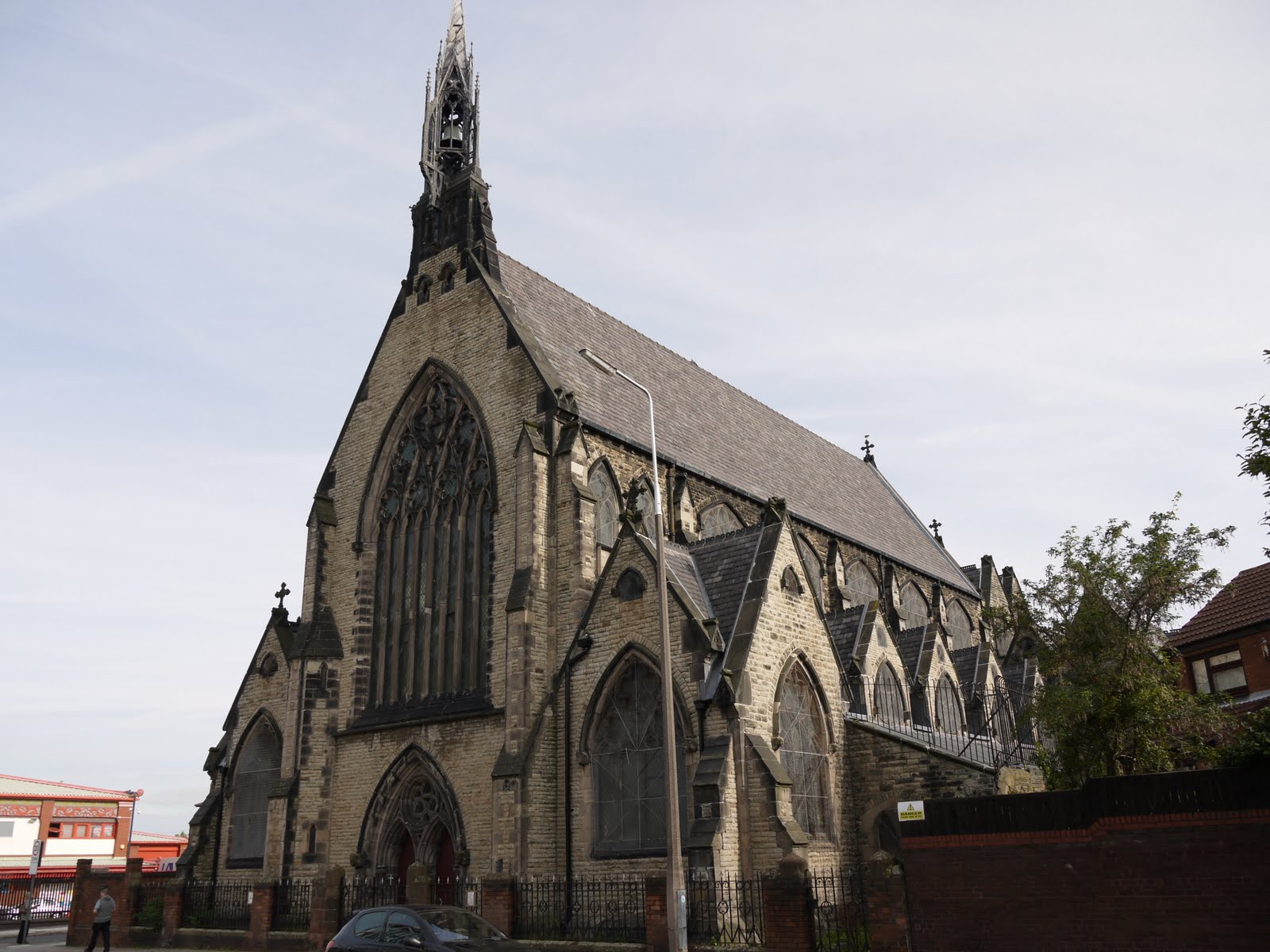


We reached the Cathedral at one corner (to the right in the photo at the head of this post) and walked along its length to find the main entrance at the west end. (In fact we were interested to to discover that the "west" end actually faces more or less due north. I had always naively imagined that churches were literally arranged with the altar at the east end, but I suppose it is obvious that the constraints of the site mean that east and west are sometimes notional.)

We enjoyed the view down over the graveyard, which was apparently once a quarry,


The Cathedral itself was designed by St Giles Gilbert Scott, who won the architectural competition for it aged only 22 (perhaps his eminent father, Sir George, helped). The diocese had only been founded in 1880. Work started in 1904 and the lady chapel was completed by 1910 at which point dramatically changed his own design, replacing the twin towers of his original with the single massive tower you can see today. There is a model of the original design in the Cathedral.

The Cathedral was not finally completed until 1978 and had been damaged in the war. It has a sense of massive, if rather incoherent, space and stylistic unity. The Pevsner Architectural Guide to Liverpool by Joseph Sharples describes it as "the final flowering of the Gothic Revival as a vital, creative movement" and as "one of the great buildings of the C20".

We went to the top of the 331 foot high tower and enjoyed the views. This one shows Albert Dock, with the nearly finished Museum of Liverpool just to the right.


We took a slight different return route, heading past the small Greek temple-like Oratory and down Upper Duke St, past the wide Georgian Rodney St.


A bit further on we came to the former Great George St Congregational church of 1841.


Sharples describes this as "an outstandingly successful building".

From here we walked through Chinatown back down to Park Lane and thence to Albert Dock.

Conditions: warm, sunny.

Distance: about 3 miles.

Rating: four stars.

Note: I did a previous walk around the City Centre.

Sunday, 4 October 2009

Port Sunlight

Port Sunlight: Park Road

In Liverpool on a family visit, we took the opportunity to fulfill a small ambition and visit Port Sunlight. I found the directions for this walk on the Guardian website. You could just wander around, but this very well-structured route makes the most of the village.

Port Sunlight is a model village built by William Hesketh Lever, later Lord Lever, for workers at his soap factory. Sunlight Soap was the company's flagship product. The houses are the work of nearly 30 architects and are in a variety of styles, but all the early ones at least have an Arts and Crafts feel to them. The overall feel is of a garden city: wide streets and lots of open space. The houses all have unified front gardens, which creates a very ordered effect.

The walk starts at the railway station, close to the factory, which is still in production, now part of Unilever. This is where building began in 1891. An immediate detour reveals the rather quaint Fire Station.


Turning away from the factory, you are presented with this fine block in a Dutch gabled style.


Round the corner you come on the sprawling picturesque Lyceum of 1896, originally the village school and church, but now used in part as the Social Club (the remainder houses Unilever's archives).


A little further on you reach the bowling green, faced by another splendidly extravagant block.


Passing to the left of the 1901 Hulme Hall, you reach an impressive arch, through which can be seen gardens, the war memorial and in the distance, the Lady Lever Gallery.


The Gallery can be seen much more clearly once you have reached the memorial.


The Gallery was in fact our other reason for visiting Port Sunlight. Its crowing jewel is a fine collection, all in one large room, of 19th century painting: Pre-Raphaelites such as Millais, Holman Hunt, Burne-Jones and Rossetti and classicists such as Leighton and Alma-Tadema.

I was staggered to find that this is the home of Holman Hunt's wonderful "The Scapegoat". Even more wonderful in a way, the gallery also houses the well known painting by Millais called "Bubbles". Leaving aside any artistic judgement, it is amusing to find it here, given that it was used to advertise Pears soap, presumably Sunlight Soap's bitterest rival.

To return, you swing round behind the gallery, walk along Church Road, passing the school with its cupolas.


A loop along Bolton Street and into The Gunnel brings you to the pretty small park known as The Dell, from which you emerge opposite the station.


Rating: Four stars. Wonderfully interesting. Some lovely houses, richly individual and most with beautiful detailing in wood, plaster and terracotta. One can also see aspects of town planning which are still honoured today, albeit at much higher densities.

It is unusual perhaps to include an art gallery on a walk, but it is an absolute delight, thoroughly enriching the experience.

The walk description was very detailed and helpful but would have benefited from giving more street names and being linked to a proper street map. I downloaded one from the Liverpool Museums website.

Saturday, 31 January 2009

Heswall Shore and the Dungeon

Heswall Shore

This is a very pleasant and varied 3.5 mile walk which falls into four clear stages. The walk begins in the car park / bus terminus in Banks Road a hundred yards from the shore. You first walk up Banks Road away from the shore and, after passing through a housing estate, climb steadily through a nature reserve.

It is slightly disappointing when this ends with your arrival at a residential road to begin the second stage, along the road. This gives way to a farm track and then a fenced path by fields, all the time parallel to the shore, with increasingly clear views over the Dee estuary.

Stage three involves the descent to the shore and is the prettiest stage of the walk. You into a path which leads steadily downhill through an imaginatively named ravine, called The Dungeon. We couldn't find any convincing explanation for this, although we did see a rocky overhang which might have suggested a secret dungeon, or oubliette.

The Dungeon does have a delightful stream wending through the trees ....


.... and then turning into a small waterfall.


The path continues at a higher level, and later crosses the Wirral Way - here on a section of disused railway line - before a final track brings you to the shore.

For stage four, you walk along the shore to reach a boatyard, which happily has Sheldrake's pub and bistro nearby, where we had an enjoyable lunch before returning to the car.

There were a lot of seabirds just out of clear view to the naked eye, but we were impressed to see two birdwatchers ensconced with telescopes and cameras stoically observing them. We admired their fortitude as it was bitterly cold day, especially on the shore, but we were not tempted to emulate them.

Rating: three stars

Friday, 30 January 2009

Liverpool City Centre

The Royal Liver Building

Something a bit different today: a city centre walk around Liverpool, courtesy of last summer's edition of the the Ramblers Association Walk magazine. A description of the walk is available online, but only to members.

The walk begins at Lime Street station and you cross the street to St George's Hall. Originally separate design competitions were held for a new hall for concerts and public events, and for a new assize court. Both were won by the young architect Harvey Lonsdale Elmes, then aged only 25. Elmes later proposed combining the two functions in a single building which would express Liverpool's civic pride and be bigger than Westminster Hall, St Paul's Cathedral and - most importantly - Birmingham Town Hall. Work started in 1842 and the Hall was opened in 1854.

It is hailed as a triumph of neo-classical architecture, but personally I have always found it heavy and oppressive. Inside however is a different story. You can now visit the cells and the courtroom which are both quite interesting. But the most wonderful thing is the that the massive tiled floor of the Great Hall, which has been covered by a wooden floor for most of its existence is currently exposed to view, and is in sparkling condition. The tiles are by Minton.


A virtual tour of the Hall is available on the BBC Liverpool website. Immediately adjacent are the splendid Walker Art Gallery, the Central Library and the World Museum.

You then walk down Victoria Street, turn left onto Stanley Street past the "Cavern quarter". Mathew Street, Cook Street and Castle Street bring you to the Town Hall. The core of the building dates from 1749-54 and is by John Wood. The dome and portico were added by James Wyatt in 1802 and 1811 respectively. It was disappointing to see how dirty this fine building has become: it urgently needs a facelift.


From here you go to Water Street, leading down towards the Mersey. In Water Street you can look into the India Buildings with its wonderful coffered ceiling over the long central arcade. It was built in 1930 and designed by Arnold Thornely and Herbert Rouse. It was damaged during the war and rebuilt under Rouse's supervision afterwards; the arcade is in fact a later addition, presumably during the rebuilding. We were given a very warm welcome here and provided with explanatory leaflets.


Almost opposite, is Oriel Chambers. It dates from 1864, but its cast iron frame and expanse of glass have accorded it the status of a modernist icon. I have seen similar buildings in Prague and Vienna which date from 40 years later. Pevsner described it as "one of the most remarkable buildings of its date in Europe".


At the end of Water Street you cross the road to reach Pier Head and the three buildings known locally as the Three Graces: the Royal Liver Building (1908-11), the Cunard Building (1916) and the Port of Liverpool building (1903-7). They occupy the site of the former George Dock which was drained in 1899.

Port of Liverpool building

Skirting the building works for the new museum, you then reach the Albert Docks. It was designed by Jesse Hartley and built in 1843-7 without any combustible material. Joseph Sharples, in the invaluable Pevsner architectural guide to Liverpool, describes it as "one of the great monuments of C19 engineering" and refers to its "monumental solemnity".


This is Piermaster's House taken from the swing bridge.


And this is the dock itself, from the same position.


Leaving the dock, you walk back along the Strand and turn up James St, and then continue up Lord Street and Church Street to return to the beginning.

On the corner of James St is the White Star Line offices (1895-98). I was struck by its resemblance to Old Scotland Yard in London and was delighted to discover that it was by the same architect: Norman Shaw.


Finally, just of Church Street down Church Alley you come on the oldest surviving building in the city centre: the Bluecoat Chambers, begun in 1716. Originally built by a sea-captain, Bryan Blundell as a school for poor children it is now a centre for the arts. It is not clear who the architect was.


Rating: four stars. A really interesting walk, with some unexpected treats.

Sunday, 8 June 2008

Crosby

Crosby Beach, looking towards Bootle

Visiting Liverpool, our first thought was to do our usual style of walk inland. But then a much better idea struck - why not go and see Antony Gormley's celebrated men on the beach / in the sea at Crosby.

We parked in a quiet street full of splendid Victorian mansions, crossed a grassy area behind the dunes and came on the beach with a promenade behind it. The picture below shows the first view of men and beach.


The installation - correctly known as "Another place" - consists of 100 life size figures spread out along 3 km of beach. They are made from cast iron, from a mold of the artist's body.

I hadn't realised that they had previously been displayed in Cruxhaven in Germany, Stavanger in Norway and De Panne in Belgium. It had been planned that they would move to New York at the end of 2006 but after a successful appeal it is now planned that they will remain permanently in Crosby.

The figures are all on a one metre base and some are slightly above ground (sand) level and others are set into the sand up to the knees. Most are immersed in the sea at high tide, while some are permanently under water.

One surprising feature is that because the figures are quite widely spaced out, you can only really see a few at a time. Looking along the beach they become indistinguishable from the real people out for a walk or sight-seeing.


It would be interesting to see an aerial photo, but it seems that the figures are arranged in parallel lines at a slight angle to the shore, so that as you walk along the beach from south to north the figures are gradually further from the shoreline.

According to Sefton Council's website "The work is seen as a poetic response to the individual and universal sentiments associated with emigration - sadness at leaving, but the hope of a new future in another place."

The figures certainly have a melancholy air, but you could just as well see them as waiting ....


Gormley's own website says that " The idea was to test time and tide, stillness and movement, and somehow engage with the daily life of the beach." And this they definitely do. You can see how exposure to the elements has changed the figures in different ways, and they also make the beach a more interesting place - you could see people taking photos draped over the figures, lined up with them, placing hats and scarfs on them. Perhaps inevitably, one or two have been treated to a a paint job.

It is hard to escape the conclusion that Gormley has a strong narcissistic streak - most of his work seems to involve his own body - but this is a truly impressive and affecting work of art.