Showing posts with label cloister. Show all posts

Wednesday, 25 May 2022

Naples


                                                                        The Castel Nuovo

We are in Naples for a family wedding, but first we are keen to see something of the city and also the great sights of Pompeii and Herculaneum. We leave our rather grand hotel (apparently popular with professional footballers) and walk to the Castel Nuovo. It was founded in 1279 and is also known as the Angevin Castle (its founder was Charles I of Anjou). The white triumphal arch was commissioned by Alfonso of Aragon in 1442.

The castle is rectangular, with a large courtyard: this is the opposite end, viewed from the outside.

 
We followed the pavement by the main road towards and then beside the sea. There are many fine buildings on the landward side of the main road. This often crowded path brought us to the second of Naples' castles: the Castel dell'uovo, Naples' oldest castle - and yes there is an egg supposedly buried in its foundations.
 

The castle stands on a small island which was once used by the Greeks as a harbour and which was converted into a fort by the Normans in the 12th century. We had a pleasant ramble through the castle, which is now used for cultural events and exhibitions. This is the view from the ramparts inland towards the city.


The Castle is now surrounded on the landward side by a large selection of restaurants. Looking back the way we came we caught a glimpse of a three-masted sailing boat, with the twin peaks of Vesuvius behind it. Not my best photo, but better than nothing.


We headed inland towards the Piazza Trieste e Trento and then walked up via Toledo as Ange was in need of new sunglasses. Once that need was satisfied we continued along this long pedestrianised street to reach the spacious Piazza Dante ...
 
 
... inevitably with a statue of the great man himself.


We then headed through a warren of streets to find a grand baroque church, the Gesu Nuovo, hidden behind scaffolding. We later discovered that the scaffolding concealed a rather austere and not very attractive facade. The Baroque interior was a bit OTT.


More or less opposite was the church of Santa Chiara which was built in 1313–1340 by Queen Sancha of Majorca and her husband King Robert of Naples who is also buried in the complex. Inside the church is spacious and with a pleasant interior. Beyond the church there was an incredible garden and cloister. The garden features these exquisite columns with majolica tiles added in 1742 by Domenico Antonio Vaccaro.
 
 
The four walls of the splendid cloister were covered with seventeenth century frescoes depicting Saints, allegories and scenes of the Old Testament.
 

It remained only to amble back to our hotel and its footballers. Not that we actually saw any.

Saturday, 15 February 2020

Portugal: Lisbon - Belem


 The Belem Tower

We are trying something different again today – a mixed bus and walking tour focusing on the Belem district, down by the River Tagus. We pick up the Yellow Bus at the Liberadores stop in Praca Dom Pedro IV and make one intermediate stop at the Calouste Gulbenkian Foundation. The Foundation was built to house Gulbenkian's collection after his death in 1955 and opened in 1969. It offers a wonderful journey through art history from Egyptian and Roman artifacts, through medieval and Renaissance painting up to the Impressionists, with tiles, furniture and items by Lalique as well. 

Unfortunately, photos were not allowed inside the gallery, but this fantastic piece in the foyer could be. It is a called La Primavera: A homage to Jean Goujon and was sculpted by Alfred-Auguste Janniot between 1920 and 1924. Janniot does not seem to be well known, but we thought it was a wonderful price of work.


We got back on the bus and followed quite an interesting route down to Belem, which included an aqueduct and the gaol. We learned that Portugal was the first country to end capital punishment.We enjoyed this view over the Tagus.


 The first main sight of course is the Belem Tower. Here is a detailed view.


It was built in 1519 as a defence for Lisbon. A matching fort was built on the other side of the Tagus, but there is no trace of it now. The Tower is a UNESCO World Heritage Site.

We took advantage of a wonderfully entrepreneurial venture: Wine a view. It was a sort of mobile wine bar with a wide selection of wines served in plastic glasses which you keep. A small number of chairs were placed by the retaining wall of the river, or you could sit on the wall if they were full. We enjoyed a delightful interlude sipping wine and enjoying the warm sunshine (!). This is one aspect of the view.


After a while we strolled along the riverside promenade towards the magnificent Monument to the Discoverers. On the way we passed this curious brick lighthouse, seemingly derelict.


Soon after we reached the magnificent Monument to the Discoveries …


The monument was conceived in 1939 by  architect José Ângelo Cottinelli Telmo, and sculptor Leopoldo de Almeida, as a temporary feature of the Portugese World Exhibition opening in June 1940. The building you see today was completed in 1960 and formed part of the of the 500th anniversary of the death of Henry the Navigator. He is the leading figure, more easily seen in the close up below. Vasco de Gama, the only other Portugese discoverer I can think of, is behind Henry on the other side of the monument.


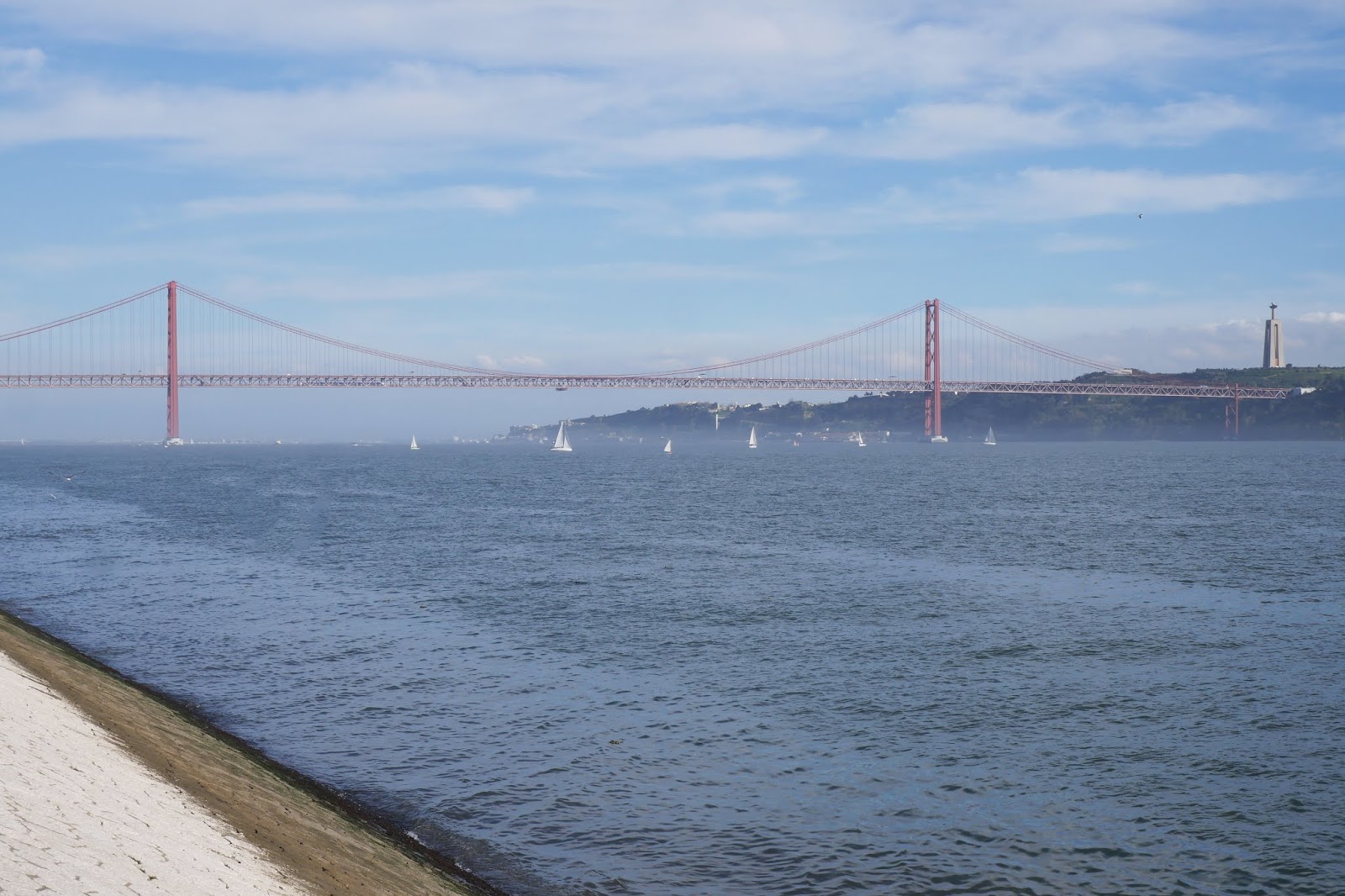
Beyond it was the splendid 25th of April Bridge which we had driven across on our way into Lisbon the previous day. We discovered later that a railway line runs underneath the roadway.


On the far bank was the statue of Christ the King – in the style of the more famous Christ the Redeemer in Rio di Janeiro – towered impressively. It was consecrated in 1958 and was built in thanks for Portugal avoiding the horrors of World War 2, although this possibly owed more to the policies of the Portugese dictator, Salazar.

Now we headed away from the river to take the underpass beneath the road and railway which leads to St Jeronimo's Monastery, which is also an UNESCO World Heritage site. This enormous structure consists of two parts, the Monastery on the left hand side which now seems only to host exhibitions (and the ticket machines for the cloister) …


… and the church and cloister on the right (the cloister is behind the church).


The complex was built to fulfill a promise made by the King of Portugal to do so if Vasco de Gama returned from his inaugural voyage of 1498 to India. Happily he did. Construction began in 1502 in the Manueline style. Vasco's tomb lies inside the church.

The ceiling of the church has beautiful vaulting.


You leave the church and enter the Cloister by its separate entrance (where your machine-produced ticket is validated by a man with a pen). The first sight of the two storey cloister was extremely impressive, especially with the late afternoon sun illuminating the far side. (We had been here before, 26 years ago, but it is still capable of making a tremendous impression.)


The whole thing is on a grand scale: this is one side of the downstairs section.


A staircase leads to the upper section which also offers a view towards the church highlighting its dome.  


Finally, we enjoyed the former refectory with its tiled walls and vaulted ceiling.


It remained only to catch the Yellow Bus back to Rossio square. 

Conditions: mainly warm and sunny.

Rating: five stars.

Thursday, 19 September 2019

Padua: South East quarter

 Basilica of Sant'Antonio

The South East quarter of Padua is dominated by the massive Basilica of Sant'Antonio, but there are several other interesting sights. As we walked towards the Basilica from the city centre we crossed a road that had once been a canal and passed this beautiful palazzo in Piazza Antinore.


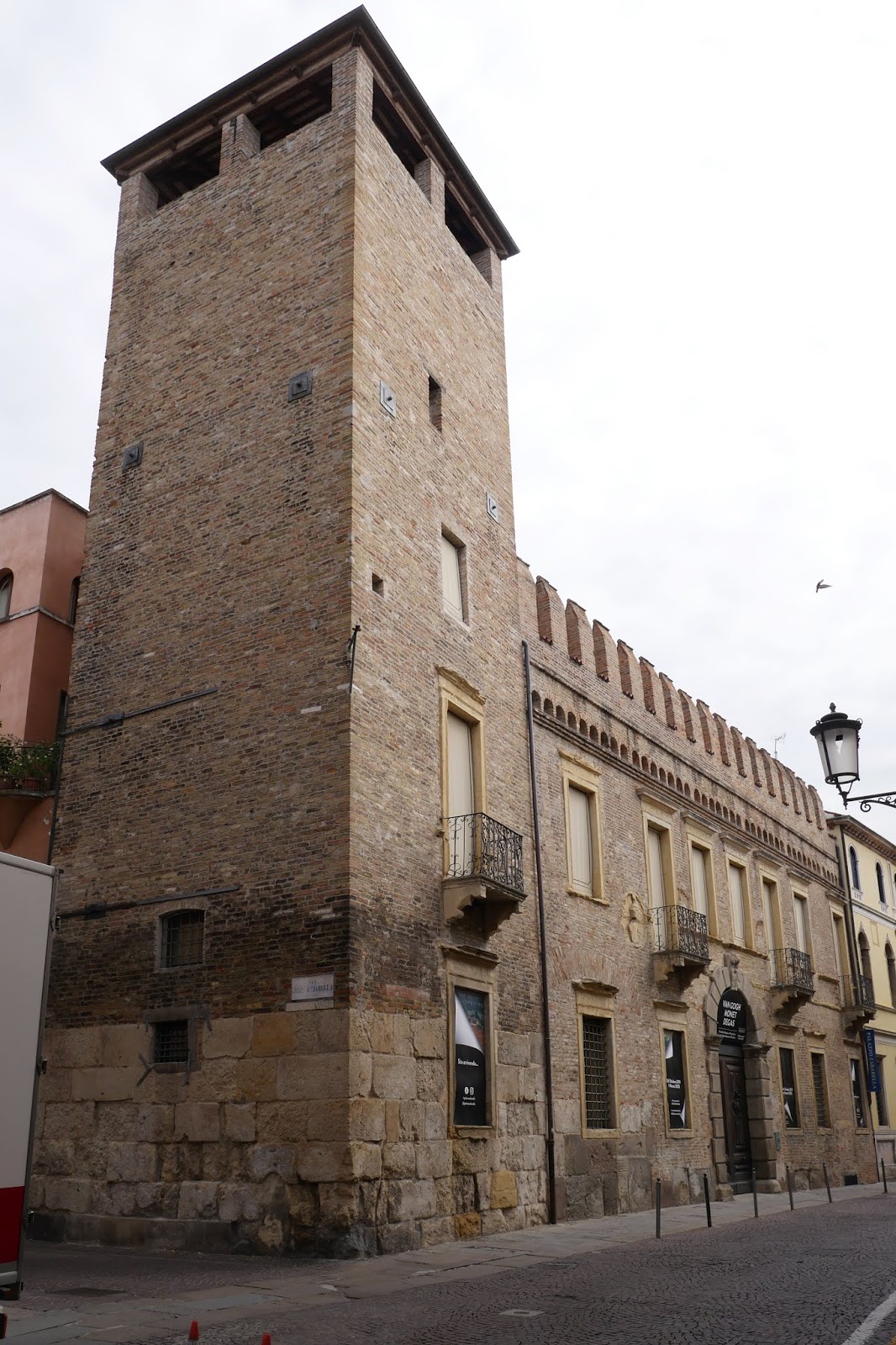
 Soon afterwards we turned right at the castle-like Plazzo Zabarella, now an art gallery.


The Via del Santo brought us to the large square in which is located the Basilica of Sant Antonio. Saint Anthony of Padua, a celebrated 13th century preacher, was actually born in Lisbon, but lived and worked in Padua. His tomb is now a pilgrimage site.

The church is quite unusual having a series of domes above the nave, with others above each of the transepts and the choir. in addition there are two slim towers. The domes were heightened in 1424.
This is the facade.


 The inside is completely overwhelming with sculpture and frescoes on every surface. Perhaps helpfully, photography is banned inside the church. Consistent with the massive scale there are no less than four cloisters, the oldest one being the most pleasing.


It also has this hilarious image of a monk.


In the plaza in front of the Basilica is an equestrian statue,in fact the first monumental equestrian statute since Roman times. It was the work of the great sculptor, Donatello.


Now we walked along via Cesarotti a short way to a site which seems unknown and overlooked: the beautiful Cornaro Loggia and Odeon. We and one other visitor were treated to a detailed tour with an enthusiastic guide. Two structures sit at right angles, the golden Loggia and the white Odeon.


They were built for Alvise Cornaro, a wealthy man who was an early enthusiast for the Renaissance. The architect was Giovanni Maria Falconetto. The Loggia was built in the 1520s intended as a place for plays to entertain Cornaro's circle of the wealthy and sophisticated enthusiasts for the Renaissance. It was the first truly Renaissance building built in the Veneto.

 When you enter the exquisite Loggia you find a frescoed ceiling.


The rather plain Odeon was intended for musical performances, and rather wonderfully, some classical music was being recorded while we were looking at the Loggia. Happily for us, the recording finished in time for us to go in and see inside. It too was naturally heavily frescoed with themes from Roman antiquity.


As we walked away we were very struck by the contrast between the religious solemnity of the Basilica and the paganism of the Loggia and Odeon.

Our final destination was the huge Prato della Valle This huge square is the largest in Italy and one of the largest in Europe. It was once a big swamp, then a ground for jousting tournaments when, in the late 1700s, Andrea Memmo, whose palace still overlooks the square, conceived of a large plaza and park, and work began on the public space you see today. At its center is a green park surrounded by a canal; along its banks stand 78 statues, including one of Memmo. 


On one side is the beautiful Loggia Amulea.


Conditions: grey at first, but sunny later.

Rating: four stars (but 5 for the Cornaro Loggia and Odeon).

Wednesday, 24 April 2019

Westminster Abbey


Westminster Abbey

We were on holiday recently in Milan, where we made a thorough exploration of the magnificent Duomo as part of seeing some of the main sights of the city. After we got home, it struck me that although we have seen many of England's great Cathedrals (Lincoln, Salisbury, Norwich, Canterbury, Hereford ...), we have never been inside Westminster Abbey. I decided that I would treat Ange to a surprise visit there.

The first Minster was completed in 1065, but most of what you see today was built 1245-1272, in the reign of Henry III, as a new shrine for the remains of Edward the Confessor. The nave was not completed until 1498 and the vaulting not until 1517. The splendid west towers (see above) were only added in 1745, by Nicholas Hawksmoor.

Our first sight of the Abbey was the North Transept, seen from Parliament Square, where demonstrators against climate change were pretty much outnumbered by the police. The North transept is the main entrance, but you have to go round to the left of the main facade to get there.


Once inside, I reached for my camera to start taking a some pics. My first one was the Queen's Window, designed (on his iPad, naturally) by David Hockney. At this point there were loud cries of "no photography" so I stopped - hence the use of scanned postcards for much of this post.


Inside there is a route to follow which leads you initially into the magnificent nave ...


... and then into the elaborate Quire and Sanctuary. In front of the High Altar is the beautiful Cosmati Pavement started in 1268 and constructed by Italian craftsmen led by a man named Odoricus (how wonderful the name of the master craftsman has been preserved until today!).


Carrying on towards the east end of the church you pass the Edward the Confessor's chapel and the north ambulatory where the tombs of a great array of kings and queens are to be found including Henry III and Henry V.

This leads into the Lady Chapel, whose construction was ordered by Henry VII. At ground level, in the nort aisle, are the tombs of Henry himself and Elizabeth I and Mary I. I was absolutely stunned by the quality of the fan vaulting, which to me seemed even more remarkable than that at St George's Chapel in Windsor or in the chapel of King's College, Cambridge.


This was magnificent, but it was quickly followed by another surprise. After a brief review of Poet's Corner, we climbed the stairs to see The Queen's Diamond Jubilee Galleries, having been give the tip off when we entered the Abbey that we should not miss it. The Galleries occupy an unusual area known as the Triforium, a space above part of both transepts and the crossing. It was floored and strengthened by Wren in the 18th century. This area now houses a wealth of interesting material. The highlight for me was an effigy of the head and shoulders Henry VII made from his death mask. It was highly lifelike and you can really what a tough and determined man he was.

Perhaps even better than the artifacts on display are the incredible views along the nave. I have never seen a nave from a vantage point near the roof: it was an incredible sight. If only to gift shop had a photo!

I did take one guerilla photo however on my way down the stairs: the Houses of Parliament just across the way.


We passed Poet's corner and admired the wonderful rose window in the South Transept.


We entered the cloister to first of all see the wonderful Chapter House, which was begin in 1250.


There were some fine medieval wall paintings on the wall on the left hand side.


A little further along the Cloister was the strangely named Pyx chamber, which, along with the Undercroft was built around 1070-80 and is therefore one of the oldest parts of the Abbey. It contained a pyx, a box containing standard pieces of gold or silver against which the coinage was tested annually.


My final picture was the rear of the West Towers taken from the a corner of the Cloister.


Conditions: cool and grey.

Rating: five stars. Simply magnificent. A major warning against ignoring wonderful sights on your own doorstep.