This walk route is quite lengthy and varied. A copy of Irene Reid's "Strolling Around Lille" book is essential to get the full picture. My photos are quite selective.
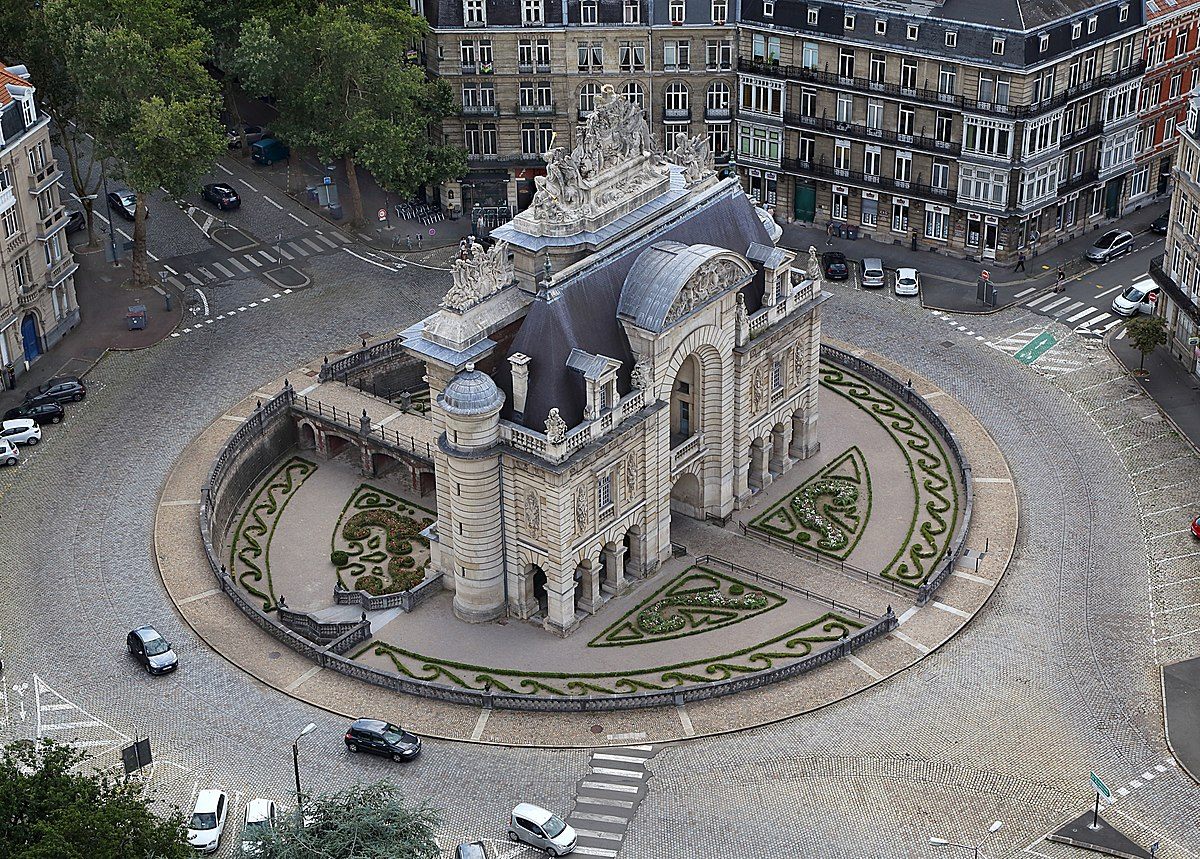
The walk starts in the Place de St Hubert near to Gare Lille Flanders and Rue les Canonniers. On the left (above) is the Le Maison de Vieux Hommes It has some affinity with the almshouses we have in England. The Porte de Roubaix at right angles.

This is the view from the other side: rather more elaborate and colourful. The two plaques one of which commemorates the gate's construction in 1621 and the other its restoration in 1875.

We walked towards this rather strange structure, Deborence Island. It is named after an ancient forest in Switzerland and is entirely enclosed as an experimental site to see which plants settle there without any external intervention.

A bit further on there is a memorial to Louise de Bettignies, who is said to have run the largest spy network in the First World War. She was caught and sentenced to 15 years hard labour, dying just 3 years later.

The next milestone was also concerned with war. The Musee des Cannoniers was originally a convent, but in 1667 and again in 1792 the Cannoniers saw active service in defence of the town.

We continued onwards to reach the Place Louise de Bettignies and quickly discovered the house of Gilles de la Boe, a 17th century spice and cloth merchant. It is one of Lille's oldest houses.

Turning into Rue de la Monnaie we turned into Rue de la, the oldest street in the city, with its fine houses.

Further along the street we saw the remains of an ancient watermill.

The imposing Museum of the Hospice of the Countess of Flanders in rue de la Monnaie is next.

The next major landmark is the Cathedral of Notre Dame de la Treille. Irene Reid suggests that visitors will either love it or hate its unusual design. I thought it was great. It was begun in 1854, but not completed until the 1990s. The facade of the Cathedral is
quite unlike the nave and transepts of the rest of the building.
The Rose Window surrounded by the modernist facade is totally out of the
ordinary. Sadly, I couldn't find a better picture.

The rather contorted statue shows Achille Lienart who was Bishop of Lille from 1928 and then Cardinal from 1930 to 1968. He died in 1973.

On the left side of the Cathedral there are a group of colourful houses. The narrow houses have a gangway over what was once a canal. The charming figurehead above the window is very entertaining.

Two final images:

 A lovely balcony in Rue Esquermoise

The Sphinx above the door into the Headquarters of the Freemasons in Rue Thiers. They are still a force in France .... and ...