Showing posts with label Worcestershire. Show all posts

Tuesday, 10 April 2018

Croome

Croome Court

Merv and I have just visited Pershore, but I had a feeling when I was planning it that we might feel slightly disappointed so I proposed a visit to walk around Croome as well. I found it on the National Trust website. I didn't realise what a delight it would be.

We arrived to find what looked to be a newly established visitor centre housed in a load of Nissen huts. We emerged to be routed towards the interesting RAF museum. We gradually came to understand that a large slice of land which was part of Croome was taken over during the war as a secret RAF base, known as RAF Defford, which undertook research and development on airborne radar. More than 2,000 service personnel and scientists worked there. So that was rather a surprise.

Now began the walk proper. We wandered along a marked track through woodland and then emerged at a high point overlooking a classic country house park with the great house, Croome Park maybe half a mile away below us. It was a great moment.

To our further surprise a gothick church stood on slightly higher ground to our left.


It is the church of St Mary Magdalene. According to the NT website: A church at Croome is first mentioned in 1283 and was dedicated to St James the Apostle, this church was close to the house but was demolished by George Coventry, the 6th Earl of Coventry, when he inherited the estate in 1751 and set about remodelling the house and landscape. The current church was designed by Capability Brown (who knew he did churches as well as landscaping?). The rather lovely interior was by Robert Adam.


We headed past the ice house ...


... to reach the lovely Rotonda. This was also the work of Capability Brown and dates from the 1760s.


It is a bit battered inside.


We walked around the privately owned walled garden and past the Victorian wing to come to the imposing rear facade of Croome Court. The key to understanding what follows is that it remained in the Coventry family until 1948 but was then sold as the family had fallen on hard times. It then passed through the hands of several property developers as it gradually declined. The Natiaonl Trust bought the park in 1996 and the Croome Heritage Trust was formed to buy the house in 2007. It is now leased to the National Trust, which is presumably finding the renovation work.


The entrance is on the other side, so we continued clockwise, this view showing us more of the layout and with the church in the distance.


Off to the left was the long thin lake also designed by Brown with a nice wooden bridge.


Inside, the house is undergoing a substantial renovation. This is Adam's wonderful long gallery. Apparently it was his first complete room.


There is no furniture and there are no paintings, so the Trust has bravely put sundry modern art works in place to reduce the emptiness. I can see why they have done it, but it is not entirely successful to my mind. The modern and the Georgian are rather discordant.

Further along we came to the Tapestry Room. Sadly, the tapestries were long ago sold to a French dealer to cover a gambling debt and then to American buyers  and are now in the Metropolitan Museum of Art in New York. All that remains is the frames on which they would have been mounted and the ornate ceiling.


We wondered round the rest of the house, but there was little of interest to see. Upstairs rooms once used as classrooms, that sort of thing.


Leaving Croome Court we headed across the grounds towards the Orangery but couldn't reach it as a ha-ha lay in the way. That felt like the cue to finish, so we returned to the car park and headed home.

Conditions: grey, cool.

Distance: 2 or 3 miles.

Rating: four stars. A wonderfully interesting experience.

Pershore

Pershore Abbey

Another outing with my friend Merv, this time to Pershore in Worcestershire. We parked just off the High Street and walked along Priest Lane in the direction of the Abbey. Opposite the Abbey is the imposing White Horse Hotel, built on a curve and with a fine main door case.


We walked along Newlands past this attractive terrace painted in pastel shades ...


... and this fine timber framed house, The Almonry, on the left.


It was an attractive street with an interesting mix of houses. I especially liked this rather quirky one.


We then retraced our steps to have a proper look at the Abbey. The rather attenuated building you see today is what remains of the third church to be built on the site. It was built in the Norman or Romanesque style between 1090 and 1130. Lime other abbeys it was a victim of the Dissolution of the Monasteries by Henry VIII. The monastic buildings, the Norman nave and two chapels were demolished and their building materials were sold. The parishioners of Pershore bought the monks' choir for £400 to be their parish church. This is a rather similar story to that of Sherborne Abbey which Ange and I visited recently. 

Later, the nave was rebuilt in the Gothic style and the north transept fell which resulted in rather ugly buttresses being installed to prop up the crossing tower. There was also the inevitable 19th century restoration. That said, the interior is quite pleasing with its unusual relationship between the columns and the windows.


The south transept contains this fine effigy of a 13th century knight, which is thought to have once been in the churchyard.


We left the Abbey and crossed the road to head towards the High Street. The view back was attractive with a fine cedar of Lebanon on the left and a redundant church, now a community centre, on the right.


We headed south past a fine Georgian coaching inn ...


... to reach the well-named Broad Street, an eclectic mix of Georgian and Victorian architecture.


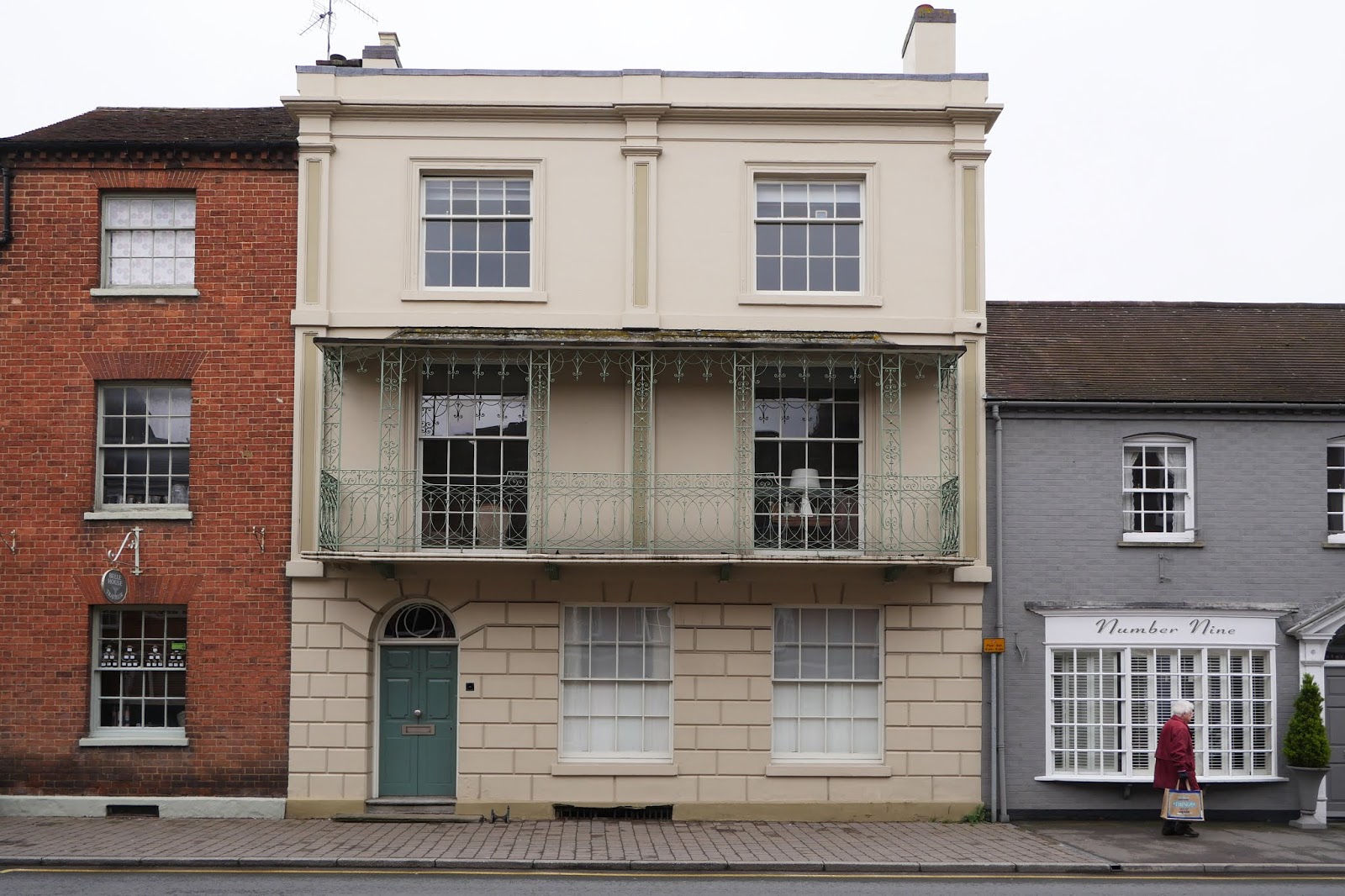
At the end we turned right into the High St which as has an unspoilt character and a large number of Georgian buildings. This house was one of several with lovely wrought iron balconies.


Further along, a grand three story mansion.


And a little beyond, this lovely house with an unusual facade and windows.


I could go on. High St really is a Georgian gem. This is the view looking back from Bridge Street which leads down to the river.


Conditions: grey and cool.

Distance: a couple of miles.

Rating: three and a half stars. A lovely concentration of Georgian buildings and an interesting Abbey. We enjoyed our walk, but in truth there was nothing really outstanding.

Sunday, 9 May 2010

Broadway and Buckland

Broadway Coppice

The second walk of our Broadway weekend. We left the Lygon Arms where were staying and walked up the High St and turned right just before Trinity Fine Arts (once the village school) and followed a path across fields, beside a kennel and then along beside the church.


We then crossed the road and followed the Cotswold Way across fields and a road to eventually enter Broadway Coppice. We climbed through the wood, with scattered bluebells all around and emerged into fields. We continued on the Cotswold Way until a track leading down to Buckland appeared on the right.

We descended down to the village along this farm track to enter this very pretty and well-groomed village which sits in a sheltered combe below the hills. We passed a circular stone house which was once a game larder belonging to the manor.


Further along the road was the fine church of St Michael. We noted the splendid gargoyles on the tower, but because we had to hurry back to the hotel in time for a midday check-out we did not explore its interior. We therefore missed its painted roof, stained glass and woodwork.


A bit further on we turned right and began the climb back up to the Cotswold escarpment. The initial view back to the village was a delight.


Further up, fine views over the Vale of Evesham, Bredon and Dumbleton Hill opened up.


Soon we re-entered Broadway Coppice at a lower level than before and emerged into fields and the final leg back into Broadway, guided by the church tower.


From: Country walks around Broadway (Cotswold Voluntary Wardens). The walk is a lasso shape and we took the wrong path at the critical point and went round the circular part clockwise rather than anti-clockwise. It did not seem to matter.

Map: Explorer OL45 (The Cotswolds).

Conditions: dry, sunny, but a threat of rain.

Distance: 4 miles.

Rating: three and a half stars. Lovely views and a very pretty village.

Friday, 7 May 2010

Broadway and Saintbury

Broadway from Willersey Hill

In Broadway for a weekend of birthday celebrations, our first act was a walk. This one starts, delightfully, behind the public toilets in the public car park. Or in fact it didn't because the car park is being redeveloped, so our first challenge was to find our way round to where the path could be picked up.

You head east out of the village and cross the A44 by an underpass and head up to a pair of paths at the base of Willersey Hill. We started to lose faith in the walk description at this point: "where the track bears right, leave it and go through a gate ..." actually meant "walk straight ahead to reach a gate, ignoring a crossing track".

A bit further on, the path came out into a large grassy hillside (seen from the top in the photo above). Here we had a crisis of confidence and added a good mile to the walk by heading south east rather than northeast. However, we eventually got back on course having had a close encounter with Farncombe House, a Georgian mansion now a company headquarters.

The route then took us past a golf course, across a road and into a field of mainly black sheep, some very newly-born.


At the end of the field, the tower of Saintbury church came into view ...


The plain beyond put us strongly in mind the Somerset landscape we have often walked in - especially the view from Brent Knoll.

After a quite steep and slippery descent we had a closer look at St Nicholas's church which has early Norman elements, a 13th / 14th century tower and a 14th century chancel (Pevsner).


The walk description alerted us to this relief over the south doorway. Pevsner describes it as an early sundial, the walk description as a "mass dial".


The website of the British Sundial Society (!) explains that the gnomon (the bit of a sundial that casts a shadow) is always missing in mass dials and that this type of dial is more an event marker than a means of telling the time. I am afraid it all remains a bit opaque.

The route back to the A44 across the fields was negotiated without difficulty and thereafter we retraced our steps to return to our hotel.

From: Country walks around Broadway (Cotswold Voluntary Wardens).

Map: Explorer OL45 (The Cotswolds).

Conditions: dry, sunny, but a threat of rain.

Distance: officially 4 miles, but we managed to turn it into 5.5 or so.

Rating: three and a half stars. Lovely views.


Flower of the day

This striking blue Germander Speedwell.