Showing posts with label Italy. Show all posts

Wednesday, 31 August 2022

Ostuni


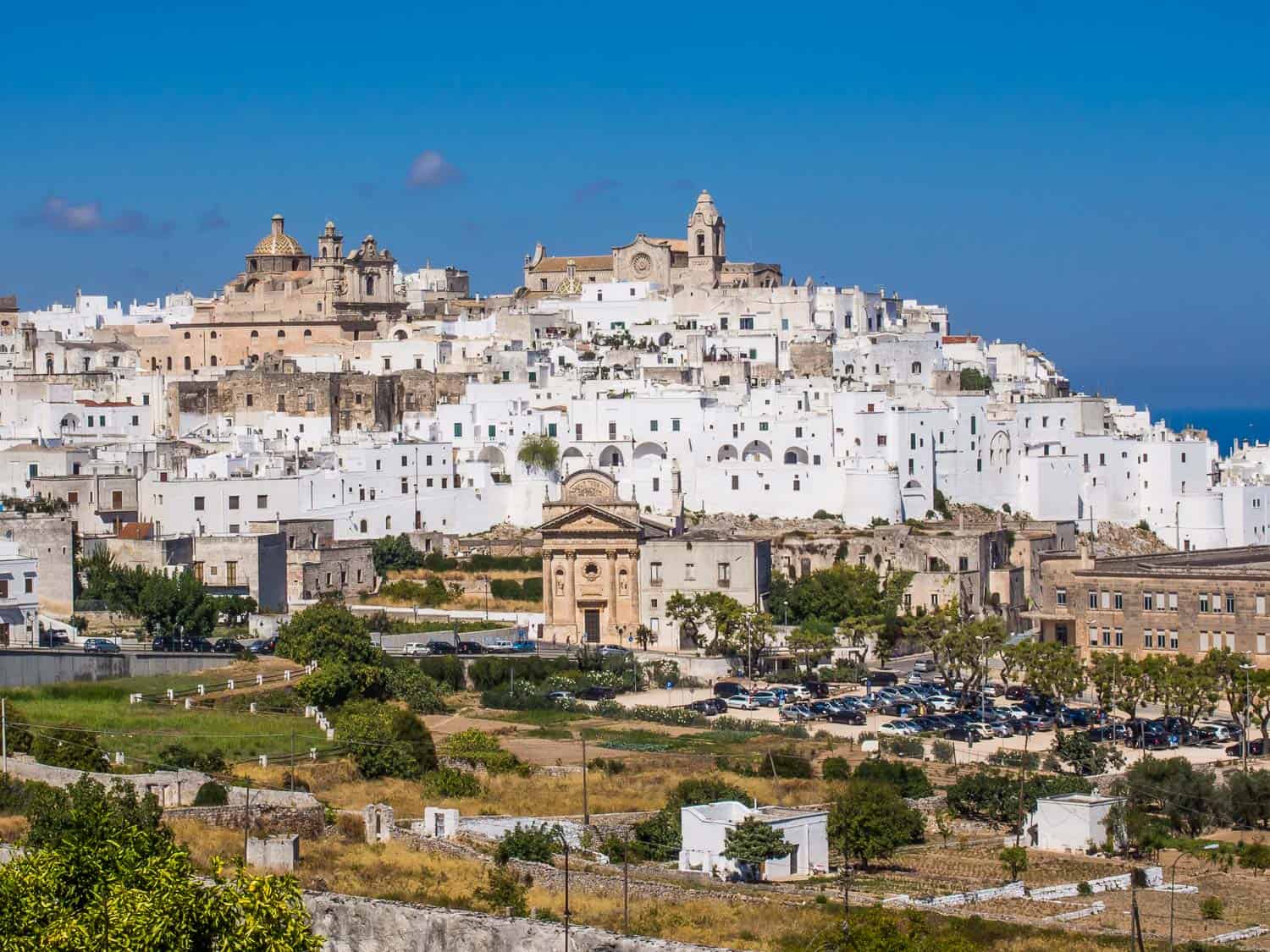
Today we are on an outing from Conversano to Ostuni, the White City of Puglia. We approached from the landward side. Had we gone  round to the seaward side (the sea is only 3 kilometers away) we would have had this more spectacular view.

Exploring Ostuni, Puglia's White City


We parked the car in a very quiet car park and found our way into the the not very imposing Porta Nova, which dates from the 15th century.


We began a leisurely upward climb along paths between whitewashed houses. Many had very elaborate stone door frames.

We emerged from a series of narrow paths into a square with the Cathedral of Santa Maria Assunta at its end. The Cathedral was built between 1435 and 1495 in the late Gothic style. The magnificent rose window has 24 finely carved ribs.


Looking back, we realised we had walked under the beautiful loggia of 1750 which links the Palazzo Vescovile and the Palazzo del Seminario.


We headed next to the interior of the church is XVIII century and has a level ceiling and Baroque side chapels.

We continued our wandering along more winding streets ...


... and then came on the Baroque church of Santa Maria Maddelena. It is now the Archaeological museum.

We headed down towards the main square ...

... but overall we felt it was too crowded by comparison with the quiet paths we had followed so far. I did rather like these arches however.


Monday, 29 August 2022

Conversano

                                                                The Castle of Conversano

We are on a family holiday in Conversano, an interesting town of 26,000 people to the south of Bari in Puglia, Italy. Much of our time will be spent by the swimming pool, but first we will do some exploring.

The Castle was believed to exist during the Gothic War of the sixth century and underwent significant reconstruction by the Normans in the eleventh century. The interior of the castle hosts an art gallery exhibiting work by Neapolitan artist Paolo Domenico Finoglio: a series of dramatic canvasses spread over several rooms. There is also a museum of clothing elsewhere in the complex.

Leaving the main part of the Castle we turn right to go round to the other side of the building. 


It leads into a lively area with bars and restaurants, with one of the town gates: the Toll Gate of 1338.

On the right of the photo is the campanile of the Church and Monastery of San Benedetto. It is somewhat chaotic, but the cloisters are very attractive. This is the main entrance ...

... and here a section of the cloister.


We head through the Toll Gate and into the Piazza 20 Settembre, to be faced by the Town Hall.


We amble downhill and eventually emerge through another gateway, La Porte del Carmine.


It feels as though this is the end of the old town so we go back through the gate and loop back uphill. We emerge in front of the Cathedral: Santa Maria Assunta Basilica Minore. It seems to have had a recent refurbishment as the interior and exterior are in excellent shape.


This marked the end of our impromptu tour, but I will just add the wonderful Calvary of Santa Maria della Misericordia which dates from the 16th century and later alterations. It is on the edge of the town.


Sunday, 22 September 2019

Padua: Cittadella

Our first view of Cittadella

We are on our way to Verona airport for the flight home, but we have spotted the opportunity to stop off on the way at the wonderful walled town of Cittadella, about 30 km north of Padua and midway between Castelfranco del Veneto and Vicenza.

We drive north and soon reach the centre of Cittadella, appropriately at the Porta Padova (Padua Gate). We were enormously impressed by the wonderful walls of Montagnana, but in many ways the walls of Cittadella are more impressive - they are certainly higher.


Cittadella was founded in 1220 as a fortified castle, designed to act as outpost of Padua in the Veneto, with the intention of protecting its borders from assault by Treviso and Vicenza. Nowadays. Cittadella is a town of 20,000 inhabitants - most outside the walls.

We decided to start by walking round the outside of the walls, to get a proper sense of them, They are basically oval, 1461m in circumference with four gates more or less on the cardinal points. This first section, anti-clockwise from the Porta Padova features a rather incongruous modern section.


We soon arrive at the Porta Treviso, with a substantial barbican.


The next section of walls is equally imposing and my photo features the moat which is fed by spring water and encircles the walls. It was once twice as deep and twice as wide as it is now and as well as being part of the defences it was a useful source of fish.


At the third gate, Porta Bassano we spotted some people on the top of the walls and quickly discovered that this is the main point of entry


We climbed up to the Tourist Office and bought our tickets for the Parapet Walkway, which was only opened in 2013 after 20 years of extensive renovation work. It is just wonderful! This is our first view of the area inside the walls. The main feature is the Duomo, built between 1774 and 1826. You can also see one of the two main roads which connect opposite pairs of gates.


Looking out from the parapets we had a good view of this beautifully frescoed house, which we had noticed as we were on Porta Bassano.


The main focus however is the imposing line of walls seen from the inside.


It was also impressive to see how the walkway passes through a whole series of towers.


This was the final quadrant, between the Vicenza and Padova gates. We were interested to notice the hills in the background.


We carried on around the full circuit (you can bail out at Porta Padova) and returned to ground level after a truly wonderful walk around the walls. We walked towards Porta Padova and at the central crossroads admired the inside view of Porta Treviso. There wasn't much to be said about the Duomo.


We headed onwards towards the Porta Padova, along a very quiet street ...


... enlivened at the end by this jolly statue.


Conditions: a bit grey.

Rating: 5 stars.

Note: According to the very helpful leaflet about the walls, other nearby walled towns include Bassano del Grappa, Marostica, Asolo and Castelfranco Veneto. We have been to Castelfranco, and indeed stayed there, but the others might form the basis of another trip!

Saturday, 21 September 2019

Padua: The Euganian Hills

Villa dei Vescovi

The Veneto is generally very flat, but the area to the southwest of Padua, the Euganian Hills, offers a bit more variety. Today's outing took us to three interesting places within this area. And on the way we paused at Battaglia Terme (one of the innumerable places claiming hot springs) to photograph two things we had noted on our trip to Montagnana a couple of days ago. The first was Castello Catajo ...


... and the second was the Ponte dei scaini, a Venetian-style bridge in the centre of the small town.


Our first main destination was Arqua Petrarca, once just plain Arqua, famous for being the final home of the great 14th century poet and humanist, Petrarch. Apart from being famous for his his own sonnets, Petrarch's rediscovery of Cicero's letters is apparently often credited with initiating the Italian Renaissance. The pretty town climbs up a hill and is divided between the lower and upper sections. The first sights are the church and the Villa Contarini.


Reaching the upper area, the small pretty church has a lovely loggia attached to it.


Just beyond is Petrarch's house ...


 ... with lovely frescoes, added later, showing episodes in the great man's life. Here is a picture of him.


And here are a couple of the Euganian Hills seen from his window: Monte Castello to the left, Monte Cero to the right.


We went on the the Barbarigo Garden at Valsanzibio. This is the first thing you see from the road: the absolutely astonishing Doorway of Diana, which is right by the roadside.


Behind this lie two pools. Walking along the side of them brings you to large, the rather down-at-heel, house ...


... with formal gardens leading away from it.


Our third port of call was the Villa dei Vescovi, a quite beautiful early 16th century country house. This is the front gate ...


 ... and behind it the main facade of the house itself. Inside, as you would expect, there are frescoes, this time by the Flemish artist Lambert Sustris ...


... and these extend into the loggias on both sides with lovely views of the Euganian Hills.


Conditions: sunny and warm.

Rating: five stars