Showing posts with label Lithuania. Show all posts

Friday, 8 July 2016

Vilnius Old Town: Pilies St, Castle, Cathedral

The Cathedral

We have already had a fine walk around part of Vilinius's large Old Town (from the Gates of Dawn to the University) and today's mission was to see the rest of it. We set off from our hotel and walked down Town Hall Square and into Pilies gatve (street, abbreviated to g.). This is the view looking down towards the Cathedral.


 We were delighted to find on the right, just before Literatu g., the first art nouveau house we had seen in the city. It looks as though renovation is not far from being complete.


Literatu g. is marked on the map we got from the Tourist Information Office as one of the top ten things to see,  but it is not mentioned in our guidebook. It turns out to house two sections of wall celebrating Lithuanian writers and authors linked to Lithuania in the form of small pieces of art honouring each writer. Two larger tablets on the right provide a key to who did each work and who it commemorates. It's rather a nice idea and it reminds me of the strong sense Lithuanians have of being a cultured people.


Next on the Top Ten list is Uzupis. This is also new to us bit we head off to find it, crossing the rather lovely Vilnia river (which doubtless gives the city its name).


Heading through a quiet corner of the city we reach a delightful small square, quite Italian in feeling, to find a column topped by a wonderful statue of an angel blowing a trumpet.


It was erected in 2002 and was the work of sculptor Romas Vilčiauskas. It turns out that Uzupis is the artists' quarter and has declared itself an independent republic.

From here we head along to the fantastic ensemble of St Anne's church and the Bernadine church. The brick St Anne's is externally a gothic masterpiece with ogive shapes on both the sides and especially the facade. Napoleon is said to have been so delighted by it that he wanted to take it back to France with him. The Baroque interior comes as a shock however.


The facade looks as though it could do with a thorough restoration. The Bernadine church was built in the gothic style and consecrated in 1516. Baroque elements were added later. In the vast interior there are frescoes discovered only in 1981.

Out tourist map now directs us to the Bernadine Gardens, a pleasant public park with a nice view up to the Hill of the Three Crosses which I had intended to be the end point of this walk. The Hill of Three Crosses is a symbol of Vilnius. The original three crosses were placed there in the 16th century to commemorate the murder of some Franciscan friars by pagans. The monument was destroyed by the Soviet in the 1950s and the current replica is part of the reassertion of national identity.


We suddenly realised that we had arrived at a bridge over the river Vilnia and that we could walk along the opposite bank then climb up to the Hill, making the walk more circular. Off we went.


It was a very pleasant walk involving quite a steep climb up wooden steps, some of which were broken. There is a lovely view from the top looking over to the remains of the Upper Castle (1419) and then down to the Lower Castle with the Cathedral behind it.


 We walk down the other side, past an arena where a folk dancing festival for kids is taking place, to cross the river again, just where it joins the much larger Neris river. Eschewing the funicular, we climb up a steep stony path to reach the Upper Castle.


Naturally we then climb to the top and enjoy a superb view in all directions, but especially over the City. This picture shows Pilies g. snaking its way uphill, past the tall free-standing tower of St John's church, towards the neoclassical Town Hall and the pink St Casimir's church.


There is also a good view downwards to the Lower Castle. I didn't remember this at all and it seems that most of it was demolished in the 19th century, having long been in a ruinous state. It was only decided at the start of the 21st century to rebuild it.

We walked down past the Lower Castle to enjoy a fabulous view of the wonderful bell tower of the 18th century Cathedral. It was designed by Laurynas Stuoka-Gucevičius, who was also responsible for the Town Hall.


Finally, we walk back up Pilies g., taking in the free-standing bell tower of St John's church on the way.


Conditions: warm and sunny.

Distance: about 3.5 miles.

Rating: five stars.

Thursday, 7 July 2016

Trakai


Trakai Island castle

Trakai is famous for its castle, but the village also has the interesting distinction of being home to a community of Karaim, a people who hold to a form of early Judaism. There is a connection between these two things: the original Karaim were brought to Trakai from the Crimea in 1397 by Grand Duke Vytautas to serve as his castle guards. We parked some way away from the castle to ensure we got the full picture.

Our first notable sight was this 17th century column housing a statue of St John Nepomuk, patron of fisherman and towns surrounded by water.


Just beyond it was the former Russian post office, dating back to the 19th century, with its unusual combination of stone columns and wooden construction.


A little further on was a much restored landside castle, built in the 14th century and ruined by the Teutonic knights at the end of that century. This does explain the famous castle is now called Trakai Island castle.


Along on the opposite side of the road is the Karaim church which does look different from a Christian one. It has the three windows which are apparently characteristic of Karaim buildings.


 The village has many wooden houses and now there was a rather lovely concentration of them.


Now you turn right to cross a footbridge to an intermediate island and then cross a second, longer, bridge leading to the castle. Although it has been very wet, there are still plenty of visitors.


The castle was built by Grand Duke Vytautas, mentioned above, and completed before his crushing victory (in alliance with King Jogaila of Poland) over the Teutonic Knights at Grunwald in 1410. We saw an information panel earlier in the walk which revealed that a staggering number of German soldiers were killed.

Later, the castle became of less strategic importance and was destroyed by Cossacks during the 1655 invasion by Russia. Perhaps rather surprisingly, the Soviet authorities sanctioned the reconstruction of the castle in the 1950s and it was completed in 1987. It is hard to know how archaeologically sound the modern version is, but it certainly is impressive.

Inside, there is a large open courtyard with a massive keep at the rear, the residence of the Grand Duke.


The rooms have been furnished to some extent, but the impressive things about Trakai are its overall appearance and its wonderful location. After wandering round for a while we exited the castle and walked around the perimeter of the walls. This offered good views of the beautiful Lake Galve and a surprising view across the lake to Uzutrakis, a late 19th century manor house.


Conditions: cloudy, but quite warm.

Distance: a couple of miles.

Rating: four and a half stars.

Wednesday, 6 July 2016

Vilnius Old Town: Gates of Dawn to the University


The Gates of Dawn

We have just arrived in Vilnius, capital of Lithuania. I am very pleased to be here again as I did a consultancy project on the development of top civil servants here in the late 1990s and thought it was a lovely city, albeit with plenty of scope for renovation. I am keen to see what it is like now.

Lithuania is a small country (25,000 square miles, the same as Latvia - three times the size of Wales) with a population of 2.9 million; Vilnius accounts for 540,000 of these.  Lithuania was once an important regional power: a kingdom of Lithuania was created by Mindaugas in 1253 and the 14th century Grand Duchy ruled over Belarus, Ukraine and parts of Poland and Russia. A Polish-Lithuanian Commonwealth was created in 1569 and lasted for over 200 years until Lithuania came under the control of the Russian empire.  An independent state was created in 1918. Lithuania was occupied by the Germans during the Second World War and part of the Soviet Union from 1945 until 1991, when it became independent. There are small minorities of ethnic Poles (6%) and Russians (5% of the population - many fewer than in the other Baltic states).

The weather looks very dubious, but we will try to have as much of an introductory walk as possible. We start from The Gates of Dawn (above), the only surviving gateway from the early 16th century city walls - you can still see the holes which were used for cannon.

In a chapel on the inside is the miraculous painting of The Madonna of Mercy, painted in the 1620s and encased in silver in the 1770s. The chapel itself dates from 1829.


We continue along Autos Vartu gatve (gatve is street) and just after St Theresa's church is the entrance to the Church of the Holy Spirit, the Russian Orthodox church dating from 1634.


Just a little further on, on the left is the wonderful Basilian Gate, a Baroque extravaganza of 1761 designed by J K Glaubitz. It leads to an enclosed courtyard which houses the Church of the Holy Trinity.

Now on the right you find the church of St Casimir. It was originally built by the Jesuits in 1604-1635, but has undergone many rebuildings and travails since then, including being used as a granary by Napoleon's army and becoming a museum of Atheism under Soviet rule. It was re-concecrated in 1991.


Beyond it lies Town Hall Square. The former Town Hall now houses the Tourist Information office at the front and a really excellent fish restaurant at the rear. It dates from the late 18th century and was designed by the Classical architect Laurynas Stuoka-Gucevicius.


The Square itself is lined with attractive houses and seemed to us to be reminiscent of English 18th century market towns.


We headed down one of my old haunts, the characterful Stikliu gatve, and turned left into Dominikou gatve where we admired the newly restored Baroque doorway to the church.


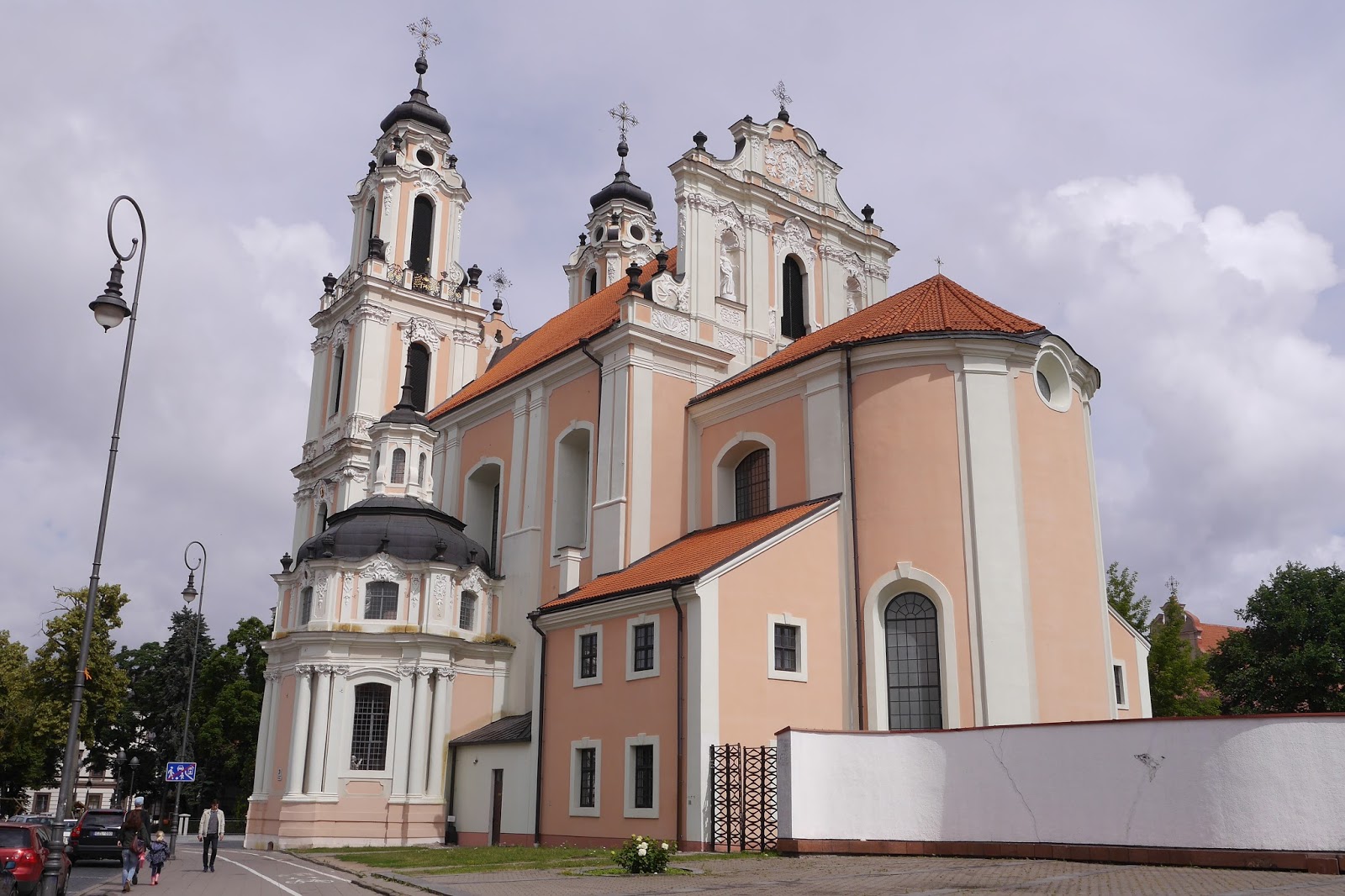
Now we headed up Vilniaus gatve to pass the Baroque St Catherine's church, looking much sprucer than when I last saw it.


Continuing along the street we passed something that definitely didn't exist in 1997-8: The Bubbles Champagneria. We came back in the evening to check it out and had a very enjoyable glass of rosé champagne in a very nice bar. A bit pricey, but good fun.


We carried on up Vilnaus gatve, passing the former site of the Public Administration Training Centre, where I worked during my project. At the end we turned right into the main street of Vilnius, Gedemino prospekt, and passed the government building, another work location. Outside is a new statue of Vincas Kudirka, the doctor and poet who wrote the words and music for the Lithuanian national anthem in the late 19th century.


Gedimino has improved greatly in the last 20 years and further down on the right is the new national theatre, with this electrifying trio outside.


At the end, ignoring the cathedral which we will visit tomorrow, we turned right into Universiteto passing the Presidential Palace, once a 14th century nobleman's palace but rebuilt in the neoclassical style in the 19th century.


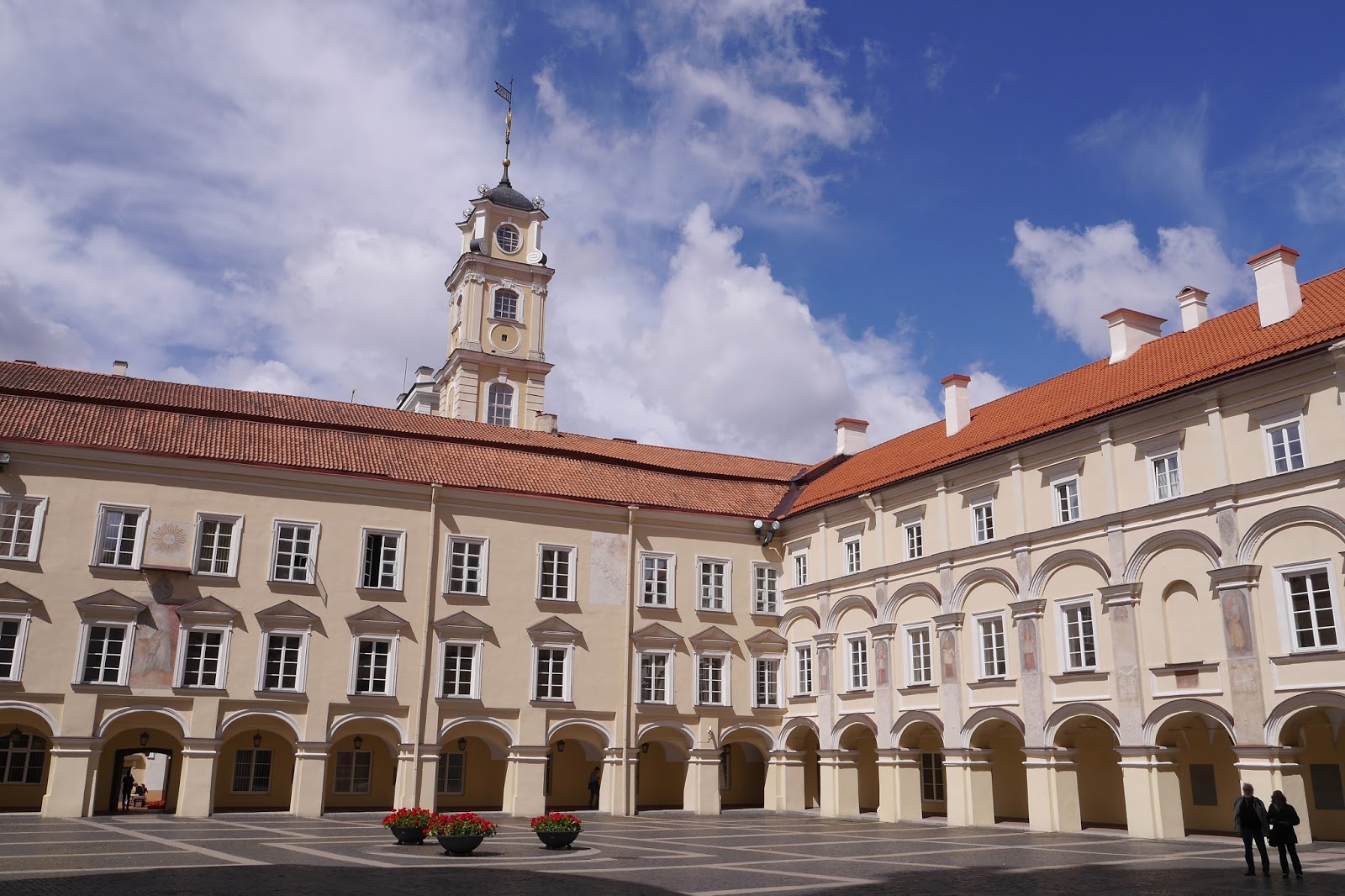
Further along on the right was the main entrance to the University which was founded by the Jesuits in 1579. It consists of a series of courtyards, like a giant Oxbridge college. This is the beautiful, mainly renaissance-style, Great Courtyard which dates from the 17th century.


It leads into the exquisite Observatory Courtyard, dominated by the astrological observatory.


The first great surprise comes in the M K Sarbievus Courtyard where the Littera bookshop has ceilings covered by wonderful frescoes painted by Antanas Kmieliauskas in 1978.


On the first floor of a building in a corner of the same court is the Philology Centre where there are even more remarkable frescoes, The Seasons, by Petras Repšys and painted 1976-1985. They represent subjects and symbols from Baltic mythology. We especially liked this Tree of Life (?), but the whole thing was wonderful.


This was a wonderful example of ending a walk on a high note.

Conditions: cloudy with sunny intervals.

Distance: only a couple of miles.

Rating: five stars. Vilnius has retained its charm, but is in much better shape than when I last saw it. The University is a real delight.