Showing posts with label Vienna. Show all posts

Friday, 11 May 2018

Vienna: Hietzing and Schonbrunn Palace


The Gloriette at Schonbrunn

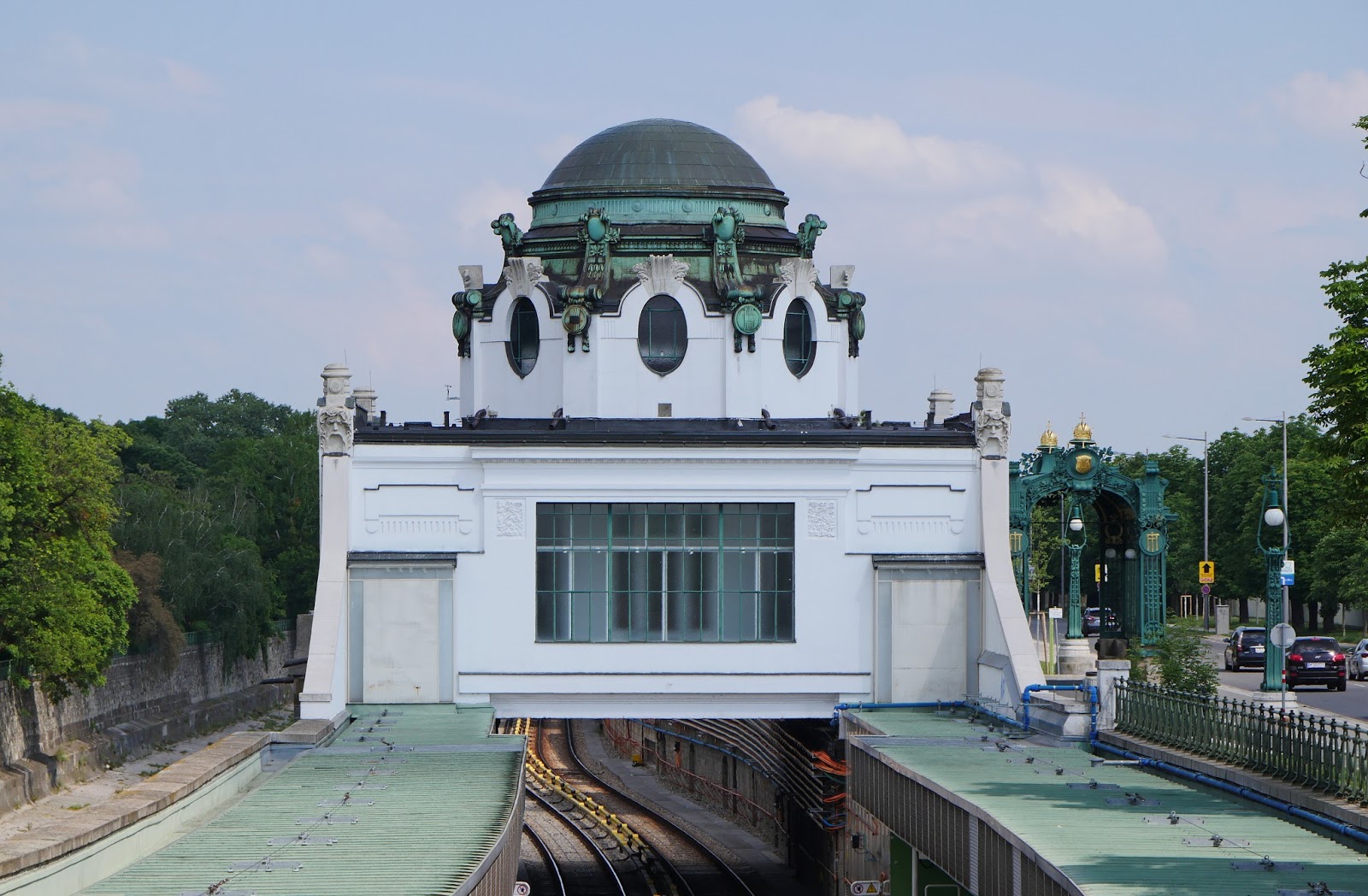
This was a very interesting walk covering a range of historical periods from the 18th century onwards. Our first goal was to continue the Otto Wagner theme by seeing his Royal station Pavilion at Hietzing. We left the U-Bahn station and stumbled on a Greek restaurant for a very nice lunch. Heading towards the Pavilion we then stumbled on this art nouveau gem at Hadikgasse 57. It looked to be newly renovated.


The Pavilion is suitably extravagant and features a sort of porte-clochere


However, it is only when you look along the tracks from the bridge by Hietzing U-Bahn station that you are seeing is a miniature private station.


As always with Wagner the details are delightful. Note the imperial helmets on the roof.


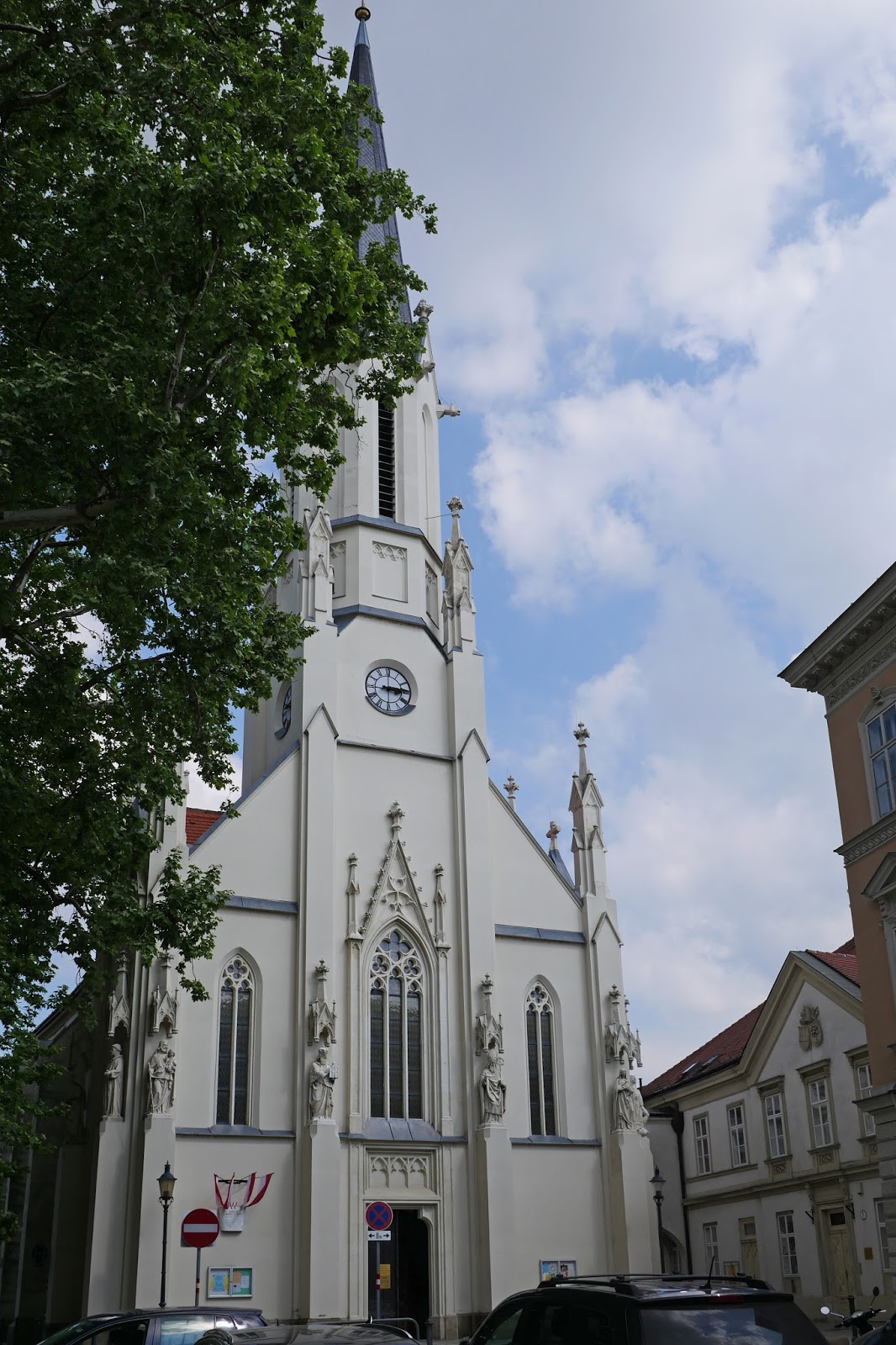
Now we doubled back and headed along Maxingstrasse, passing the pretty Gothick style church of Maria Geburt on the left.


The next, rather lengthy section took us through Hietzing. This is revealed to be a quiet, up-market outer suburb where leafy streets, notably Trouttmansdorfgasse and Gloriettsgasse, have substantial houses. Many are of the Biedermeyer style. My sister-in-law Claudia explained that the essence of Biedermeyer is a relatively plain and un-showy exterior, while elaboration and extravagance restricted to the inside. So pretty much the antithesis of art nouveau. Here is a typical example.


I quite liked this rather more exuberant house further along Trouttmansdorfgasse.


Our route took us past the Villa Primavesi which I had heard described as pretty. It was esigned by Josef Hoffman in 1913-15 for the financier Robert Primavesi in a surprising neo-classical style.


Not too long after this we emerged again on to Maxingstrasse and quickly left it to enter Maxing park. This in turn flowed into the grounds of the Schonbrunn Palace. We navigated our way towards the wonderful Gloriette, which we first approached from one end.


Here is a rear view of the left hand side ...


 ... and a view of the large orangery-like space in the central building.


Finally, we went up onto the roof for this great view of the Schonbrunn Palace.


From: DK Eyewitness Guide to Vienna. 

Distance: about 3 miles.

Conditions: bright and quite warm about 22 degrees.

Rating: Four and a half stars.

Vienna: Wagner House 1 / Ernst Fuchs Museum


We journeyed out to Hutlsdorf at the end U-Bahn line 4 and walked the mile or so to Wagner House 1 or the Fuchs Museum. You can see straightaway that it has something of a Palladian quality: a main building with two symmetrical wings, all topped with urns. Apparently Palladio was Wagner's favourite architect.

The building has quite an interesting history. It was built in 1886-88 by the architect Otto Wagner for his own occupation. By 1905 he was making plans for a new smaller house a little further along the road. It seems he saw this as being more suitable for his wife after he died (and apparently there is a German term for this type of building: “Witwensitz” or “Seat of the widow”). The house was bought by a businessman of Jewish descent named Ben Tiber and he vacated it in the 1930s when he left the country. During the Second World War the house was used by the Nazis and after the war it was left empty until 1972 when it was bought by Ernst Fuchs.

Fuchs was an artist and set about renovating the building in line with his own rather florid and exuberant taste. His then filled it with his own art works. However, he deserves great credit for saving the building from terminal decline. Happily, one wing was not altered and retains the original decorative scheme of Otto Wagner and stained glass by Koloman Moser. 

Now for the tour. The entrance is round the back and you are invited to explore upstairs first. You climb the stairs lined with a wallpaper which seems at first to be quite William Morris in style, but a closer look shows a somewhat sexual element which you gradually see pervades his work along with fantasy themes.


The large room upstairs has one original feature, a lovely ceramic panel by Koloman Moser.


There is also some nice furniture by Fuchs.


 And even a painting in the style somewhere between Burne-Jones and Munch.


Back downstairs you enter the main living room which again has quite pleasing art deco style furniture, but over-wrought paintings. The right wing gives a feeling for Fuchs's larger paintings, although again the chairs are attractive in an art deco style.


The left wing however is the great delight for any fan of art nouveau or Jugendstil architecture. This is the view through the doorway.


The upper walls and ceiling are covered with exquisite geometric patterns in gold. These are of the kind that Wagner made famous on the railway pavilions now located at Karlsplatz.


The corners of the floor have lovely mosaics with a snake pattern


The stained glass is in the Tiffany style and is full of vibrant colour.


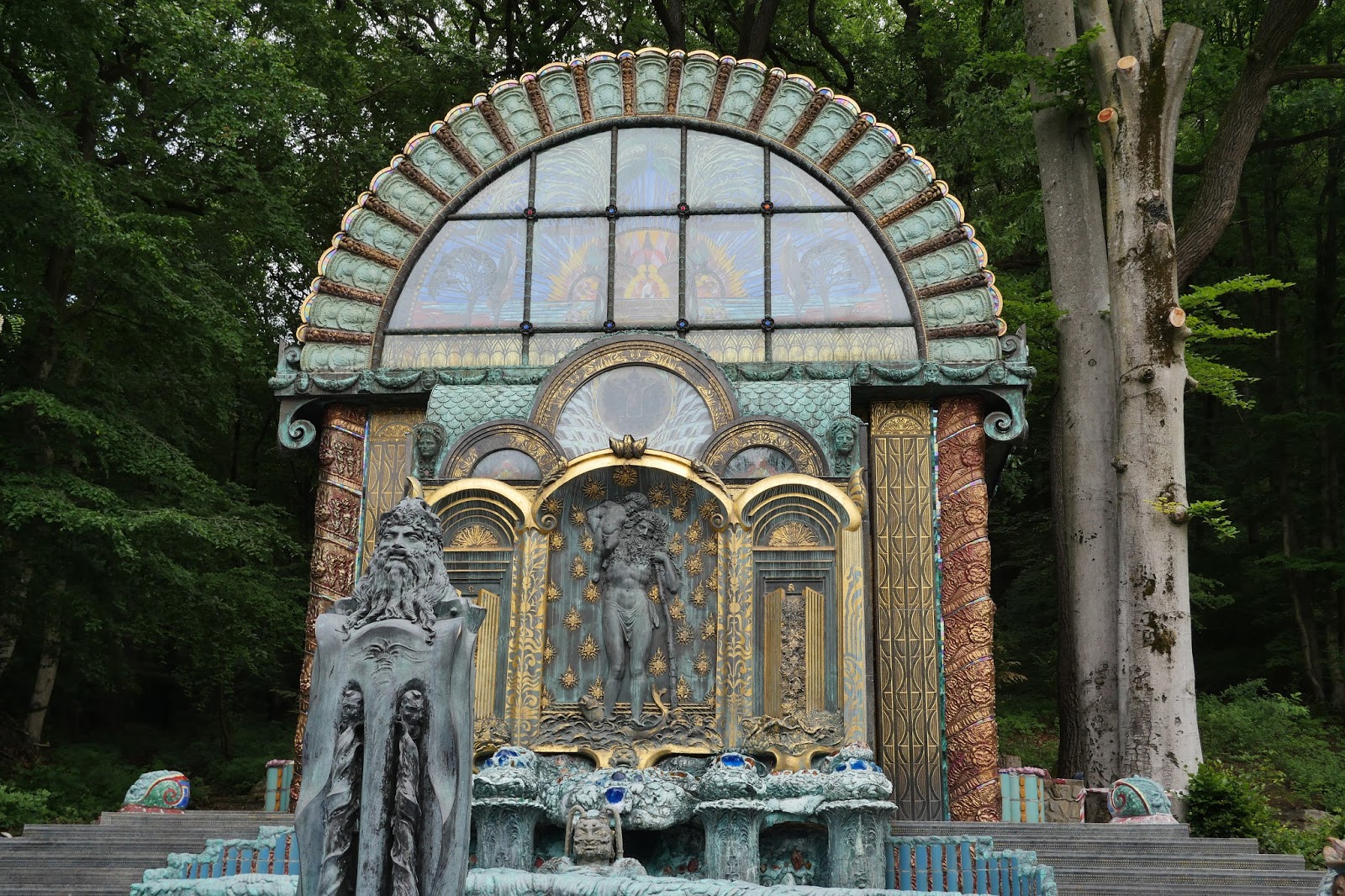
Outside there is a suitably over-the-top structure, called the Brunnenhaus, by Fuchs.


Rating: four and half stars. A very interesting experience, but I would have preferred more Wagner and less Fuchs.

Further information: there is an excellent piece about this Villa and the nearby Wagner Villa 2 (which we unaccountably failed to visit) on Wiki Arquitectura.

Friday, 12 October 2012

Fin de siecle Vienna

The Opera House

We first visited Vienna in 1997 and were completely bowled over. Now we are making a family visit and we decided to re-do a walk that we did then which is still vivid in our memories: fin de siècle Vienna.

The walk begins at the Opera House. It is located on the inner Ringstrasse built in the mid 19th century on the line of the old city walls and was one of the first buildings to be constructed in this massive, and controversial, urban renewal programme. We crossed the ring, known at this point as the Opernring, walked along a bit and turned left to reach the Fine Arts Academy.


It was also part of the Ringstrasse and was built by the Danish architect Theophil Hansen in 1872-1876 in an Italian Renaissance style. We enjoyed the terracotta panels - which are also to be seen on English buildings of the same period.

Just round the corner you come on one of Vienna's greatest buildings: the Vienna Secession building of 1898 by Joseph Olbrich. It was originally the exhibition hall of a group of artists, of whom Klimt was the most famous, who rebelled against the conservatism of the Austrian Academy.  Klimt in fact resigned from the Secession a few years later, citing artistic differences.


Although normally regarded as one of the first modern buildings, it is to the present-day eye still remarkably and beautifully decorated. On the side this rather geometrical-looking panel suddenly, when you get the angle right, reveals itself to be a trio of owls. It is credited to Koloman Moser.


We now walked back along Friedrichstrasse to take a subway passage to Karlsplatz.  Here are the famous Wagner Pavilions (1898). The architect Otto Wagner was appointed design head for the new Stadtbahn, or metropolitan railway, now the metro, and the two fantastic art nouveau pavilions which stand facing each other, were the entrances to the Karlsplatz station.

One is now a bar, but the other has recently (well since 1997) been turned into a museum to Wagner.


It is small but extremely interesting and the interior is as beautifully decorated as the exterior.


Nearby is the magnificent Karlskirche - St Charles's Church.  It dates from the early 18th century.


We walked on past the Technical University and admired the extraordinary facade of the modern extension which houses the library.


We then turned left into Operngasse and right to bring us to the Naschmarkt - a very well established street market. We carried on along the same line to see reach one of Vienna's finest old coffee houses - Cafe Sperl - where we paused for the classic combination of a glass of wine and a slice of sacher torte.


From here we looped round to rejoin the market. As you round the corner into Linke Wienzeile you see two extraordinary houses by Wagner, a fantastic culmination to the walk.


The first, with its exuberant gold decoration seems to be called the Medaillon House (1900), while the second with its floral motifs is known as the Majolika House (also 1900).


The point where they meet is especially striking, with the contrasting green balconies at the end of the Majolica House and the overlooking statue of the Medaillon.


From: Vienna walks by J Sydney Jones (Boxtree, 1994).

Distance: 2.5 miles.

Conditions: grey, obviously.

Rating: Five stars. A small number of absolute gems, and a few other random treats for good measure.