Showing posts with label Mantua. Show all posts

Wednesday, 18 September 2019

Mantua: Palazzo del Te


Visited at the end of a wonderful day on Mantua, the extraordinary Palazzo del Te deserves a post to itself. It was built between 1525 and 1535 as a suburban residence, to the south of his main base, the Palzzzo Ducale, for Federico II Gonzaga, Duke of Mantua.

The Palazzo is basically a hollow square. The main entrance was clearly in the middle of the range on the left, but nowadays visitors enter via a small doorway in the middle of the right hand range. The view through that doorway is lovely: you can see an archway on the opposite side (in fact part of a portico, and something else beyond it.


The facade is classical and just below the roof line you can even see the triglyphs (three vertical lines) and metopes (relief sculpture) of the kind you see on Greek temples.

The internal organisation is surprisingly simple: rooms the width of the building lead in to each other. First we see the Chamber of Ovid (or of the Metamorphoses), with a magnificent coffered ceiling.


Next there is the Chamber of the Sun and the Moon, with an entertaining panel in the centre of another elaborate ceiling (look closely at the charioteer on the right).


Next is the Loggia of the Muses, here seen from outside.


This is followed by a vast room, the Hall of the Horses, which was created in 1526-28.


Next up is the Chamber of Cupid and Psyche, said to be the most sumptuous in the whole palace.


At this point we are half way round the square, opposite where we came in. From this loggia the area behind the main building becomes fully visible. It is large space, laid mainly to grass, with at the end a lovely curving colonnade.
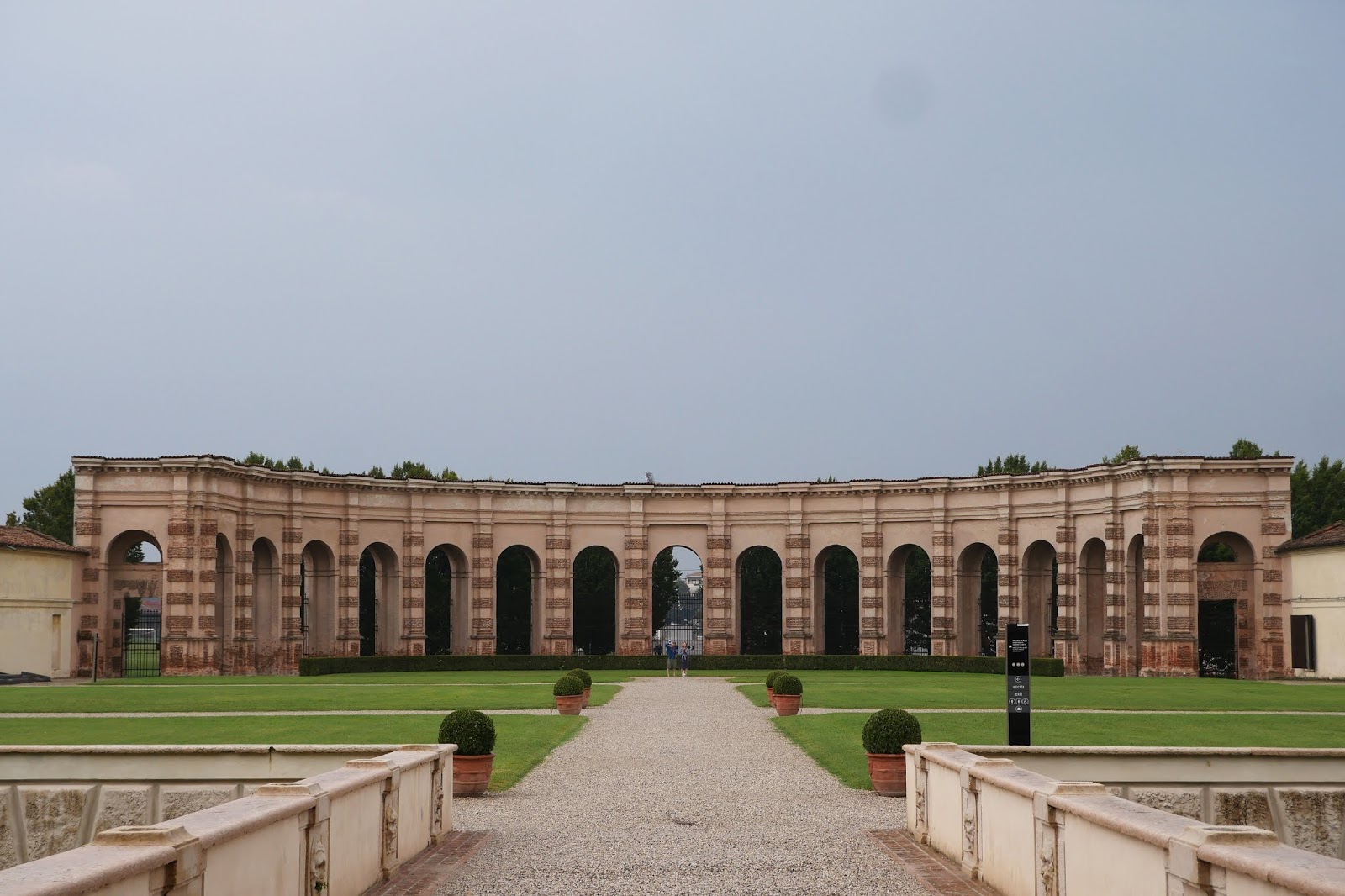


This is the view looking back to the Palace. 


 Over in one corner is a secret garden with a grotto.


Back inside the building the next room is the Chamber of the Stuccoes has a strongly Roman theme.


The next room is the last - the remaining ones were being refurbished for an exhibition - it was the Chamber of the Giants. It was the one room that we just hated: the giants on the ceiling were just about OK, but all the walls were painted with inflated versions of similar images. It called to mind Disney and felt totally out of place in this classical oasis. I couldn't bear to take a picture.

 Rating: five stars.

Mantua

Mantua from across the Lago Inferiore

Today we are on an outing from Padua to see the beautiful city of Mantua. Our first sight of the city is from the other side of the Lago Inferiore (Lower Lake). The old part of Mantua is surrounded by water on three sides, the result of a medieval project to create lakes where there was once only a stream. The other lakes are, reasonably enough, Lago di Mezzo (Middle Lake) and Lago Superiore (Upper Lake). Road causeways separate the three lakes.

Our first close up view of the city was of the rear of the group of buildings known collectively as the Ducale Palace. On the right is the medieval Castle of St George, built between 1395 and 1406. It is similar to the great castle of Ferrara, which we saw in 2013.


We walked around to the large square called the Piazza Sordello, where the entrance to the Palace can be found.


Only a limited amount of the massive castle is available to be viewed, but our first port of call was the Apartment of Isabella d'Este. The sixteen-year-old Isabella arrived in Mantua from Ferrara on 12 February 1490 to marry Frederic II Gonzaga. Only the frescoe on the ceiling remain.


We then had to leave this section of the palace and reenter to reach the Castle of St George via the lovely Piazza Castello.


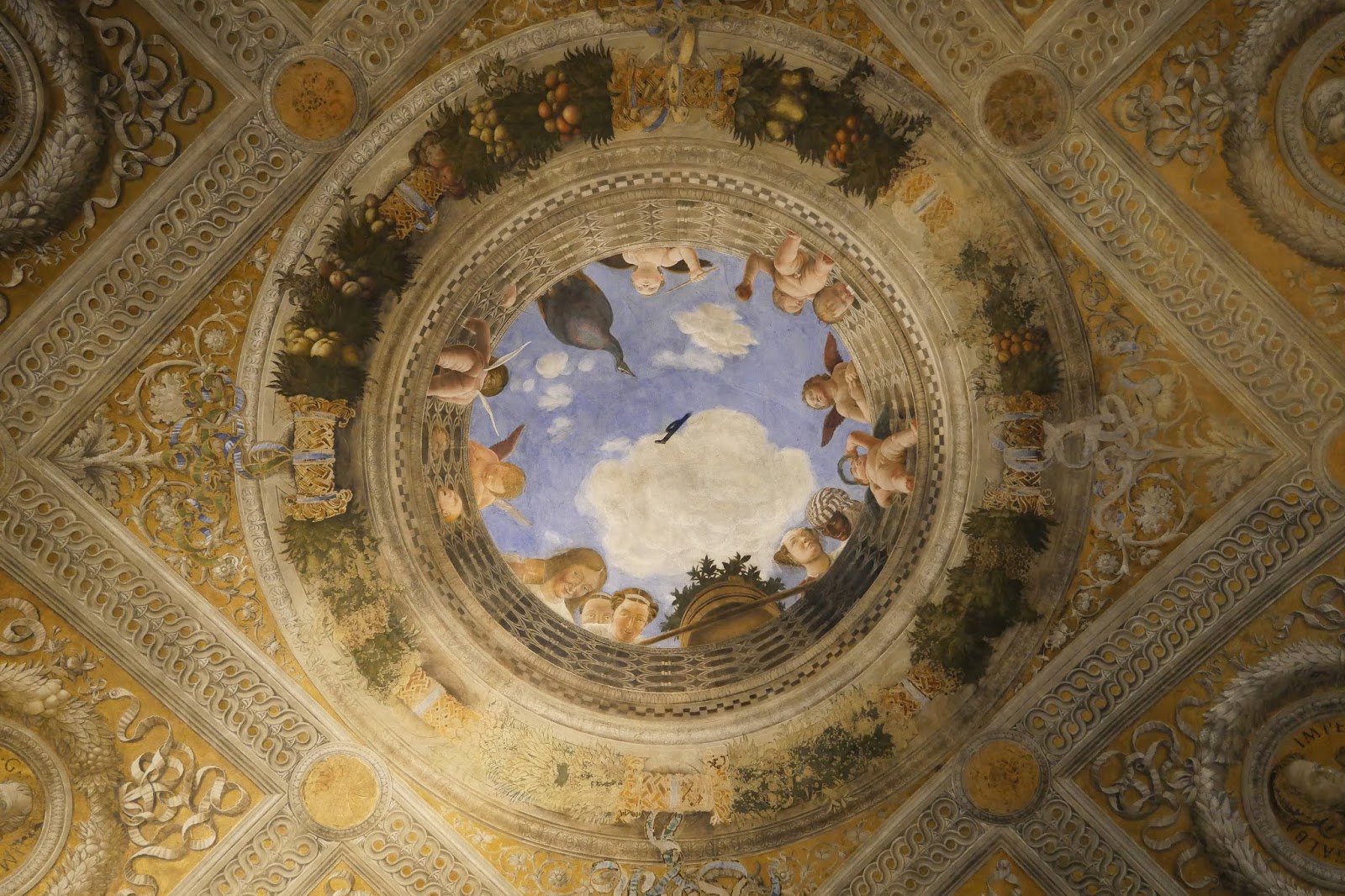
The main thing to see in the Castle is the Camera degli Sposi, the Bridal Chamber. According to Wikipedia, This room would have been used for several different private and semi-private functions such as a bed chamber for Ludovico, a gathering area for family and close courtiers, and a reception room for particularly important guests. It has wonderful frescoes commissioned by Ludovico III Gonzaga from the celebrated painter Andrea Mantegna. The walls and ceiling were painted between 1465 and 1474.


The ceiling is particularly memorable, as it is the first example of accurate perspective seen from below.


In one of the painted columns Mantegna has taken the trouble to include a small and inconspicuous self-portrait.


Returning to the Piazza Sordello, we passed the Cathedral with a Baroque facade, but rather entertaining sides featuring red bricks and triangular gables. The current church from 1756–61.


On the right is the Piazzo Castiglioni. You can also see the Torre della Gabbia, which allegedly has a cage still hanging from it where criminals were left to die (perhaps it be seen from another angle). On the extreme left is the dome of the massive Basilica di Sant'Andrea (see below).


We headed into the centre to find the wonderful astronomical clock on its splendid tower. It was constructed in 1472-3m and was one of the first mechanical clocks in Europe


Immediately to its right was the Rotonda di San Lorenzo, an exquisite round church. It was built in 1082, but in 1579 Duke Guglielmo I Gonzaga ordered it to be closed. The roof fell in and it was later surrounded by other structures. These were demolished in 1908, but its restoration, involving substantial rebuilding took place much later, I think after 2007.


Although de-consecrated, it is now a beautiful and atmospheric example of the round church.


Nearby is an unusual and very lovely Gothic merchant's house (the Casa del Mercanto of 1455) ...


... and not far away a lone, but very welcome, example of art nouveau.


In the same street, via Battista Spagnoli, is the handsome 19th century Grain Market


Our final sight was the Basilica di Sant'Andrea. It was begin in 1462 to designs by Leon Battista Alberti, but not finished until the 18th century - by then in a Baroque rather than Renaissance style. A bit over the top for my taste.


Conditions: largely grey.

Rating: five stars. A wonderful city.