Showing posts with label France. Show all posts

Sunday, 14 May 2023

Villa Cavrois: An Art Deco masterpiece


Paul Cavrois was a textile industrialist from northern France who owned modern factories for spinning, weaving and dyeing cotton and wool. In 1920 he decided to build a villa in the countryside for his growing family. When he encountered Robert Mallet-Stevens he soon decided that he had found a suitable architect for his house. It was to be a complete work of art, or Gesamtkunstwerk, inspired by the ideas of Richard Wagner. Unfortunately, Mallet-Stevens had other commitments which meant that work could not start until 1929. 

Mallet-Stevens designed the house to have yellow bricks on a concrete frame and two red brick walls. Each piece of furniture was designed by Mallet-Stevens for its specific use. He also designed the layout of the grounds with its lawns and water features.

When work did finally start, it was completed in 1932. But only eight years later the Villa was taken over by German troops. The family resumed their occupancy in 1947 and this continued until 1986. Thereafter, the new owners let it fall into decline and it was bought by the state in 2001. The villa opened again to the public in 2015.

The Villa is surrounded by a grassy park. You follow the curved path to reach the centrally positioned entrance. 

The high ceiling  and black and white floor tiles set the tone for servants' area of the house.


Next, there is the main dining room. It is a vast space. Most of what you see now is a
replica of the original room.

 
This is the children's dining room which overlooks the park.


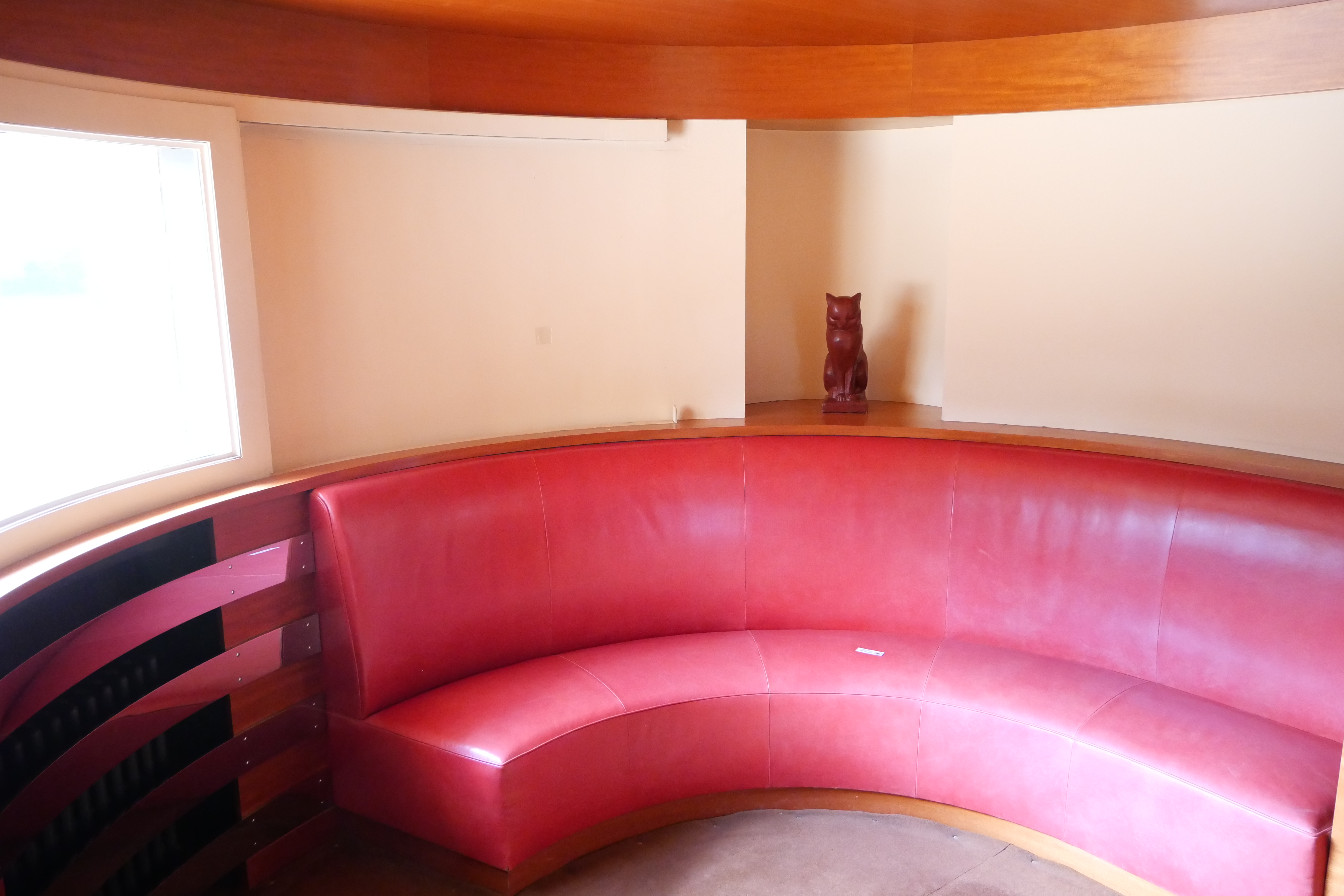
The duplex sitting room

A corner of the Smoking Room


One of the many clocks. 
 
 
The rear view of the Villa with its stream and large grass areas.


Before restoration.


Thursday, 17 October 2019

Gourdon and the Plateau of Cavillore

Gourdon

On the second day of our brief visit to Grasse we have found a lovely walk from the edge of Gourdon, a very pretty hilltop village 760m above sea level. The panorama from Gourodn etends from Nice to Théoule and under the right conditions it is possible to see Corsica. Gourdon has been rated as one of the Most Beautiful Villages in France.

The walk starts at a car park at the edge of the village. You follow the road which leads to Caussols and soon take a right which leads to a tarmaced road which winds through an area of scattered houses. You take a right and begin to climb. The path soon becomes quite rocky, but before long gives you a good view of Gourdon (see above).

As we climbed higher along a switchback path, the sun came out and provided a second view of the village from a higher position and with the sun on the houses.


As we left the village behind, I was struck by what seemed to be a newly planted wood.


We climbed steadily until we were under a rocky massive, with a lone hang-glider cruising around on the thermals.


A narrow path through the rocks brought us to the Plateau of Colliore. This was the view back.


Ahead there was a wild stony area which looked rather barren and uninviting, not least because the clouds were thickening and the temperature dropping.


We trudged across the plateau and were not sorry to quite quickly reach one of the spectacular signposts that France specialises in and to turn left towards the edge of the plateau again.


The route down from the plateau was easier than the way up, but there was still a zig-zag path to negotiate.

At the bottom, we crossed the road and followed a track which led us past the Chapel of St Vincent.


Not long after this we rejoined the Caussols road and followed it past the car park to the village. There is in truth not a lot to it. Behind the 12th century church of St Vincent there is a great belvedere ...


 ... with lovely views over the valley below.


Otherwise the picturesque streets twist and turn, filled with tourist shops – but not many tourists at this time of year. We quite liked this cast iron statue of Medusa on the corner of the church.


Distance: 5.3 km

Change of level: +300m and -300m

Time taken: 2.5 hours.

Source: RandOxygene Guide for the coastal area (Pays cotier) of the Department of the Alpes Maritimes. Free from the Tourist Office in Grasse. Two other guides are available for other parts of the Department.

Rating: four stars.

Wednesday, 16 October 2019

Grasse

 
Pink umbrellas in rue Jean Ossola

We are in France to celebrate the 70th birthday of our friend Arlette, who lives in Vence. We decided to come a few days early and explore Grasse and the area around it. Today's walk around the town was fairly slavishly based on the Heritage Trail (Circuit Patrimoniale), obtained from the Tourist Office.

We are staying just outside the centre and so the first stage was to walk down a step and lengthy flight of about 200 steps towards the centre. Grasse is located on a very hilly site and as most roads follow the contours, staircases offer a direct route. This is the view looking back - you can see only about half the steps.


As we approached the centre were were taken by this lovely yellow house, which reminded us very much of one we used to admire in the old town in Nice.


The walk proper begins in the pleasant, but cramped, Place aux Aires. Once upon a time it was a wheat threshing ground,  surrounded by battlements. Later a canal flowed through it. If you look behind you before heading on, there is a beautiful Hotel Particulier - we would probably say Mansion.


We headed through the square and at the end of the next street turned right into rue Jean Ossola, where the rather lovely pink umbrellas can be seen. It seems they were installed for Expo Rose and seem to have just been left in place.

We made a detour to go and see the Perfumery Museum (Musée International de Parfumerie). We thought this rather charming building was the entrance ...


 ... but it turned out to be the Gift Shop!

The museum traces the development and role of perfume from ancient Egypt, Greece and Rome. What we now think of as perfume was used at various times to prepare the dead for the afterlife, as incense in religious ceremonies, as medicine and to disguise lack of personal hygiene (notably in the 18th century when it was thought that contact with water could allow germs to enter the body). By comparison, the displays of modern perfume bottles and packaging were a bit boring.

Grasse was once a centre for leather making, notably gloves which were sold in Italy during the Renaissance. The only problem was that they smelled bad - this was the stimulus for the foundation of a perfume industry. The evolution of the various techniques was presented, and this 19th century photo gave a very vivid image of what it was like to work in a perfume factory.


We returned to rue Jean Ossola, which becomes narrow and winding, as befits the main street of medieval Grasse. We turned right into Rue Gazan which led us to Place du Petit Puy and the 13th century Cathedral, built in the Provençal Romanesque style.


Opposite was a beautiful art deco war memorial.


 And to one side a substantial tower.


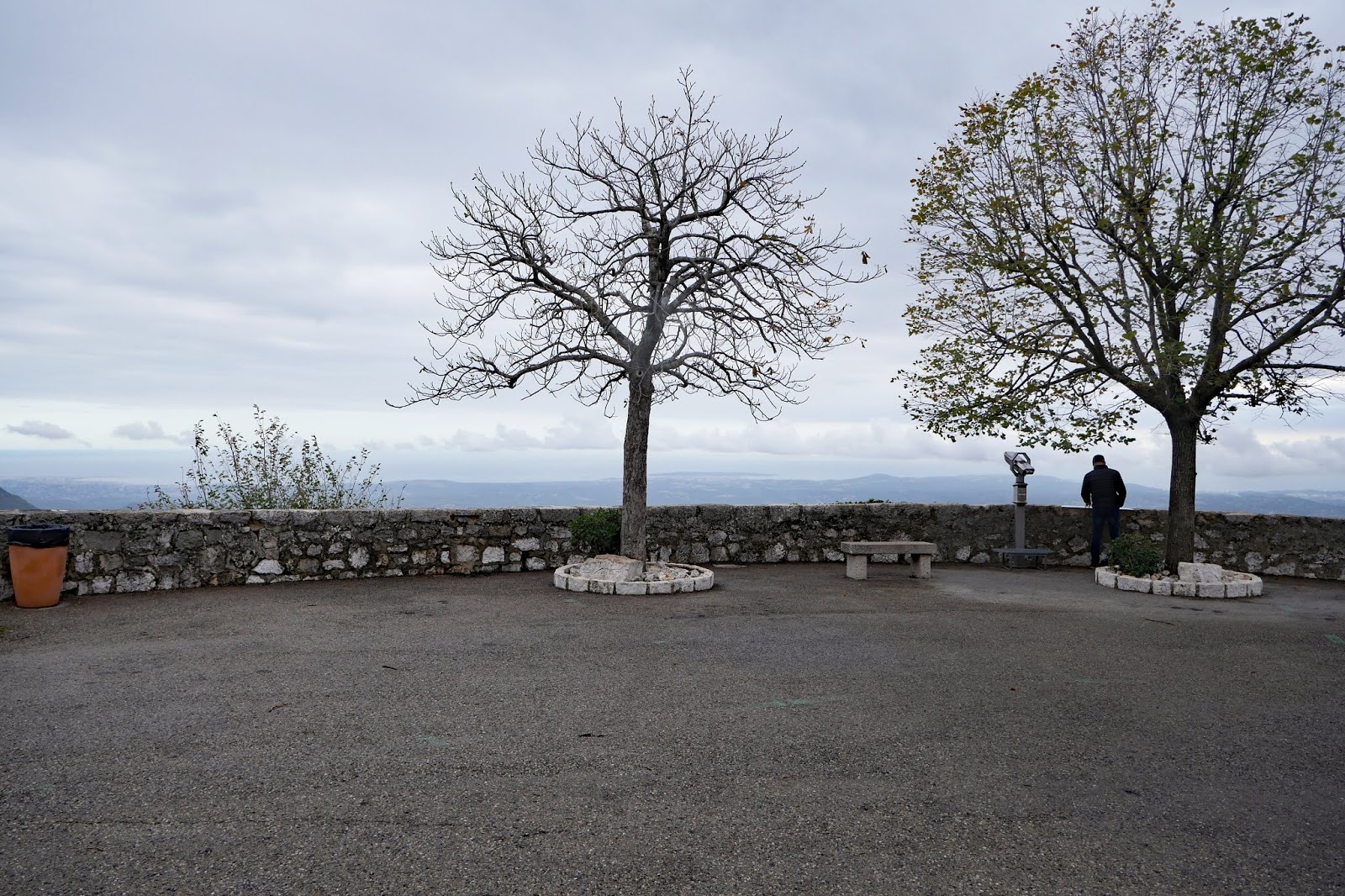
Sadly the Cathedral was closed, so we didn't see the paintings by Rubens and others, but passing to its left we came to Place du 24 Août where there was a nice viewpoint, with views extending as far as the sea.


Now down some steps to reach the Place de l'Evêché, where we paused for a drink under the former Archbishop's Palace, now the Hôtel de Ville.


We headed along Rue de la Poissonerie and into the maze of small streets to reach Rue de L'Oratoire, where we found, at number 12, a medieval house with a bossage facade (i.e. covered in stone bosses).


Found the corner is the Chapel of the Oratory. It was built in 1632, the portal and gothic window of the former Cordelier church were later incorporated in the facade. It seems that the Cordelier church became redundant and was used as a perfumery and later as a branch of Monoprix.


From here were returned to the Place aux Aires and from there walked to the rue du Peyreguis to photograph this elaborate facade which seemed to belong to a former theatre.


Conditions: warm and sunny.

Distance: probably no more than a mile from the official start.

Rating: three and a half stars.

Sunday, 16 June 2019

France: Col de l'Arpettaz


Today's outing was to the Col de l"Arpettaz where it was hoped that we would find a landscape covered in crocuses. We headed south west from St Gervais, and passed through Megève heading in the direction of Albertville before turning off the main road to begin the climb up to the Col.

We climbed steadily and passed the hamlet of Hauteville (High Town) thinking that the Col could not be much further. This was soon revealed as foolishness as we continued to climb. The scenery as we climbed was splendid (see above) and became more spectacular, with snow-capped mountains in the background as we got nearer the Col.


This was our view as we made the final approach.


We parked at the Col - 1681m above sea level - where we were pleased to find that there was a cafe for lunch and headed along a stony track. It was quite cool, but not cold.


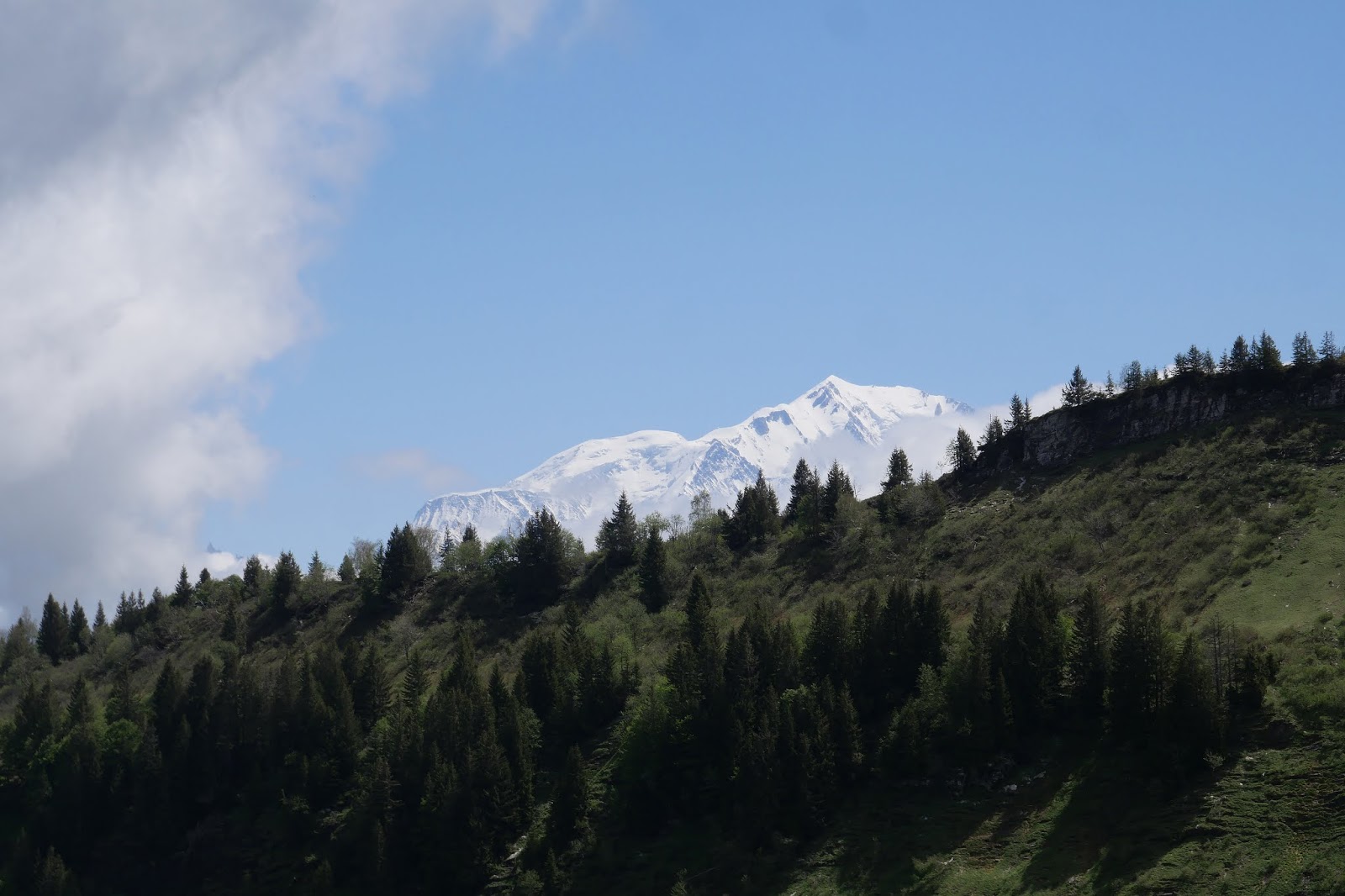
On the right a small pool reflected the sky and the top of Mont Blanc, which we were surprised to see in the distance.


A little further along the path, the view of Mont Blanc was more clearly defined.


Sadly, there were no crocuses in sight on the hillside we were walking beside - the whole area seemed to have been scoured of any life. Happily, however, a little further on, some lovely wild flowers at least could be spotted.


Just beyond this point we came upon an interesting sight. It was an area where there was still frozen snow over a small stream. John pointed out the hazard that this presented: the snow was not solid, but rather a shallow archway with a void underneath. During the climbing season, an unwary climber could easily place a foot on the insubstantial snow and have a nasty fall.


At around this point we decided to head back for lunch. It couldn't resist one last snap of the valley which stretched away from us. Lunch was excellent.


Conditions: cool, becoming warmer. Pretty clear skies.

Distance: only a couple of miles.

Rating: four stars.

Monday, 4 September 2017

Vence

The Baou des Blancs above Vence

We set out from the lovely home of our friends Derek and Arlette's in the St Martin district of Vence and headed towards the town. Immediately we noticed this wonderful art nouveau house on the right.


We crossed the bridge over the river far below and followed Avenue des Poilus towards the Old Town. On the right, was the old public laundry (below is an atmospheric shot from the previous evening).


In a road on the right we caught a view of another lovely house.


Further along, in Avenue Isnard, is the former Chapelle des penitents blancs, now used for art exhibitions. The tiled roof was especially impressive. (This view was taken from the back in Avenue de la Résistance.)

We then diverted into the main square to pick up a town trail at the Tourist Office. This quickly led into the Old Town. The main feature the old town is that its houses were built into the town walls, starting from the 15th century. There is now an oval of houses surrounded by a road and pierced by a number of gates (well, archways) three of which are medieval.

The first sight was the 12th century Tower.


 Off to the left is an ash tree said to have been planted in 1538 by Francis I.


We went through the Porte du Peyra, with a lovely  fountain dating from 1822 on the other side.


This led to Place du Peyra and Rue du Marche which in turn brought us to Place Clemenceau. Directly ahead was the remarkable Cathedral which dates from the 4th century – and is the smallest in France.


To the right and left of the main door are two stone tablets with Roman inscriptions dating back to 220 and 239 AD. After looking around the interior we went round the side to the atmospheric Passage Cahours, which once linked the cathedral to the Bishop's Palace.


Now along Rue de L'eveque to Place Godeau at the back of the Cathedral. There was a nice view of the Cathdral's tower.


We walked along the short but remarkable rue des Portiques, a section of a Roman Road which ran from Cimiez to Castellane.


We emerged through the Porte d'Orient to get an external view of the old town.


And now we followed the outside to Place Antony Mars with its old fountain. The reproduction of a painting of it by Raoul Dufy (I think) beside was actually more impressive.


We went through the nearby Porte du Signadour and crossed through the old town again to to see another fine gate, the Portail Levis.


 From the belvedere there was a great view across the river gorge to the Matisse chapel and the rocky Baou des Blancs high above it. Now we retraced our steps and headed towards the Chapel of the Rosary (the Matisse chapel). (It is the white building in the lower right of the photo at the head of this post.) 

The story of the chapel is rather lovely. In 1941 Matisse developed cancer and underwent extensive surgery. During his recovery in Nice, he recruited Monique Bourgeois who responded to his advertisement seeking ‘a young and pretty nurse’. She became his model as well as his carer. 

In 1946 Monique Bourgeois decided to become a Domican nun and was ordained as Sister Jacques-Marie. Having previously qualified as a nurse, she continued to care for Matisse who eventually bought a home in Vence not far from the convent. In 1947 Bourgeois confided to Matisse her wish to decorate the oratory in one of the rooms in their convent.  Matisse, now aged 77 and in poor health, instead offered to design a chapel that would be offered to the Dominicans. 

The chapel is a simple, quite low, rectangular building, painted white with a cheerful blue roof.

Internal photography is not allowed for "copyright reasons", so I have no photos, only one of the decoration above the entrance (below). The interior is white with tall and narrow stained glass panels along the left hand side of the nave. Some of Matisse's images are exquisitely simple and expressive, but on the the west end wall, which contains the Stations of the Cross, his images are, to my mind, crude and cartoon-like. The chapel is well worth a visit though.


Conditions: warm and sunny.

Distance: about 3 miles.

Rating: four stars.