Showing posts with label Montenegro. Show all posts

Monday, 9 September 2019

Montenegro: Butterflies

Much to my astonishment, this is my 1,000th blog post since I started this blog in 2007! I started with a focus on the countryside and nature, but there have been three main developments since then: at some point I extended my scope to include walks in towns and cities, rather than just the country; secondly, I decided to include walks done abroad  rather than just in the UK; and thirdly, I have become ever more interested in butterflies (to the extent this year of going on my first Greenwings butterflying holiday this year).

It feels very appropriate therefore that this post should be dedicated to selected pictures of butterflies spotted on a recent holiday in Montenegro. The first three are all, as I have learned to say, "lifers" i.e.never previously seen) - my total stands in the 230s, so there is a long way to go, even in Europe!

Lesser Spotted Fritillary (Melitaea trivia)

Eastern Wood White (Leptidea duponcheli)

Southern Comma (Polygonia egea)

Swallowtail (Papilio machaon)

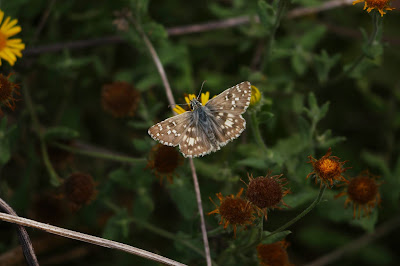
Several other species were seen which had been spotted on our Greenwings tour to Northern Greeceand elsewhere: Short-tailed Blue, Oriental Meadow Brown, Clouded Yellow, Small Heath, Spotted Fritillary, Mallow Skipper. And this butterfly which is clearly a Grizzled Skipper, but which?


Sunday, 8 September 2019

Montenegro: Perast

Perast, looking towards the Bell Tower of St Nicholas church

Perast (pronounced Per-ast, rather than Pe-rast) is a pretty town on the coast of the Bay of Kotor about 30 minutes by road from Kotor town. The town is effectively a single street along the winding shoreline with a few short streets going uphill from it. The town is mercifully bypassed by the main road around the Bay and we were dropped off at one end of the main street and our exploration consisted of strolled from end to the other.


Actually, the first thing you see are two islands a short way off-shore. (The view below was taken from the top of a church tower, so it's not the view you see initially.) On the right is Our Lady of the Rocks, where a church sits on an artificial island dating from the 15th century. A steady stream of small boats ferries visitors over to see it.


To its left is St. George’s Island where there is a monastery dating from the 12th century and a cemetery for distinguished Perastians. It is surrounded by stone walls, and hidden from view by high cypresses.


The first thing of note on the main street was the lovely Baroque Bulovich Palace, now the town’s Museum. This is the facade ...


... and here is a view back towards the Museum with the mountains behind.


As we continued along, we passed the tiny 16th century church of St John the Baptist, hemmed in by other buildings.


Soon there is another small church, the 18th century St Mark's. Note the Lion of Venice on the main facade. It sits at right angles to an impressive former palace, now a hotel.


A little further on we come to St Nicholas, which is quite small, with a single nave and no aisles. The bell tower is very impressive however ...


... and we especially liked the blue clock.


I naturally decide to climb the tower and gained this unusual view looking up.


From the top there is a nice view of the islands (see above) and a good one of the ruined castle, high above the town, which was built in 1570 and reinforced in 1620).


Continuing long the waterside path we passed a derelict palace ...


... quickly followed by the 18th century Bronza Palace.


We were very struck by these curved windows, which we noticed on other buildings in this part of the town

This was our final view back.


Conditions: warm and mostly sunny, a couple of short showers.

Rating: four and half stars. A delightful town.

Friday, 6 September 2019

Montenegro: Kotor town

 The Sea (or West) Gate

Today we are visiting Kotor, a part of the wider UNESCO World Heritage Site (The Natural and Culturo-Historical Region of Kotor, which extends as far as Perast). Kotor sits at the most inland point of the extensive Bay of Kotor. It is notable for having a complete (if battered) set of walls surrounding a pretty town and extending uphill to a castle. I will describe the town in this post and the walk up to the castle in a second one. We start in an open area in front of the The Sea Gate or West Gate, in the centre of a straight section of wall.

Off to the right is a large plaque of the Lion of Venice,  a firm reminder of the time that Kotor was a Venetian possession. Venice had control of the area from 1420 to 1797 and before that Kotor was at various times under Serb, Bulgarian and Hungarian control. Later it was under Habsburg and later Yugoslavian rule. Montenegro only emerged as an independent state in 2006 with the name
Crna Gora.


There are bastions at each end of this wall. The Gurdic or South Gate (13th to 18th centuries) to the right and the Kampana Tower and Citadel (11th to 19th centuries) on the left (photo below).


A sort of moat extends along the left hand side leading to the Sea or West Gate (1555), protected by the Bemba bastion.


Heading through the main gate you emerge into a rectangular plaza. In front is the Bell Tower (1666) …


… with a curious sort of obalisque in front of it.


At the far end of the square is a former palace, now a hotel.


We head through the narrow streets and reach St Luke's square with the Church of St Nicholas (1909) on the left and the delightful St Luke's church (1195) on the right.


Inside, St Luke's is Greek Orthodox.


Continuing along further small streets we head off to the right to find ourselves in the Piazza of the Cinema, where our attention is first drawn to a massive Black Poplar tree, which we discover was planted in what was then the grounds of a monastery in 1667 after an earthquake.


Suddenly, we realise that we now have a great view of the upper walls, the church and castle.


There is also a small church which has some partial frescoes and houses a Lapidary museum (i.e. of stonework).

We amble on to find ourselves in St Triphon's Square with the 17th century Drago Palace in the corner.


The cathedral of St Triphon, which dates from 1166, is in front of us. The current cathedral was built on the site of an earlier church built in 809, where St Tryphon’s severed head was kept after being brought from Istanbul. The saint’s remains were on their way to Dubrovnik but were intercepted in Kotor and have been there ever since.


 Inside the church there are beautiful brick columns …


… with galleries over both aisles.


We continue into Salate Square where we enjoy a very nice lunch. We are almost at the eastern end of the city here and it is much less crowded than the area just inside the main gate. The alternative route from the castle comes out here and brings a steady trickle of walkers.

Conditions: warm and sunny.

Rating: five stars. A beautiful town.

Thursday, 5 September 2019

Montenegro: Prčanj


 The Bay of Kotor

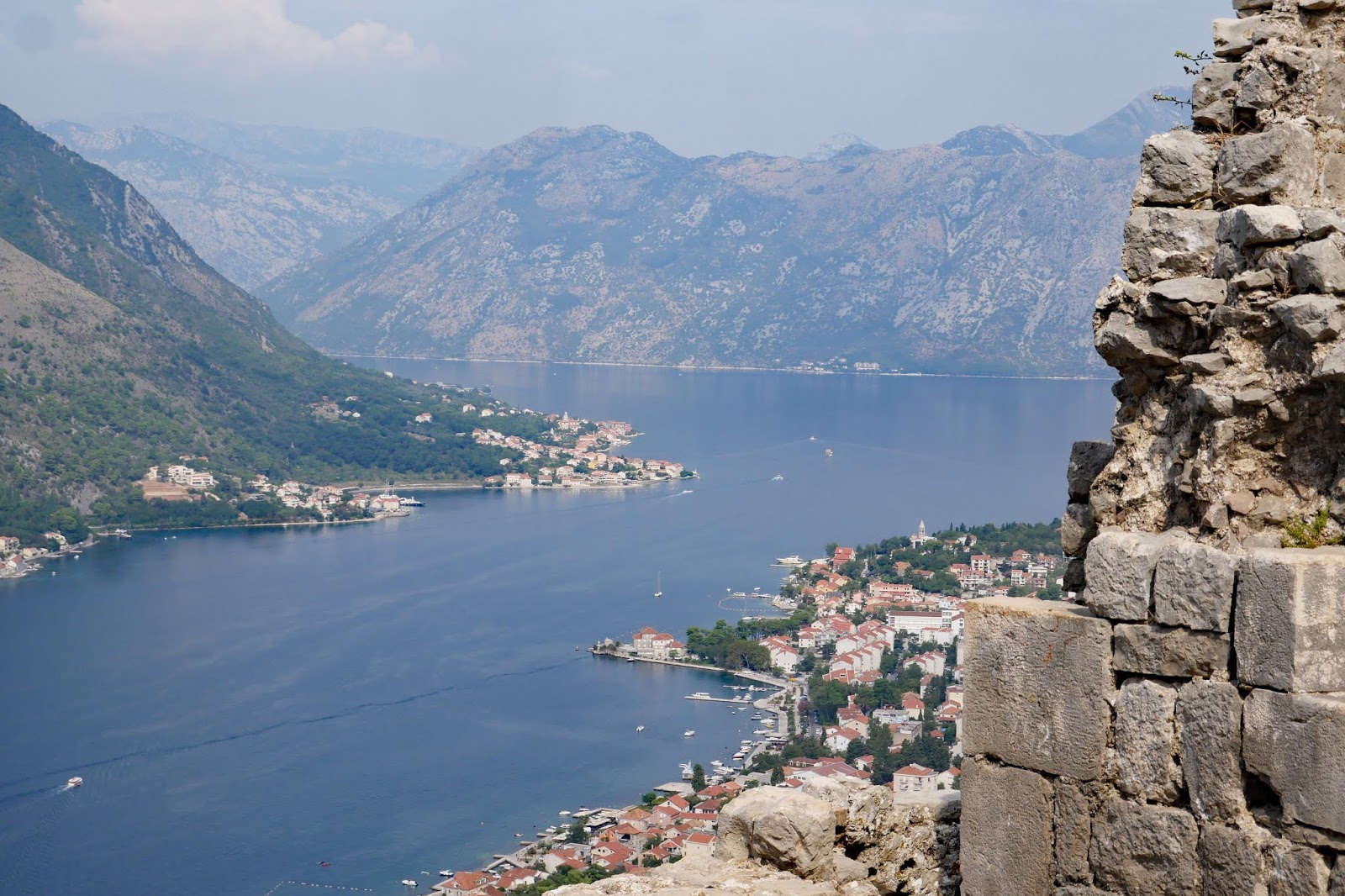
We have just arrived in Prčanj (pronounced Pr-chang) on a last minute trip for some sun and swimming, as well as some sight seeing. It is located on the innermost part of the Bay of Kotor, a large area of water that runs inland from the Adriatic (it is correctly a ria - a drowned river valley that remains open to the sea). Prčanj is the area on the left.

This is the view of the high cliffs across the bay from Prčanj.


As ever our first instinct is to get oriented and so we turn right out of the hotel (which is right on the water) and follow the coastal road for a way. The firs thing which stands out is that are no beaches, only concrete areas jutting out into the bay. This is the view back to Kotor, which we were astonished to discover, after we had made our hotel booking, is a walled town on the UNESCO World Heritage list - we plan to go there tomorrow.


After a short while we come to an interesting building, which a sign tells us is the House of the Three Sisters.


It was built in the 15th century and owned by the aristocratic Buca family. The legend of the three sisters is that all fell in love with the same sailor. When he went to sea, they stood at their windows waiting for him to return. The years went by and the sisters still waited for their sailor who never returned. As the sisters passed away one by one, their windows were boarded up – all except for the last sister, who had nobody to board up her window, and so it remains unsealed to this day. A nice little story!

A bit further on there is a zone with a couple of nice-looking restaurants, a chapel and a whole series of mansions, not all in good nick.


A headland looms ahead: the Birth of Our Lady church, Bogorodičin hram in Montenegrin. It is said to be the biggest religious building on the Adriatic coast. It was begun in 1789 but not completed until 1908.


It is positioned on a high base - here is the front-on view.


 Inside is a classic Baroque basilica.


Interestingly, on one wall of the nave is a wonderful representation of a cross. To me, it suggest a multitude standing before an altar.


While behind the church is a small and rather battered bell tower.


We turned round here and headed back past a betting shop in the small settlement by the church (how does it keep going?) and walked back along the Molo di Capitan Lorenzo, with lots of lovely Oleanders. It is the only path along this section.  


Finally, we spotted a minute stretch of sandy (actually gravel) beach - possibly the world's smallest.


Conditions: hot, hazy sunshine.

Distance: three miles or so.

Rating: four stars. An interesting introduction to the locality. Tomorrow Kotor!