Friday, 17 February 2017

Venice: Accademia to San Giorgio Maggiore


The Doge's Palace and San Marco campanile from San Giorgio Maggiore

Today's walk is derived from one in our walk book with some extra bits. It was cold and grey so we decided to start with a focused visit to the wonderful Accademia art gallery. It was a bit disorientating at first as there had been a major rearrangement since our last visit, but we soon found the 14th and 15th century masterpieces we wanted to see, notably Giorgone's The Tempest and one of the best of Bellini's Madonnas. However, the two most dramatic pictures we saw were a Madonna del Parto by an unknown Master (we saw Piero della Francesco's famous one at Monterchi a few years back) ...


... and San Crisogono (c 1375-1410) by Michele Giambono, a painter we had never previously heard of.


The inspiration for today's walk was Andrea Palladio, the great architect whose buildings we explored on a past holiday in the Veneto. One wing of the Academia complex is by Palladio and here is a view through a reasonably clean window - you can't unfortunately get out into the courtyard.


We headed along Rio Tera Antoniao Foscarini (Rio Tera denotes a canal which has been filled in to create a wide path) to reach the Fondamente Zattere, where we turned left to photograph Palladio's great church of the Redentore on the opposite side of the Guideca Canal. The church was the result of a vow to honour Christ the Redeemer made by the Venetian Senate in 1576 at the height of an outbreak of plague which killed 30% of the population.


We took the vaporetto across the canal and began the route from our walk book, turning right to reach the odd-looking, and much altered, church of Sant' Eufemia.


There was a nice view along the adjacent canal canal, reminiscent of those on the outlying islands of Burano or Murano.


We turned left and were passing the former convent of Santi Cosima e Damiano when we noticed an open door. It was undistinguished from the outside and has now been converted into apartments, but inside there was a quite beautiful cloister - a quintessentially Venetian moment.


We returned to the Fondamenta San Giacomo to soon reach the the Ponte Lungo with a fine view down its canal.

Not long after this we reached the Redentore for a close up of the facade.


 The interior was simple but impressive.


We continued along the Fondamenta to reach the Zitelle vaporetto stop where we made the short hop avross the Guiudeca canal to San Giorgio. From the boat there were nice, but misty, views across to the Dogana and Santa Maria della Salute. The facade of San Giorgio, also by Palladio, is similar to his later church of the Redentore but more monumental. The church was begun in 1566, but the facade was not erected until 1607-11, 25 years after Palladio's death. It was however precisely as he designed it.


The interior is quite austere, but grand.


 We headed towards the campanile, noting this lovely sculpture of an angel on the way.


The views from the top were most enjoyable, even if constrained by the mist. Perhaps the best were down to the cloisters ...


... and over the dome towards the Dogana (Customs House).


Back at ground level, and after a restorative grappa, there was a lovely view of one of the two lighthouses across the Basino of San Marco.


One final vaporetto took us across the Basino of San Marco and we couldn't resist a tourist shot of the celebrated Bridge of Sighs which linked the Doge's Palace to his prison.


Conditions: cold and grey.

Distance: about 3 miles.

From: Venice. History. Mystery. Walks (AA publications).

Rating: Five stars.

Thursday, 16 February 2017

Venice: The golden triangle - Accademia, Rialto and San Marco

The Basilica of San Marco

We have just arrived in Venice for a short break and we are staying at hotel midway between San Marco and Santo Stefano, so we set out to reacquaint ourselves with the city by doing a favourite triangular walk. We were soon in Santo Stefano, the large campo (square) named after the lovely Gothic church. Outside is typically red brick and white marble details.


Inside there is a famous - and almost unique - Ship's keel Roof.


We made the short detour to the Accademia bridge, one of only two across the Grand Canal. There is a great view towards the mouth of the Canal with the church of Santa Maria della Salute on the right and the Dogana (Customs House) beyond it.  


We headed off towards Rialto quickly reaching Campo S Anzolo, where there were a couple of classic palaces and the traditional well-head fed by an underground cistern.


Looking back you can see the leaning campanile of Santo Stefano, one of the tallest in Venice.


A sequence of narrow streets leads to the Rialto bridge. It is difficult to photograph from the right bank so we crossed over to the other other side to see it more clearly. It is always entertaining to remember that it was the work of Andrea da Ponte.


Now we doubled back to Campo St Bortolomio where there is an exquisite group of windows.


 We followed the narrow winding Merceria to reach San Marco where the facade of the Basilica was illuminated by the late afternoon sun.


So too was the adjoining Doge's Palace.


The 15th century Clock Tower however was in the shade.


There was, finally, a fantastic view across to the island church of San Giorgio Maggiore.


It remained only to head toward Accademia and return to our hotel So, all very touristy, but a great way to re-connect with the unique city that is Venice.

Distance: a couple of miles.

Conditions: bright and sunny.

Rating: 5 stars.
Saturday, 11 February 2017

Old Wardour to Win Green (Wessex Ridgeway [Wiltshire] 10)

Old Wardour Castle

We had our first view of Old Wardour Castle on the previous leg of this walk. Today it was open and it was possible to snatch this picture from the front gate. It has to be said that it is a less romantic ruin than I thought it would be.

We headed south west, soon passing this intriguing, but unmarked gateway.


To the right there was a distant hazy view of the rear facade of New Wardour Castle. This has the classical portico that no self-respecting neo-classical building would be without.


The countryside we were passing through was attractive but hard to fully discern in the murk.


We entered Park Copse and enjoyed the sight of some early catkins.


We then descended a very steep and slippery track to reach the scattered village of Donhead St Andrew. We enjoyed these straw birds on one of the thatched roofs.


Now uphill and across fields, descending to Milkwell and then climbing again to reach Lower Berrycourt Farm where there was a fine old stone barn.


A track and further fields brought us to a point overlooking Ludwell, where extensive watercress beds could be seen behind the attractive thatched cottages.


We passed the excellent Grove Arms pub, where we would later enjoy lunch, and turned right walking past the watercress beds and then along field  paths always uphill to finally reach Win Green. The views from the top were fantastic, but the weather was by now even more murky and there was no point in trying to take a picture.

Conditions: Cold and grey.

Distance: 6 miles.

Map: 118 (Shaftesbury & Cranborne Chase).

Rating: four stars. This would be a lovely walk on a good day.

Friday, 10 February 2017

Lincoln

Lincoln Castle: The East Gate

An opportunity to extend my list of cities walked in courtesy of out friends Roger and Deborah. WE start our walk outside the East Gate of the castle. In 1068, the Normans constructed a motte and bailey castle here, re-using the remaining stone walls of the later Roman city, Lindum Colonia. The castle walls were built in stone in the late 11th century, replacing the temporary wooden palisade. The Castle was besieged for the final time in 1644, during the English Civil War, when the Royalists holding it were overwhelmed by a stronger Parliamentarian force.

The area inside the walls is suprisingly large and contains a variety of buildings of which the most surprising is a Victorian Gaol. A gaol was first built in 1788 to hold both felons and debtors. 
In 1848, a national prison building scheme saw the demolition of the felons' wing and the construction of a new Victorian prison wing. This became a 'holding' centre for short term male, female and child prisoners awaiting trial at the courthouse, and convicts pending removal elsewhere to serve their sentence. The debtors continued to be held in the Georgian gaol building.


The Victorian prison was designed to implement the 'separate system' - a regime intended to keep prisoners separate from the corrupting influence of their fellow inmates, and bring about their moral reform. Separate cells were provided with a sink, toilet and hammock so that there was no need for prisoners to leave them except for exercise and fresh air in the airing yards, and the daily chapel service led by the prison's chaplain, the Reverend Henry Richter. The separate system was never fully implemented however due to overcrowding, a fever which swept through the prison and, ultimately, the reluctance of the magistrates. By 1878, expensive running costs and declining prisoner numbers led to the prison's closure just 30 years after it had opened.


The separation system extended to the chapel in a shocking way. One of these figures is not a mannequin.


We returned from the fascinating tour of the gaol to climb up to the top of walls and do a circuit. There was a fine view of the Cathedral, of which more later.


At the far end of the enceinte was the Court House. It was built in 1826 for the Lincolnshire Assizes and is still in use as Lincoln Crown Court.


Looking outside the walls as we went further round we saw this massive the imposing Westgate water tower.  The 120-feet-tall building was commissioned as a result of a Typhoid epidemic caused by contaminate drinking water which swept over the city between November 1904 and April 1905. 1006 people contracted the disease and 113 people died.


Having completed the excellent circuit of the walls we left the castle and headed across to the Cathedral which stands opposite across a small square. and through a gateway. Work started on the Cathedral in 1072 and it was consecrated in 1092. Unfortunately, after a fire in 1124 and an earthquake (!) in 1185, leaving only the West Front untouched. It is truly magnificent.


The remainder of the Cathedral was rebuilt in the gothic style from 1192.


The Chapter House of 1220 onwards is also particularly fine, with its elborately ribbed roof.


We returned to the nave and then went to the choir to search for the famous Lincoln Imp. The 14th century story has it that two imps were sent by Satan to earth to do mischief. An angel came out of a book of hymns and told them to stop, one of the imps was brave and started throwing rocks at the angel, but the other imp cowered under the broken tables and chairs. The angel turned the first imp to stone, giving the second imp a chance to escape. It is said that even on still days it is always windy around the cathedral, which is the second imp circling the building looking for his friend. The imp can be seen directly above the head of a man at the top of this column.


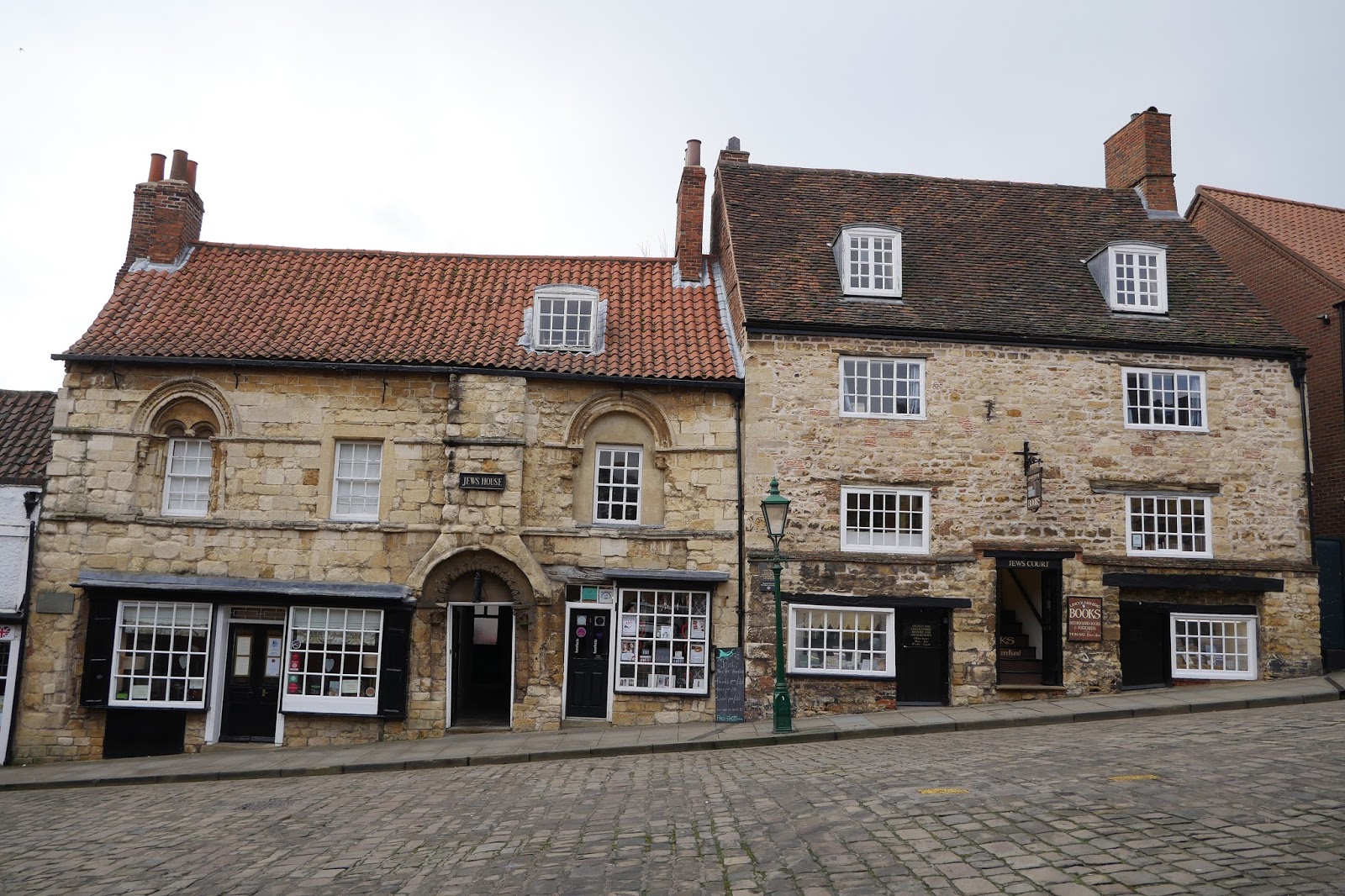
When we had completed our tour of the Cathedral we headed down Steep Hill to pass the Jew's House on the left and the Jew's Court on the right, two of the oldest houses in the city.


At the bottom, we passed through the Stonebow gate with the Guildhall on the right (viewed looking back from the other side).


Further along on the right there was a splendid art deco shop front.


We reached the point where the street crosses the River Witham. Off to the left was an impressive modern statue.


To the right was this large building (viewed from the river bank behind it) - one of the few remaining instances of a bridge with a building on it.


We headed right past the large Brayford Pool  and waterfront area and, as time was running out, we headed back along Mint Street to retrace our steps to where we had parked the car near the castle. In Mint St (I think) we stumbled on this fantastic art nouveau shop facade. I couldn't believe my luck.


Conditions: bright at first becoming greyer and eventually raining.

Distance: two or three miles.

Rating: five stars.