Tuesday, 13 May 2014

A view of Delft

The town hall

A day trip to Delft, home of Vermeer, one of our favourite painters. We learned from the Delft website that the Tourist Office had a leaflet describing a walk around Old Delft and we headed straight there to buy it. It was easily the best such leaflet, in fact more of a booklet, I have ever seen.

We started in the nearby Market Square. It is a large rectangular space with the Town Hall at one end: this is the very harmonious Renaissance building in the picture above. The unusual thing about it is that is built around the 13th century gothic Earl's Tower you can see at the back. The tower was used as a prison.

At the other end of the square is the Niewe Kerk, a colossally tall building of 1383-1510. It has in fact the second highest spire in the Netherlands (that of Utrecht Cathedral is the highest).


You leave the square at the church end and pass the twin spires of the Maria van Jesse Roman Catholic church to reach the Beestenmarkt. Before it became the animal market it was the site of a monastery. A funky statue commemorates its former role.


Now we took an optional loop to see the Oostpoort (Eastgate). This led along quiet streets beside quiet canals. Many of the houses had coloured glass in some of the windows. This
beautiful art nouveau pattern caught my eye.


The Oostpoort is a lovely sight from the other side of the Rijn-Schie canal. It dates from about 1400 and is the only one of the eight city gates to survive.


We enjoyed the view back towards the Niewe Kerk.


Then we followed the bank of the Rijn-Schie canal to see the Klaeuwshofje, an almshouse with a very plain exterior.


We have seen others in Amsterdam, but this was the first time we were able to see the courtyard garden which is a normal feature.


The loop took us back to the Beestenmarkt and then round the back of the Niewe Kerk and into the Market square again. We went to the back of the Town Hall to see the medieval Waag (municipal weighing house).


A glance to the left revealed this fabulous art nouveau building, not mentioned in the guide (presumably it is not historic enough), in Oude Langedyjk, the street where Vermeer lived from 1660.


We then walked to to other end of the street to see a beautiful house of 1598 with the traditional stepped gable. This was the official start of the walk.


Now it was time to embark on a second optional loop, so we walked down the strangely named street of Oude (Old) Delft, either side of a quiet canal and full of grand houses, some of which were once breweries. The goal of this excursion was to see the spot where Vermeer painted his great View of Delft. First we passed the imposing Armamentarium, once the artillery stores of the states of Holland and West Friesland, now the Army museum.


Eventually you reach the Rijn-Schie canal again and can stand at Vermeer's vantage point. This is how it looked when Vermeer painted it. The Niewe Kerk is now the only recognisable element. The Rotterdam gate on the right is not unlike the Oostpoort we saw earlier.


For my picture, I moved my focus a bit to the right, because the buildings now on the left were fearfully dull. I suppose it is still a nice enough view.


We headed back into the centre along a parallel route and then rejoined Oude Delft to go north towards the Oude Kerk. The spire was built 1325-50 and is indeed leaning, as it appears. In fact, rather like the leaning tower of Pisa, it began to subside before it was even finished.


Just before you reach the Oude Kerk, you pass the attractive small church of St Hippolyte (1400).


To one side of the Oude Kerk is the former convent of St Agnes, also of about 1400. During the Dutch reformation, in 1572, William of Orange moved here and the building became known as the Prinsenhof. Every Dutchman knows that William was murdered here in 1584: you can still see the bullet holes. This is the view from the garden.


Just a little further on is the gateway to the Bagijnhof - we saw its equivalent in Amsterdam two days ago. Beguines were women who helped the poor and lived good lives, but without actually taking the vows of nuns. This is where they lived.


And amazingly when you walk through to other entrance, reaching the line of the old city walls, you turn right and see ... a windmill! It used be situated on the wall and dates back to 1728. This was a great point to mentally finish the walk. Only finding somewhere for lunch in the town centre and walking back to the station remained.


Conditions: warm and sunny.

Distance: about 4 miles.

Rating: five stars.

Sunday, 11 May 2014

Amsterdam: East to West


Thoas Swallowtail

After an extremely wet morning, we made our way to the zoo (Artis - Natura Artis Magistra, in full) to enjoy the butterfly pavilion in the dry - I was thrilled to get a reasonable picture of a Thoas Swallowtail. This post describes the walk back when mercifully the rain had finally stopped.

Just along Henri Polklaan street from the zoo is de Burcht (1899), once the headquarters of the General Dutch Diamond Workers Union.


It was designed by H P Berlage and part of his brief was to create a defensible building that could be used as a refuge during a strike. The building's real glory is its interior, but unfortunately this was not one of its open days.

After going through the Wertheim Park we passed the massive Portugese Synogogue, inaugurated in 1675. It apparently inspired the Bevis Marks synagogue in London which I saw on a walk around the City East earlier this year.


 Jodenbreestraat brought us to Rembrant's House, now of course a museum. The artist lived and worked here from 1639 to 1656.


Then, to the left there was an excellent view of the tower of the Zuiderkerk, dating from 1612. 


We now turned left down Kloveniersburgwal and crossed the Amstel to see the Munttoren. The base of the tower formed part of a gate in the city walks and survived a fire in 1618. The clock tower was added later in the century. It gets its name from the Mint being temporarily housed there during the French occupation in 1673.


We headed up the pedestrianised Kalverstraat, the only cycle-free street we have yet seen, and turned left into Spui to find the Begijnhof. This was originally founded in 1346 as a sanctuary for the Begijntes, a lay Catholic sisterhood.

There are only two entrances, one of which is the small door in the building to the left.


You go through a tiled arched passageway.


Inside it is like a village green surrounded on all sides by terraced houses. One of these is the oldest surviving house in the city.


And there is a church at one end of the green: the 15th century English Church.


We finished this walk behind Dam Square where there is the enormous and imposing former Post Office building, now a shopping mall.


Conditions: dull at first, becoming  brighter.

Distance: about 2 miles.

Rating: four stars.

Friday, 9 May 2014

Amsterdam centrum


 The Koninklijk Palace

We have just arrived in Amsterdam for a short break and we decided on a short tour of the city centre to begin to orientate ourselves. We headed off from our hotel on Herengracht towards Dam Square. To be honest it is not a very impressive city centre square. The main building is the Koninklijk Palace, which we thought looked like a large city hall. And wonderfully, it was in fact built as the city hall in the mid-17th century by architect Jacob van Compen, only becoming a royal palace in 1808 when Napoleon's brother Louis was installed as ruler of the Nederlands. It has been state property since 1936, but is still apparently occasionally used by the royals.

Wedged into a corner of the square is the Niewe Kerk (New Church).


This dates from the 14th century, but has been destroyed by fire several times and also restored more than once.

Then were walked up Damrak, a wide Oxford Street-like road. On the right is the extraordinary former Stock Exchange building, the work of the great Dutch architect H P Berlage. It was built in 1903 and was remarkable for its time. The shallow relief sculptures for instance anticipate art deco by twenty years.The interior is evidently remarkable, but unfortunately we were unable to to get in to see it.


At the head of the street is the wonderful Centraal station of 1889, which effectively cuts Amsterdam off from the sea. It was built on three artificial islands. It now offers an incredible variety of modes of transport apart from rail: metro, water cruise, tram, bus, taxi, bicycle.


From here we found our way studiously along the edge of the famous red light district to the Oude Kerk, whose skyline presented an interesting mix of stone and brick gables topped by a splendid tower of 1565. The present structure dates from the 14th century and grew substantially over the centuries. The interior seemed rather incoherent to us.


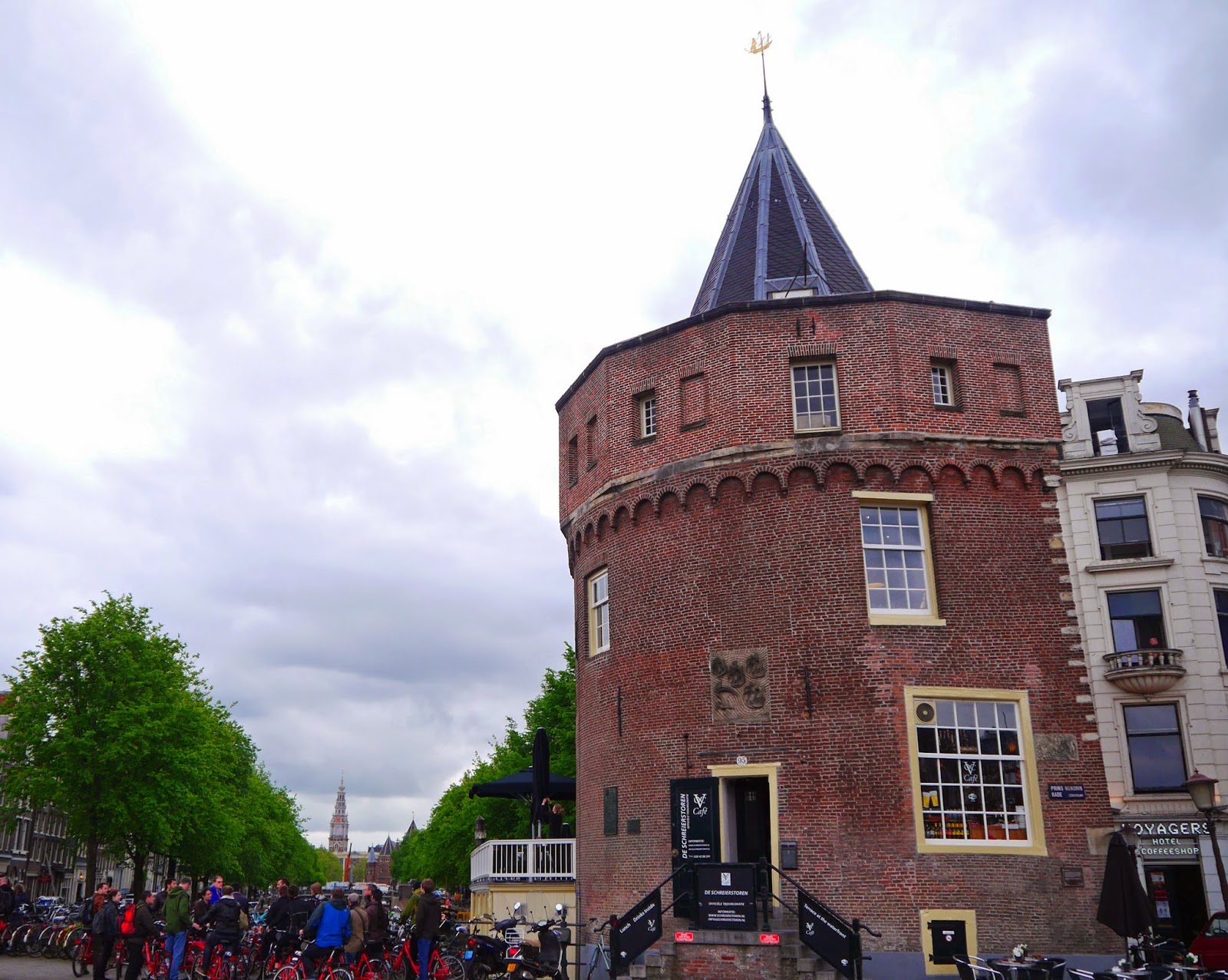
We then briefly followed Zeedijk, originally the location of a 14th century dike, but now the centre of Amsterdam's small Chinatown, to reach Schreierstoren. This translates as Weepers' Tower and dates from 1480. It was once part of the city wall and was one of the few bits not demolished as the city expanded.


Now we headed south east to the Montelbanstoren, which can be seen in the background in the picture above. This dates from 1512 and stood outside the city wall as a defensive fortification.


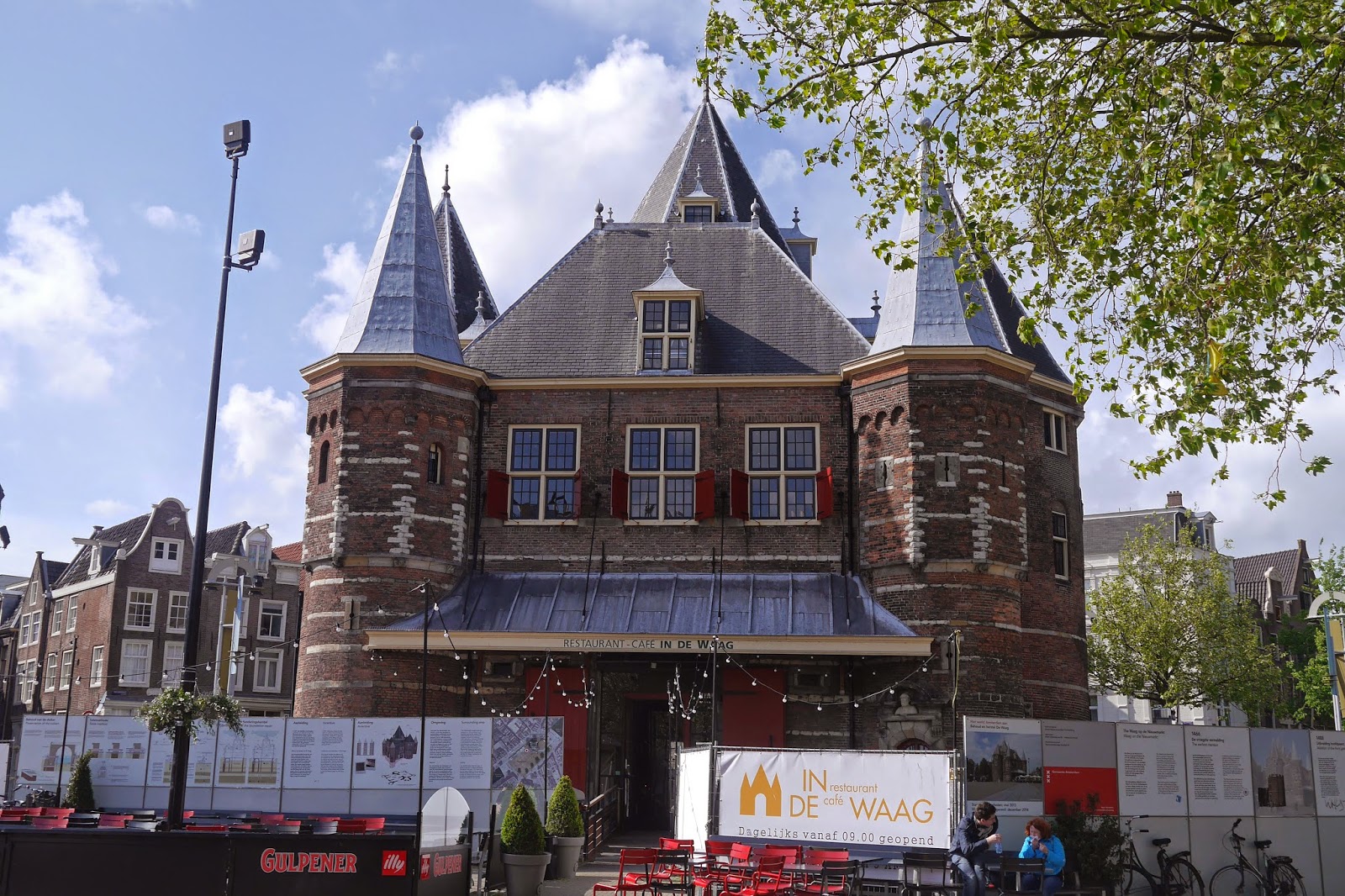
The next stop was the Niewemarkt square. Here stands the wonderful many-towered Waag, originally a city gate (built in 1488) and later (1617) a public weigh house.


Finally, we crossed a couple of the draw bridges which Holland is famous for. The first one had the true-love padlcocks that we saw in Paris and which seem to have become a global phenomenon.


Three quick impressions: there are an extraordinary number of attractive buildings lining the canals, many of the older ones have a pronounced lean forwards and boy is the centre crowded. I later discovered that the forward tilt was by design, to make it easier to get stuff up to the top storey by means of an external hoist. The extent of the forward projection was limited by law.

Conditions: sunny and fairly warm until the end.

Distance: 3 miles.

Rating: four stars.

Tuesday, 6 May 2014

Hammoon to Fifehead Magdalen (Stour Valley Path 6)


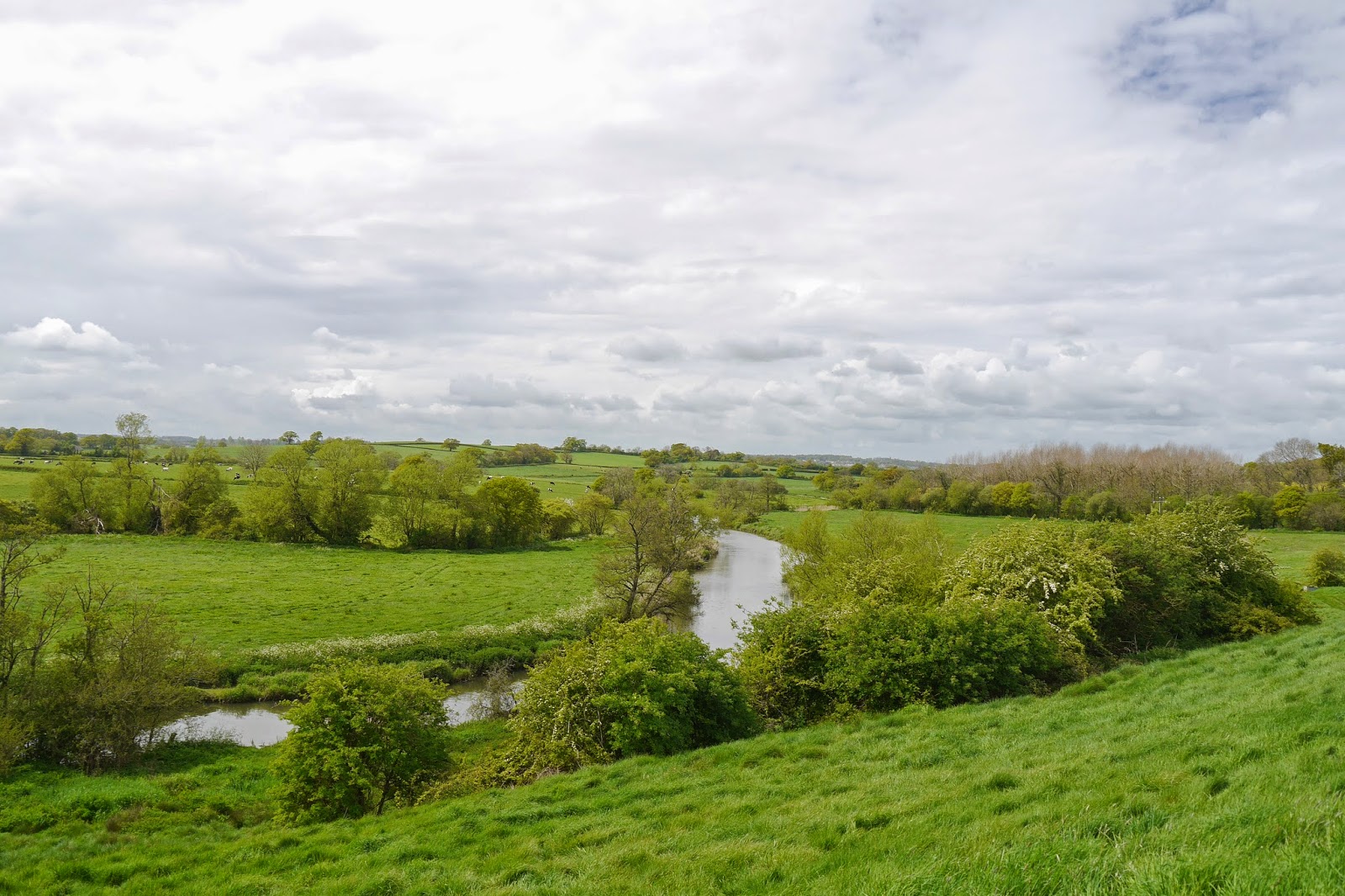
The Stour near Fiddleford

 We had an unexpected opportunity to make further progress on the Stour Valley Path and so headed to the tiny hamlet of Hammoon to pick up the route by walking along the former railway towards Sturminster Newton (Stur to the locals).


In fact, we got so carried away with the rapid rate of progress along this excellent path that we were almost at Stur before we realised we should have turned off to follow a curving path down to Fiddleford Mill. This is what we should have seen, taken in the evening on the way home.


We had a very nice lunch in the Swan pub in Stur and admired the Museum.


Then we headed down to the river to follow it for a couple of miles to Cutt Mill. The first notable sight was the partly-dismantled former railway bridge.


Why, we wondered? Was there a desire to make sure the railway could never easily be reinstated? After a short muddy stretch we emerged into a grassy area and the path climbed a small hillside giving lovely views to the west. 

We walked along the grassy river bank: the first really sustained walk by the river since we started the walk. Now we started to see some butterflies and I was very pleased to get a photograph of these Green Veined Whites mating.


 There were also at least three different types of dragonfly. This is a Banded Demoiselle.


Cutt Mill was a pleasant spot. The ruined mill is not all that distinguished architecturally, but it was interesting to see how solid the piers of the bridge were: presumably this was once a much more important crossing.


There was also a female Orange Tip showing the delicate underwing markings that enable you to tell it from a Small White.


Walking up the lane from the mill we turned left across fields to enjoy spectacular views to the west over the Blackmore Vale.


More field paths brought us to the sprawling village of Marnhull. It claims to be the biggest village in Dorset and we found this claim to be very convincing. We left the old centre along Love Lane and walked north across fields in the direction of Fifehead Magdalen.

After crossing one particularly enormous field, we touched the winding river again. After this we had a bit of a struggle to find our way to the village, but did eventually succeed. The view east towards Duncliffe Hill on the left was very pleasing.


The little 14th century church of St Mary Magdalene was very attractive.


Conditions: warm and sunny for the most part, but quite a lot of cloud. Muddy underfoot in many places.

Distance: 7.5 miles. Total now covered 47.0 miles.

Guide: The new Stour Valley Path by Edward R Griffiths, Greenfield Books, 1998, but sadly out of print

Map: Explorer  129 (Yeovil & Sherborne)

Rating: four stars. The long section by the river after Sturminster Newton was a real highlight.