Sunday, 8 September 2019

Montenegro: Perast

Perast, looking towards the Bell Tower of St Nicholas church

Perast (pronounced Per-ast, rather than Pe-rast) is a pretty town on the coast of the Bay of Kotor about 30 minutes by road from Kotor town. The town is effectively a single street along the winding shoreline with a few short streets going uphill from it. The town is mercifully bypassed by the main road around the Bay and we were dropped off at one end of the main street and our exploration consisted of strolled from end to the other.


Actually, the first thing you see are two islands a short way off-shore. (The view below was taken from the top of a church tower, so it's not the view you see initially.) On the right is Our Lady of the Rocks, where a church sits on an artificial island dating from the 15th century. A steady stream of small boats ferries visitors over to see it.


To its left is St. George’s Island where there is a monastery dating from the 12th century and a cemetery for distinguished Perastians. It is surrounded by stone walls, and hidden from view by high cypresses.


The first thing of note on the main street was the lovely Baroque Bulovich Palace, now the town’s Museum. This is the facade ...


... and here is a view back towards the Museum with the mountains behind.


As we continued along, we passed the tiny 16th century church of St John the Baptist, hemmed in by other buildings.


Soon there is another small church, the 18th century St Mark's. Note the Lion of Venice on the main facade. It sits at right angles to an impressive former palace, now a hotel.


A little further on we come to St Nicholas, which is quite small, with a single nave and no aisles. The bell tower is very impressive however ...


... and we especially liked the blue clock.


I naturally decide to climb the tower and gained this unusual view looking up.


From the top there is a nice view of the islands (see above) and a good one of the ruined castle, high above the town, which was built in 1570 and reinforced in 1620).


Continuing long the waterside path we passed a derelict palace ...


... quickly followed by the 18th century Bronza Palace.


We were very struck by these curved windows, which we noticed on other buildings in this part of the town

This was our final view back.


Conditions: warm and mostly sunny, a couple of short showers.

Rating: four and half stars. A delightful town.

Friday, 6 September 2019

Montenegro: Kotor's walls and castle

The ruined buildings near the top

It was not obvious at first where to start the walk along the walls up to the castle (or citadel) – according to a waiter at our hotel a walk which involves climbing 2,000 steps. The map of the town suggested that you would start at the Bembo Bastion (1540) but when we got there we found the wide path had a barrier. However, we found a street parallel to the wall and continued though a beautiful archway (dated 1760) to reach the entrance.


It became clear that the climb consists in a diagonal section up to the church and then a second, longer section to the remains of the castle. As we approached the church of Our Lady of Remedy (1518) we had our first view down over the town. The church of St Nicholas can seen on the left.


The church of Our Lady of Remedy makes a sort of first base, about a third of the way up, and so it was quite crowded. I had to settle for a photo looking back after we had passed it.


The church is lit up at night along with the rest of the walls and can be plainly seen from out hotel in
Prčanj. The photo also gives an idea of the route of the walls.


From a bit higher up the triangular nature of the old town becomes clear. Note also the daily cruise ship.

  
This was a typical section of the climb. It was often easier to walk up the stony slope rather than the steps. The steps however were much better to walk down on.


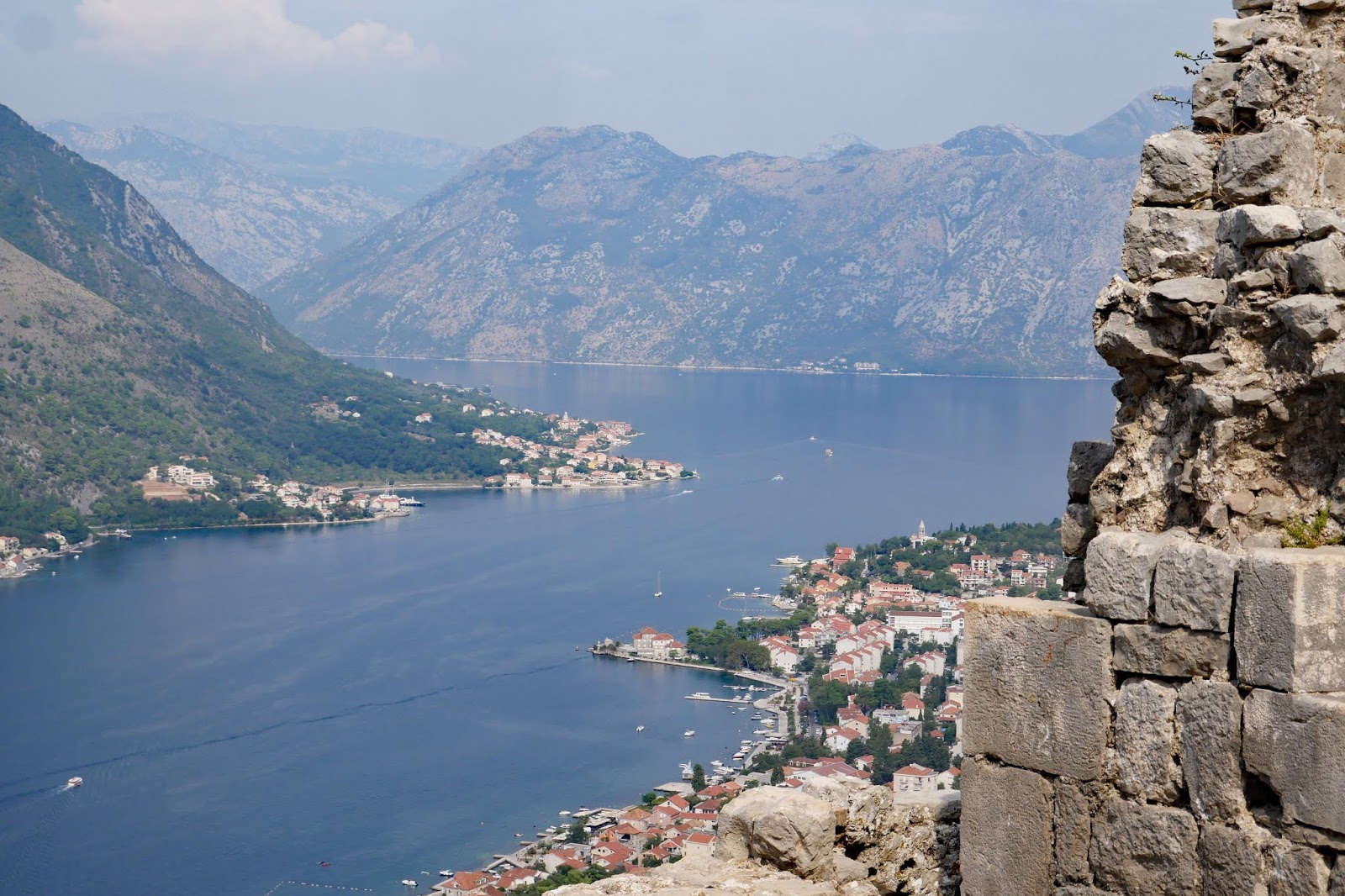
We reached a bastion which offered a nice view over the Bay of Kotor.


A little further up there was a great view back over the Old Town.


We then negotiated our way through this collection of defensive buildings.


It has to be said that the final section of the climb was a bit disappointing. There was no dramatic finale and the buildings looked mostly as though they had been cobbled together in the 19th century. However, the main sense of accomplishment came from completing the climb and subsequent descent without any great difficulty.

Conditions: warm and sunny - we were glad we started the walk early in the day.

Rating: four and a half stars. Great views!

Montenegro: Kotor town

 The Sea (or West) Gate

Today we are visiting Kotor, a part of the wider UNESCO World Heritage Site (The Natural and Culturo-Historical Region of Kotor, which extends as far as Perast). Kotor sits at the most inland point of the extensive Bay of Kotor. It is notable for having a complete (if battered) set of walls surrounding a pretty town and extending uphill to a castle. I will describe the town in this post and the walk up to the castle in a second one. We start in an open area in front of the The Sea Gate or West Gate, in the centre of a straight section of wall.

Off to the right is a large plaque of the Lion of Venice,  a firm reminder of the time that Kotor was a Venetian possession. Venice had control of the area from 1420 to 1797 and before that Kotor was at various times under Serb, Bulgarian and Hungarian control. Later it was under Habsburg and later Yugoslavian rule. Montenegro only emerged as an independent state in 2006 with the name
Crna Gora.


There are bastions at each end of this wall. The Gurdic or South Gate (13th to 18th centuries) to the right and the Kampana Tower and Citadel (11th to 19th centuries) on the left (photo below).


A sort of moat extends along the left hand side leading to the Sea or West Gate (1555), protected by the Bemba bastion.


Heading through the main gate you emerge into a rectangular plaza. In front is the Bell Tower (1666) …


… with a curious sort of obalisque in front of it.


At the far end of the square is a former palace, now a hotel.


We head through the narrow streets and reach St Luke's square with the Church of St Nicholas (1909) on the left and the delightful St Luke's church (1195) on the right.


Inside, St Luke's is Greek Orthodox.


Continuing along further small streets we head off to the right to find ourselves in the Piazza of the Cinema, where our attention is first drawn to a massive Black Poplar tree, which we discover was planted in what was then the grounds of a monastery in 1667 after an earthquake.


Suddenly, we realise that we now have a great view of the upper walls, the church and castle.


There is also a small church which has some partial frescoes and houses a Lapidary museum (i.e. of stonework).

We amble on to find ourselves in St Triphon's Square with the 17th century Drago Palace in the corner.


The cathedral of St Triphon, which dates from 1166, is in front of us. The current cathedral was built on the site of an earlier church built in 809, where St Tryphon’s severed head was kept after being brought from Istanbul. The saint’s remains were on their way to Dubrovnik but were intercepted in Kotor and have been there ever since.


 Inside the church there are beautiful brick columns …


… with galleries over both aisles.


We continue into Salate Square where we enjoy a very nice lunch. We are almost at the eastern end of the city here and it is much less crowded than the area just inside the main gate. The alternative route from the castle comes out here and brings a steady trickle of walkers.

Conditions: warm and sunny.

Rating: five stars. A beautiful town.

Thursday, 5 September 2019

Montenegro: Prčanj


 The Bay of Kotor

We have just arrived in Prčanj (pronounced Pr-chang) on a last minute trip for some sun and swimming, as well as some sight seeing. It is located on the innermost part of the Bay of Kotor, a large area of water that runs inland from the Adriatic (it is correctly a ria - a drowned river valley that remains open to the sea). Prčanj is the area on the left.

This is the view of the high cliffs across the bay from Prčanj.


As ever our first instinct is to get oriented and so we turn right out of the hotel (which is right on the water) and follow the coastal road for a way. The firs thing which stands out is that are no beaches, only concrete areas jutting out into the bay. This is the view back to Kotor, which we were astonished to discover, after we had made our hotel booking, is a walled town on the UNESCO World Heritage list - we plan to go there tomorrow.


After a short while we come to an interesting building, which a sign tells us is the House of the Three Sisters.


It was built in the 15th century and owned by the aristocratic Buca family. The legend of the three sisters is that all fell in love with the same sailor. When he went to sea, they stood at their windows waiting for him to return. The years went by and the sisters still waited for their sailor who never returned. As the sisters passed away one by one, their windows were boarded up – all except for the last sister, who had nobody to board up her window, and so it remains unsealed to this day. A nice little story!

A bit further on there is a zone with a couple of nice-looking restaurants, a chapel and a whole series of mansions, not all in good nick.


A headland looms ahead: the Birth of Our Lady church, Bogorodičin hram in Montenegrin. It is said to be the biggest religious building on the Adriatic coast. It was begun in 1789 but not completed until 1908.


It is positioned on a high base - here is the front-on view.


 Inside is a classic Baroque basilica.


Interestingly, on one wall of the nave is a wonderful representation of a cross. To me, it suggest a multitude standing before an altar.


While behind the church is a small and rather battered bell tower.


We turned round here and headed back past a betting shop in the small settlement by the church (how does it keep going?) and walked back along the Molo di Capitan Lorenzo, with lots of lovely Oleanders. It is the only path along this section.  


Finally, we spotted a minute stretch of sandy (actually gravel) beach - possibly the world's smallest.


Conditions: hot, hazy sunshine.

Distance: three miles or so.

Rating: four stars. An interesting introduction to the locality. Tomorrow Kotor!

Wednesday, 7 August 2019

Red House, Bexleyheath

The Red House

I have been an enthusiast for William Morris and his circle for a very long time, but not until today had I seen Morris's first family home, the Red House - it was the natural next step after our recent visit to Kelmscott Manor.

Morris and Janey married in 1859 and Philip Webb was commissioned to design the house (Morris took responsibility for the interior decoration. It was Webb's first commission. (You can read about the rest of his output in Sheila Kirk's excellent book Philip Webb. Pioneer of Arts and Crafts Architecture). Morris and Janey only lived there until 1865, during which time their daughters Jenny and May were born. Fortunately, the house had many sympathetic owners thereafter, including three architects in succession. A Trust was established in 1998 to take over the property from the last private owners, and the house was acquired by the National Trust in 2003.

The first sight of the house comes as you walk along the drive. A large red brick building looms in front of you with irregular massing and a projecting tower over a large open porch. The tall windows seemed reminiscent of the Board schools which were built all over London later in the 19th century.


We join a very good tour which starts in the entrance hall. It seems rather bare and the main item of interest is the settle on the right hand side with unfinished paintings by Morris depicting the Joyous Gard (the home of Lancelot in Arthurian legend) on the doors.


We move next into the Dining Room where the main item of furniture is a massive dresser designed by Webb. The National Trust have restored it to something like its original colour scheme.


The main decoration in this room was intended to be set of eight embroideries of Chaucer's "Good wimmin". One of these is illustrated on the right. The completed ones can be seen at Castle Howard and at Kelmscott Manor.

We headed upstairs and admired the recently decorated ceiling


The first floor Drawing Room was the heart of Red House. It is decorated with a painting by Burne-Jones called the Tale of Sir Degrevaunt.


In the bedroom of Morris and Janey is a mural, discovered only in 2013, thought to be the collective work depicting characters from Genesis by Edward Burne-Jones, Dante Gabriel Rossetti, his wife Elizabeth Siddal, Ford Madox Brown and Morris. You can read the full Guardian story here.


When the excellent tour ended we emerged into the garden by the lovely Well


We completed our visit with a look at the back of the house.


This was the most striking feature. But what would you call it? The answer I am informed is "a buttress supporting an oriel window".


Conditions: cool, threat of rain, but some sunshine (we got wet on the way back to the station though).

Rating: Five stars. A must for anybody interested in the Arts and Crafts movememnt or 19th century architecture in general. The National Trust have done some great restoration work, but there is still more to do.