Tuesday, 10 April 2018

Croome

Croome Court

Merv and I have just visited Pershore, but I had a feeling when I was planning it that we might feel slightly disappointed so I proposed a visit to walk around Croome as well. I found it on the National Trust website. I didn't realise what a delight it would be.

We arrived to find what looked to be a newly established visitor centre housed in a load of Nissen huts. We emerged to be routed towards the interesting RAF museum. We gradually came to understand that a large slice of land which was part of Croome was taken over during the war as a secret RAF base, known as RAF Defford, which undertook research and development on airborne radar. More than 2,000 service personnel and scientists worked there. So that was rather a surprise.

Now began the walk proper. We wandered along a marked track through woodland and then emerged at a high point overlooking a classic country house park with the great house, Croome Park maybe half a mile away below us. It was a great moment.

To our further surprise a gothick church stood on slightly higher ground to our left.


It is the church of St Mary Magdalene. According to the NT website: A church at Croome is first mentioned in 1283 and was dedicated to St James the Apostle, this church was close to the house but was demolished by George Coventry, the 6th Earl of Coventry, when he inherited the estate in 1751 and set about remodelling the house and landscape. The current church was designed by Capability Brown (who knew he did churches as well as landscaping?). The rather lovely interior was by Robert Adam.


We headed past the ice house ...


... to reach the lovely Rotonda. This was also the work of Capability Brown and dates from the 1760s.


It is a bit battered inside.


We walked around the privately owned walled garden and past the Victorian wing to come to the imposing rear facade of Croome Court. The key to understanding what follows is that it remained in the Coventry family until 1948 but was then sold as the family had fallen on hard times. It then passed through the hands of several property developers as it gradually declined. The Natiaonl Trust bought the park in 1996 and the Croome Heritage Trust was formed to buy the house in 2007. It is now leased to the National Trust, which is presumably finding the renovation work.


The entrance is on the other side, so we continued clockwise, this view showing us more of the layout and with the church in the distance.


Off to the left was the long thin lake also designed by Brown with a nice wooden bridge.


Inside, the house is undergoing a substantial renovation. This is Adam's wonderful long gallery. Apparently it was his first complete room.


There is no furniture and there are no paintings, so the Trust has bravely put sundry modern art works in place to reduce the emptiness. I can see why they have done it, but it is not entirely successful to my mind. The modern and the Georgian are rather discordant.

Further along we came to the Tapestry Room. Sadly, the tapestries were long ago sold to a French dealer to cover a gambling debt and then to American buyers  and are now in the Metropolitan Museum of Art in New York. All that remains is the frames on which they would have been mounted and the ornate ceiling.


We wondered round the rest of the house, but there was little of interest to see. Upstairs rooms once used as classrooms, that sort of thing.


Leaving Croome Court we headed across the grounds towards the Orangery but couldn't reach it as a ha-ha lay in the way. That felt like the cue to finish, so we returned to the car park and headed home.

Conditions: grey, cool.

Distance: 2 or 3 miles.

Rating: four stars. A wonderfully interesting experience.

Pershore

Pershore Abbey

Another outing with my friend Merv, this time to Pershore in Worcestershire. We parked just off the High Street and walked along Priest Lane in the direction of the Abbey. Opposite the Abbey is the imposing White Horse Hotel, built on a curve and with a fine main door case.

We walked along Newlands past this attractive terrace painted in pastel shades ...


... and this fine timber framed house, The Almonry, on the left.


It was an attractive street with an interesting mix of houses. I especially liked this rather quirky one.


We then retraced our steps to have a proper look at the Abbey. The rather attenuated building you see today is what remains of the third church to be built on the site. It was built in the Norman or Romanesque style between 1090 and 1130. Lime other abbeys it was a victim of the Dissolution of the Monasteries by Henry VIII. The monastic buildings, the Norman nave and two chapels were demolished and their building materials were sold. The parishioners of Pershore bought the monks' choir for £400 to be their parish church. This is a rather similar story to that of Sherborne Abbey which Ange and I visited recently. 

Later, the nave was rebuilt in the Gothic style and the north transept fell which resulted in rather ugly buttresses being installed to prop up the crossing tower. There was also the inevitable 19th century restoration. That said, the interior is quite pleasing with its unusual relationship between the columns and the windows.


The south transept contains this fine effigy of a 13th century knight, which is thought to have once been in the churchyard.


We left the Abbey and crossed the road to head towards the High Street. The view back was attractive with a fine cedar of Lebanon on the left and a redundant church, now a community centre, on the right.


We headed south past a fine Georgian coaching inn ...


... to reach the well-named Broad Street, an eclectic mix of Georgian and Victorian architecture.


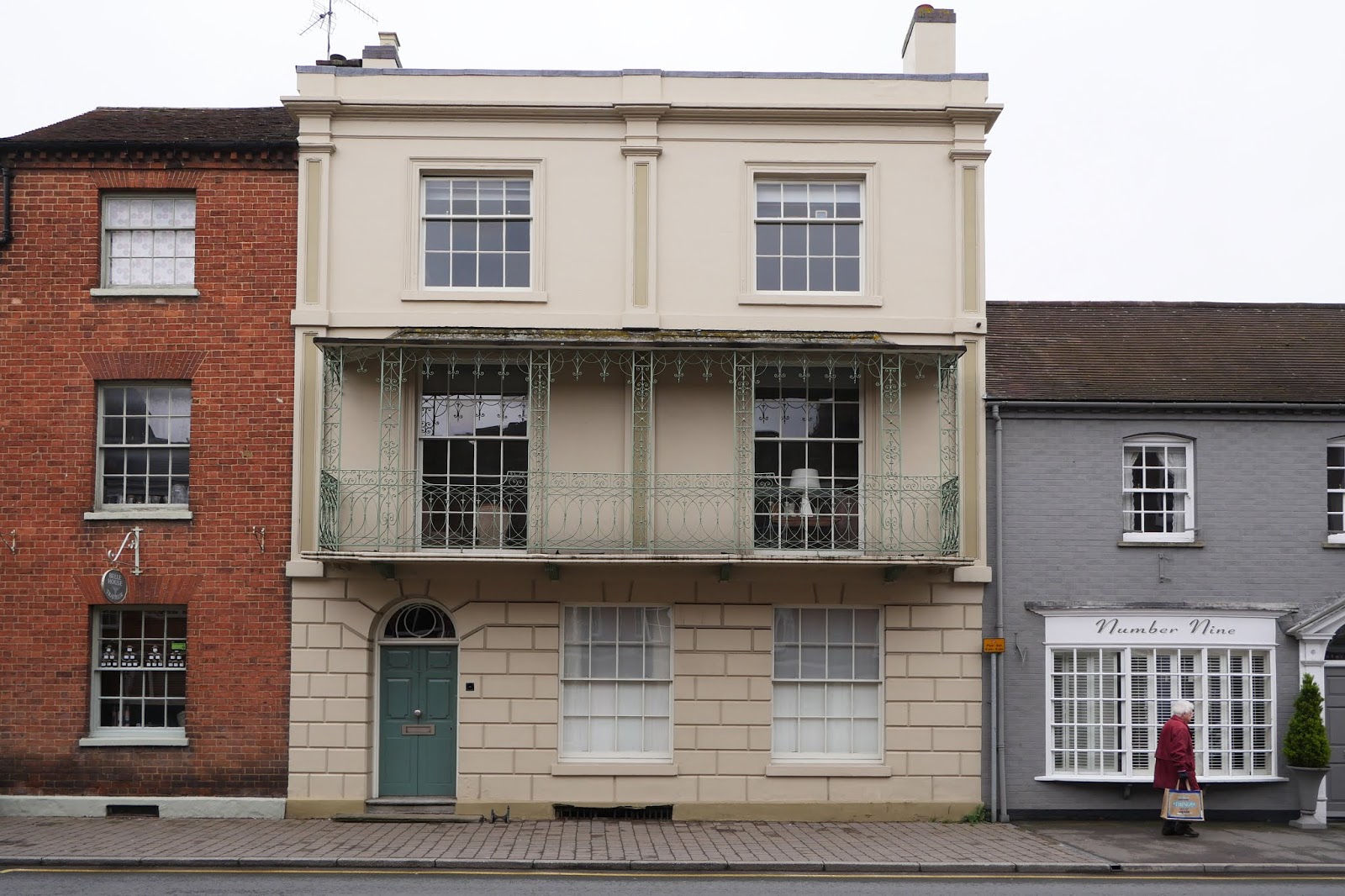
At the end we turned right into the High St which as has an unspoilt character and a large number of Georgian buildings. This house was one of several with lovely wrought iron balconies.


Further along, a grand three story mansion.


And a little beyond, this lovely house with an unusual facade and windows.


I could go on. High St really is a Georgian gem. This is the view looking back from Bridge Street which leads down to the river.


Conditions: grey and cool.

Distance: a couple of miles.

Rating: three and a half stars. A lovely concentration of Georgian buildings and an interesting Abbey. We enjoyed our walk, but in truth there was nothing really outstanding.

Sunday, 25 March 2018

Huntingdon

Huntingdon and Godmanchester bridge

We are on the way back home from a dinner in Cambridge and it seemed to be an excellent opportunity to detour slightly for a look around Peterborough. It is a town of Saxon origin and gained a Royal Charter in 1205.

We started at the 19th century Riverside mill and crossed the medieval  which dates from about 1332. There was apparently a rivalry between the two towns (Godmanchester was the more important in Roman times) and there are differences in the cutwaters between the Peterborough side and the Godmanchester side. Two of the six arches on the Peterborough side are beautifully decorated and one of them is shown above.

We passed the Old Bridge Hotel and turned left into Castle Moat Road. On the left was a mound which was once the site of Huntingdon Castle, built in 1068. A little further on, on the right, are the St John's Almshouses, built 1843-51 and upgraded in 2011. The central double gable is an unusual feature.


We retraced our steps and turned left into the long High St. soon reaching Castle Hill House, a fine Georgian mansion of 1787.


Opposite is St Mary's church, dating from Saxon times but mainly 13th century. The tower was rebuilt 1608-20 and is approached by a very pleasant flower-lined path.


There were some attractive Georgian town houses on the left hand side as we approached the town centre, but we especially enjoyed the Commemoration Hall (1842).


Soon afterwards we arrived at the spacious Market Hill, the centre of the town. On the left was the Town Hall of 1745.


On the right was a rather incongruous Sopwith Camel (presumably a replica). Some of these WW1 planes were apparently made nearby.

Continuing the war time theme, in the centre of the square is the ‘Thinking Soldier’ a rather fine war memorial sculpted by Kathleen Scott, the widow of Scott of the Antarctic.


Continuing round the square we come to All Saints Church, medieval but with many later alterations and additions. These include a font in which Oliver Cromwell was allegedly baptised - he was certainly born and brought up in Huntingdon.


Finally, there is the very interesting building which now houses the Cromwell Museum.


It was originally the infirmary hall of the Hospital of John the Baptist. This was later much reduced in size and then became a school. It was rebuilt in the later 19th century century, but remains a very characterful building.

We continued up the High St passing the imposing George Hotel, once a coaching inn.


On the right we admired this keystone on a bank window.


At the top was the splendid Whitwell House of 1727.


The only drawback with this exploration was there was nothing for it but to retrace our steps. Huntingdon was historically a linear town.

Conditions: bright but cold.

Distance: about 3 miles there and back.

Rating: four stars.

Thursday, 1 February 2018

Sherborne

Sherborne Abbey

It was a beautiful, sunny winter's day as we visited Sherborne on our way home from Poole. We had a nice walk route to follow from Dorset Life magazine, but we decided to go off piste first by walking away from the town to see if we could a view of the town's two castles (we knew they wouldn't be open). The new (Tudor) castle is almost entirely hidden by trees, but we did get a reasonable impression of the old castle (built in the early 12th century and ruined during the Civil War) from the road.


We tuned left and headed towards the town centre along Long Street. This proved to be interesting and picturesque and we enjoyed this fine Georgian mansion, The Red House.


Soon, on the left, was the former C19 Whittle & Co brewery, now tastefully converted into apartments.


Further along, almost at the town end of the street, was this rather wonderful pair of houses.


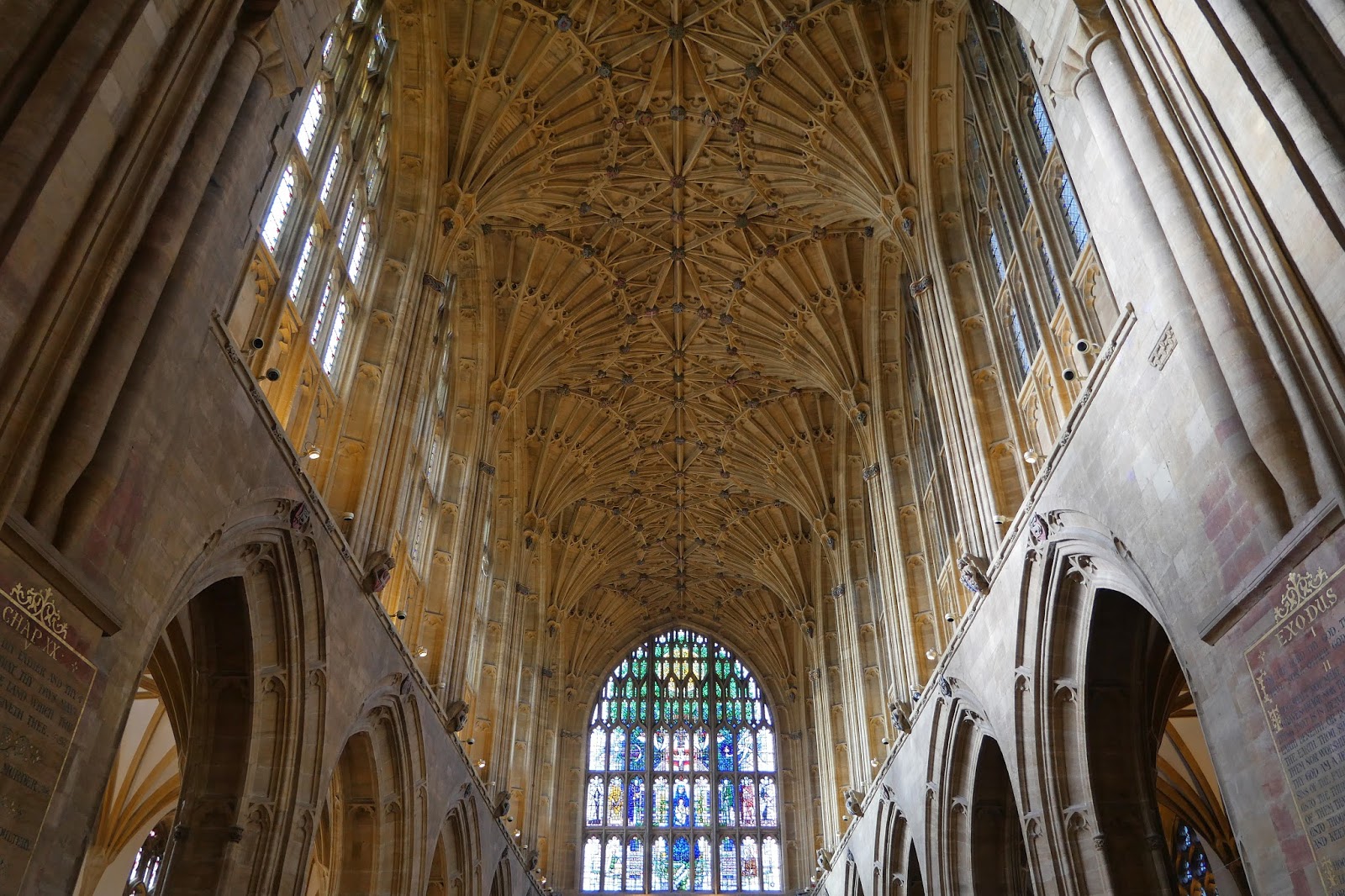
We crossed Cheap Street to visit the Abbey (photo at the head of this post). The original abbey church was built as a cathedral, until the bishop moved his seat to Old Sarum in 1075. The church was rebuilt after a fire related to riots in 1437 in the Perpendicular Gothic style. After the dissolution of the monasteries the monastic building, including the abbey were bought by the town for use as a parish church.

Inside the Abbey we were especially impressed by the beautiful fan vaulting in the nave and by the Great West window.


Just to the left of the Abbey are some of the buildings of Sherborne School, but there was no real photographic opportunity. Also nearby is the almshouse of St John the Baptist and St John the Evangelist, built in 1438-48. It is a handsome and picturesque grouping.


We then made a brief detour down Digby Road to see The Digby, once a grand hotel and now an independent school. The Digby family were the owners of the Sherborne Estate, which included the new Castle.


We retraced our steps as far as the Abbey, past the interesting Church House Gallery, a long-house built 1530-34, with a row of shops at street level and a hall above.  This brought us to Cheap (Market) St, where we headed north, admiring the rocket-like spires of the Methodist church of 1841.


Further along on the left was this fine half-timbered house, Abbeylands House.


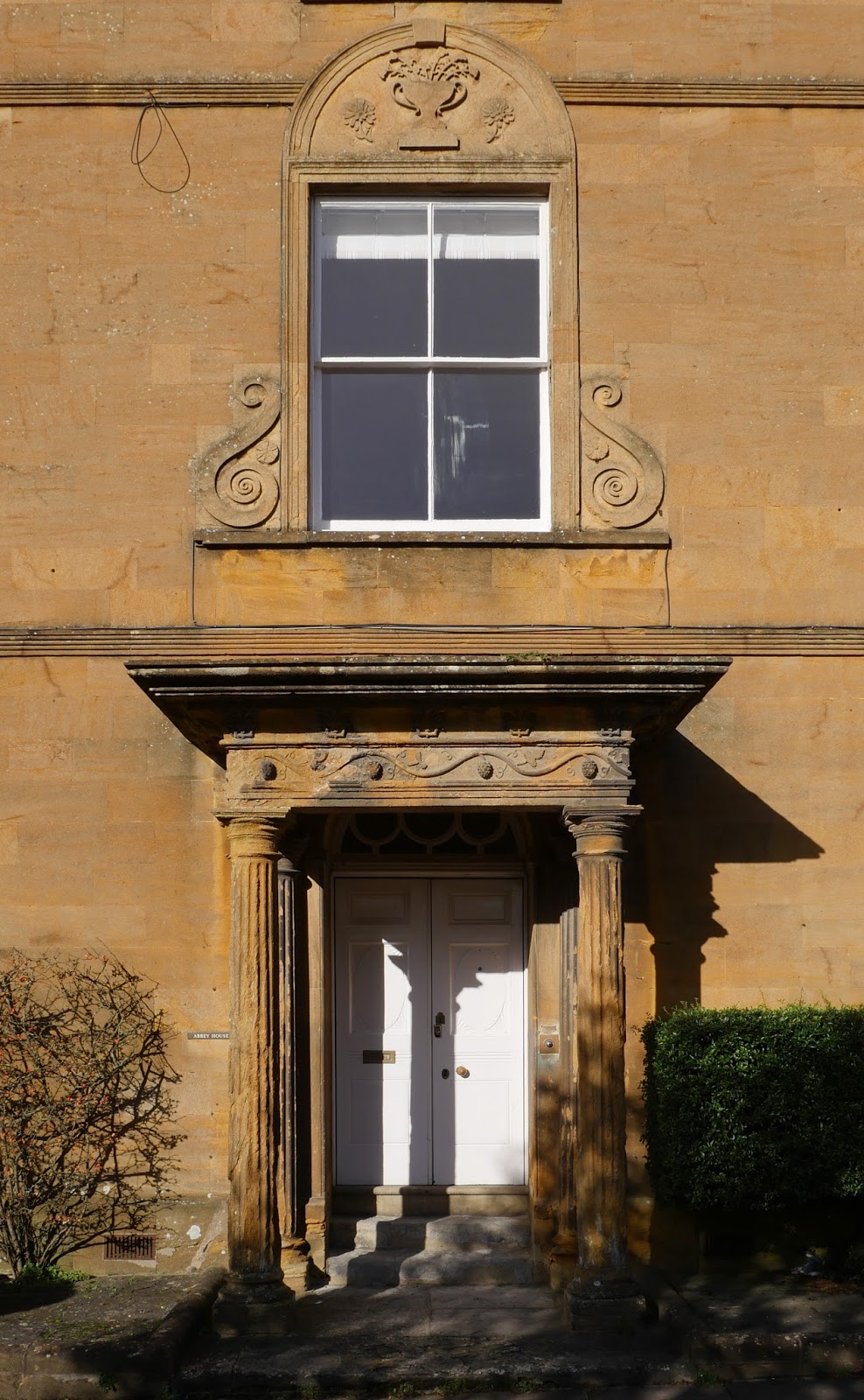
We then turned left into Hospital Road and admired the rather battered, but still beautiful, front of a Georgian mansion.


This took us past more School building and brought us to The Green, a sort of irregular square. On the opposite side was the New Inn, built in the 15th century to relieve the monastery of its duty to provide accommodation for travellers.


We headed down Higher Cheap Street, passing this picturesque grouping on the left ...


... and then followed Cheap St and South Street to return where we had parked near the station.

Conditions: a lovely sunny day.

Distance: three miles or so.

Rating: four stars. We will return, in season, to see the two castles.