Sunday, 10 January 2016

London: Clerkenwell

The Charterhouse

It was too wet and muddy to walk in the country, so we decided on another walk in London from the excellent London's Hidden Walks (vol 2) by Stephen Millar. We weren't entirely sure where Clerkenwell was, but it turns out to be the area between Barbican and Farringdon. Starting from Barbican tube station you walk through Charterhouse Square to reach the Charterhouse, once a medieval hospital, then an almshouse and school and finally, from 1872, only an almshouse.

I already knew about the Charterhouse, but a short distance away along Charterhouse St, was a wonderful surprise: the art nouveau Fox and Anchor pub dating from the 1890s. We would have gone in to investigate further had it been open ...


Now across the road and through the centre of Smithfield meat market to West Smithfield, a pleasant sort of square, with some nice eateries - although it was once apparently a place of public execution (William Wallace, to whom there is a monument bedecked with Saltires, was one such unfortunate.) Tucked away in the corner is the hidden gem of St Bartolomew the Great, the "finest Norman church ion London". A service was underway, so we couldn't go in, but there are some nice photos in the City West walk I did a couple of years ago.


St Bart's hospital is around the corner and, unusually, it has a church inside its boundary, St Bartholomew the Less. Its tower can be seen in the photo below behind Henry VIII's gate, the main entrance to the hospital.


Coming back through Smithfield, we were struck by the beauty of the iron arches over the road.


Now the route heads north and we lost our way momentarily, but this did lead us past this intriguing house in Peter's Lane.


Going along St John's St we came on another surprise, the medieval St John's gate, the surviving part of the Priory of the Knights of St John of Jerusalem (or Knights Hospitaller, founded in 1099). The second surprise was that was site has been owned since 1872 by the British Order of St John, founders of the St John Ambulance Brigade, which is still headquartered there.


Soon after this we were in Clerkenwell Green, with the 18th century St James's church off to one side.


At the end of Clerkenwell Green there is a housing development by the Peabody Trust and nearby the Horseshoe pub, a cosy example from the early 19th century.


Just round the corner is the former Hugh Myddleton school, now converted into apartments. Our route takes us past the front and round to the back where there were three entrances: Boys, Girls & Infants, and Special Girls. What were Special Girls? Was that good or bad?


Soon we pass through Exmouth Market and and turn left into Farringdon Rd, passing the Mount Pleasant Sorting Office and later the Coach and Horses pub in Herbal Hill which runs parallel. In the road outside the pub is a grille under which runs the River Fleet, hidden underground since the mid-19th century.

Off to the left there is a glimpse of this wonderful house, Abbots Court, in Farringdon Place. I can't find out anything about its history.


And back in Farringdon Road is this Victorian gem in the style of a Venatian palazzo. Again, I would love to know more.

Returning now to the route, we walked further along Herbal Hill and turned right into Clerkenwell Road to see the wonderful Italian church founded in 1853. This area was home to many Italian immigrants in the 1850s and clearly still remains an Italian enclave: it was noticeable how many people we heard in the streets nearby speaking Italian.


Finally, we walked through Hatton Garden, with many jewellery shops open even on a Sunday afternoon, to pass the hidden Ye Olde Mitre Tavern, dating from 1546, and reach Ely Place. Here stood Ely House, the grand London residence of the Bishops of that town. The church of St Etheldra, dating from 1290, is the only surviving part of Ely House.


From here, it was a short walk to Farringdon Tube station.

Conditions: cold but sunny.

Distance: about 3 miles.

Rating: Four stars.

Monday, 21 December 2015

Glasgow: House for an Art Lover

The house for an Art Lover

There is a wonderful story behind the House for an Art Lover in Bellahouston Park. In 1902 Charles Rennie Mackintosh and his wife Margaret Macdonald entered a design competition run by a German design magazine to design a house suitable for someone who was an art lover. 43 entries were received but no first prize was awarded. The Mackintoshes were disqualified on the grounds that they had not submitted the full required set of drawings, but they did win a special prize for "pronounced personal quality, novel and austere form and the uniform configuration of interior and exterior".

Then 80 years later a Consulting Engineer named Graham Roxburgh who was responsible for restoring Mackintosh interiors in nearby Craigie Hall, had the idea to finally build the House for an Art Lover. Work began in 1989 and the House opened to the public in 1996, after delays caused by the recession. Purists stress that it is an interpretation of Mackintosh's design as it includes a café which was of course not part of the original design and the top storey does not contain the rooms specified in the original design.To my mind, it is probably best seen after other Mackintosh work in Glasgow, when it becomes clear that it epitomises most of what is best of Mackintosh's art.

You enter through the gift shop in the bottom right corner of the facade and then go upstairs to an exhibition which sets the scene by describing the story of how the House was built. A free audio guide gives a detailed account of each room. A recurrent feature is the research that the numerous craftsmen and women had to do to turn the designs and images into a completed building.

The first room is the Oval Room with classic tall Mackintosh chairs and an absolutely exquisite glass lampshade. Fitted seats either side of the window create a space for people to chat.


Next door is the astonishing Music Room. You enter from a dark hallway into a a room filled with light from the tall windows and pale decorative. This a normal feature of Mackintosh's houses and is remarkably effective. The windows are separated by tall, tapering posts and the excellent free audio guide explains that these are symbolic trees - they have stylised green leaves at the top. Outside is a large terrace. 


The fireplace is a tremendous ensemble. I thought that the piano setting at the other end was less pleasing.


From the Music Room you emerge into the dark hall again to explore its decorative charms, notably the beautiful stained glass panels set into the party wall and the silver panels on the two main columns which hold up a gallery.


The Hall leads into the Dining Room, always dark in Mackintosh's houses. We read somewhere that this was to show off the brilliant white shirts of the male diners and and the brightly coloured tops of their female companions. This may have been the effect, but it is hard to believe that Mackintosh would have had such a trivial objective.


We admired the delicate hanging lights. The gesso panels just below the ceiling are delightful ...


... as is the rose wall surrounding the fireplace.


Off the hall, in a lobby leading to a private area, I spotted another superb piece of stained glass in door.


And climbing the stairs to the gallery brought this staggering light fitting into view, with delicate painted glass in the window behind it.


Around the back of the House is the Elephant for Glasgow sculpture by Kenny Hunter. It was cast in part from recycled, redundant or scrap parts of locomotives, sourced in India and South Africa, that were originally built in Glasgow. It is seen as a symbol of Glasgow's historic role as a "workshop of the world". I rather liked it.


Completing the anti-clockwise tour of the outside you reach what I now see is the main entrance, featuring the portico which once belonged to Ibrox Hill House, a mansion demolished in 1914 which stood on the site now occupied by House for an Art Lover.


Conditions: very wet and cloudy for the most part.

Distance: it is a mile so from Ibrox metro station, past the famous football stadium.

Rating: five stars. An absolute gem.

Sunday, 20 December 2015

Glasgow: Mackintosh church, Art Scool and Willow Tea Rooms

The Mackintosh church

We are in Glasgow for a mini break with the principal aim of seeing as much of Charles Rennie Mackintosh's work as possible. We decided to start at the Mackintosh church at Queen's Cross, taking the metro to Cowcaddens and walking about a mile up Maryhill Road. The church was built for the Free Church of Scotland and the design brief required a simple design. It was completed in 1899 and became redundant in 1976. Soon after it became the headquarters of the Charles Rennie Mackintosh Society.

The exterior is quite squat and lumpy and has the unusual feature of a corner tower which becomes narrower as it goes up. It was apparently based on a Medieval church in Somerset  and on Norman Shaw's Holy Trinity, Latimer Road. The irregularly placed windows are typical of Mackintosh.

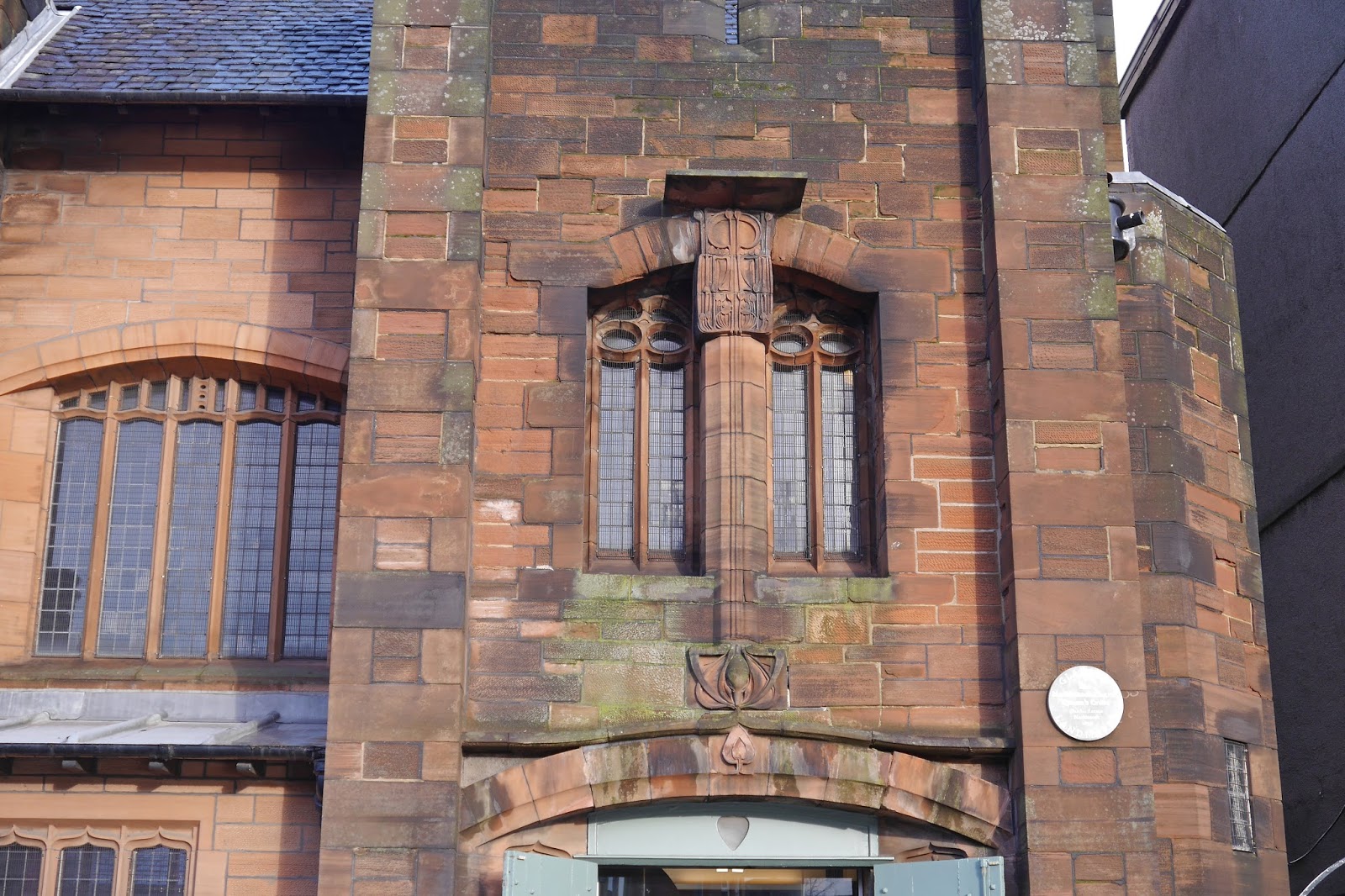
Although looking rather austere from the outside, there are still some delightful flower motifs of the kind that Mackintosh incorporated in all his designs. This is a close up of the area above the main entrance (on the right of the exterior).


The interior seems fairly plain at first and is dominated by the wonderful "blue heart" window at the east end and by the barrel vault with its steel cross-beams.


Here is a close up of the window showing the unusual tracery and the variegated shades of blue as well as the stylised flowers beloved of Makintosh.


At the west end there is another stained glass window with more minimal stained glass.


There are also two galleries and scattered throughout the church, on the pulpit, on the capitals of the columns holding up the galleries, on doors and woodwork there are delightful floral details. They are quite unobtrusive and one wonders if Macintosh almost smuggled them in when the church.

We headed back down the hill and headed towards Renfrew St. Here is Mackintosh's most famous building, the Glasgow School of Art. It was built in two phases between 1896-99 and 1907-09. A serious fire in 2014 caused serious damage including the destruction of Mackintosh's famous library.

Approaching the building uphill from the east, it can be seen that about half it is swathed in scaffolding. The large windows light a series of studios and looking at the east end it is striking how one half is completely blank, while the other has a variety of windows, mouldings and a turreted staircase. This was a clear example of exterior design rigorously following internal function, and was quite controversial at the time.


This is a view of the front of the building with its famous entrance.


I have seen many pictures of the School of Art entrance, but what I hadn't previously spotted was the amount of ornamental ironwork, including fence posts and even a street lamp. The fence posts seem to be sprouting a clump of tulips.


From the School of Art it is only a short hop to Sauchiehall Street and the Willow Tea Rooms. This was converted from a warehouse in 1903 to designs by Mackintosh and his wife Margaret Macdonald. The client, Catherine (Kate) Cranston had four such enterprises in the city which provided places for people, especially women, to meet without the temptation of the demon drink. Mackintosh was involved in the design of all of these, but only the Willow Tea Room remains. Over time it was incorporated into a department store and became its tea room. It was refurbished in the 1980s.


The ground floor is now the gift shop, but the first floor houses one of two tea rooms. It is pale coloured with ladder-back chairs and geometrical and flower motifs.


The real glory of the Willow Tea Rooms however is the Room Deluxe on the second floor. This smallish square room is surrounded on three sides by an extraordinary frieze of purple glass in a elaborate leadwork design.


The chairs are more elaborate than downstairs and the window has exquisite stylised tulips, which are gold on the inside and silver outside (see the exterior photo above).


On the top floor is the former Billiard Room. This houses a small exhibition and has an original fireplace. But the best bit is the high window with this series of brilliant blue glass panels.


Conditions: rainy and cloudy.

Distance: no more than 3 miles.

Rating: five stars.

Monday, 14 December 2015

London: Mayfair

Eros

I picked this walk around Mayfair from the excellent London's Hidden Walks (vol 1) by Stephen Millar; it starts from Piccadilly Circus. Naturally, my first picture was of Eros, but how many people know that it commemorates the 7th Earl of Shaftesbury, the great Victorian philanthropist. Eros was the son of Aphrodite and god of love in Greek mythology, so what is the link? The sculptor intended the statue to represent Anteros (Eros's twin brother, god of unrequited love - it's no clearer why this was thought appropriate), but others have claimed it represents the Angel of Christian Charity. Nowadays, no-one seems too worried by any of this.

Just along Piccadilly there is St James's church by Wren, strangely not mentioned in the walk description. A mouthwatering food market was in full swing.


Further along on the left is The Albany, an 18th century house which was converted in 1802 into bachelor apartments. Edward Heath lived there.


Set back from the road in a similar way is Burlington House, home of the Royal Academy of Arts. In the courtyard is the well-named Tree by Ai Weiwei (part of his exhibition which has just closed). Ai’s trees are made from parts of dead trees from the mountains of southern China. They are curiously affecting.


On the other side of the road is Fortnum & Mason whose famous clock dates only from 1964. When the clock strikes the hour the figures of Mr Fortnum and Mr Mason emerge from the two boxes.


Now for Burlington Arcade, also not mentioned in the walk description, opened in 1819.


A right turn brings you into Albemarle St where 45-6 is an influential modernist building of 1957 by the Hungarian architect, Ernö Goldfinger. I can't say I like it. Perhaps this is why Goldfinger's name was borrowed by Ian Fleming for one of his Bond villains.


Also in Albemarle St is the Royal Arcade of 1879. It and the Burlington Arcade are certainly as impressive as the Paris arcades we saw on a walk there in 2010.


The route now meanders through Dover St, Hay Hill and Curzon St, passing through the charming Shepherd Market to return to Curzon St and head left up Chesterfield Gardens. Many places highlighted in the description are where famous people lived or died. I can't usually summon much enthusiasm for this, but I was struck by 4 Chesterfield St which had accommodated both Beau Brummel and Sir Anthony Eden.


The route continues to the lifeless Berkeley Square and then into Mount Street, which is home to a number of impressive red brick and terracotta buildings.


The pretty Mount Street Gardens leads to the Church of the Immaculate Conception, a catholic church of 1849 with an elaborate altar by AWN Pugin.


You emerge from the gardens into South Audley Street and the Grosvenor Chapel build in 1730 for the Grosvenor Estate, which continues to own much of the land in this area


South Audley Street leads into Grosvenor Square, the second largest in London after Trafalgar Square. It is dominated by the American embassy on the west side. There is a nice statue of Franklin D Roosevelt on the north side


You leave the square from the north east corner and walk up Duke St to find the delightful Brown Hart Gardens. They were laid out in 1903 above an electricity sub-station, but closed from the mid 1980s to 2007. The decking reminded me of the High Line linear park in New York.


Opposite is the Ukranian Catholic Cathedral of the Holy Family in Exile. It was designed by Alfred Waterhouse and was previously a Congregational church.


The walk continues back to Piccadilly Circus, but I left it here.

Conditions: pretty grey.

Distance: About 2.5 miles.

Rating: three stars. Interesting enough, but no real stand-out sights. I did not find myself in sympathy with Mayfair's aura of wealth and privililege.