Wednesday, 20 May 2015

New York art deco part two

The Chrysler Building from the corner of 42nd St and Madison Avenue

We had a great time with part one of this walk two days ago, and after a day in the art galleries we return to it today. We walked up Madison Avenue from our hotel to 42nd St and just before we got there (at 40th St) discovered this fine building at number 275. It has a marble facade at street level with engraved decoration. The invaluable NYC architecture images site reveals that it dates from 1931 and was the work of Kenneth Franzheim. The lobby is said to have rose coloured marble and I wish now that we had followed our usual practice and had a look inside.


We turned right onto 42nd St and soon found our first planned target: the Chanin Building at number 122, a massive brown brick structure with a band of beautiful floral motifs. Beneath that there are green metal decorative features. The building dates from 1927-9 and the architects were Sloan and Robertson (who also did the Fred F French building we saw yesterday). René Chambellan and Jacques L. Delamarre are credited with the lobby and the ornamentation.


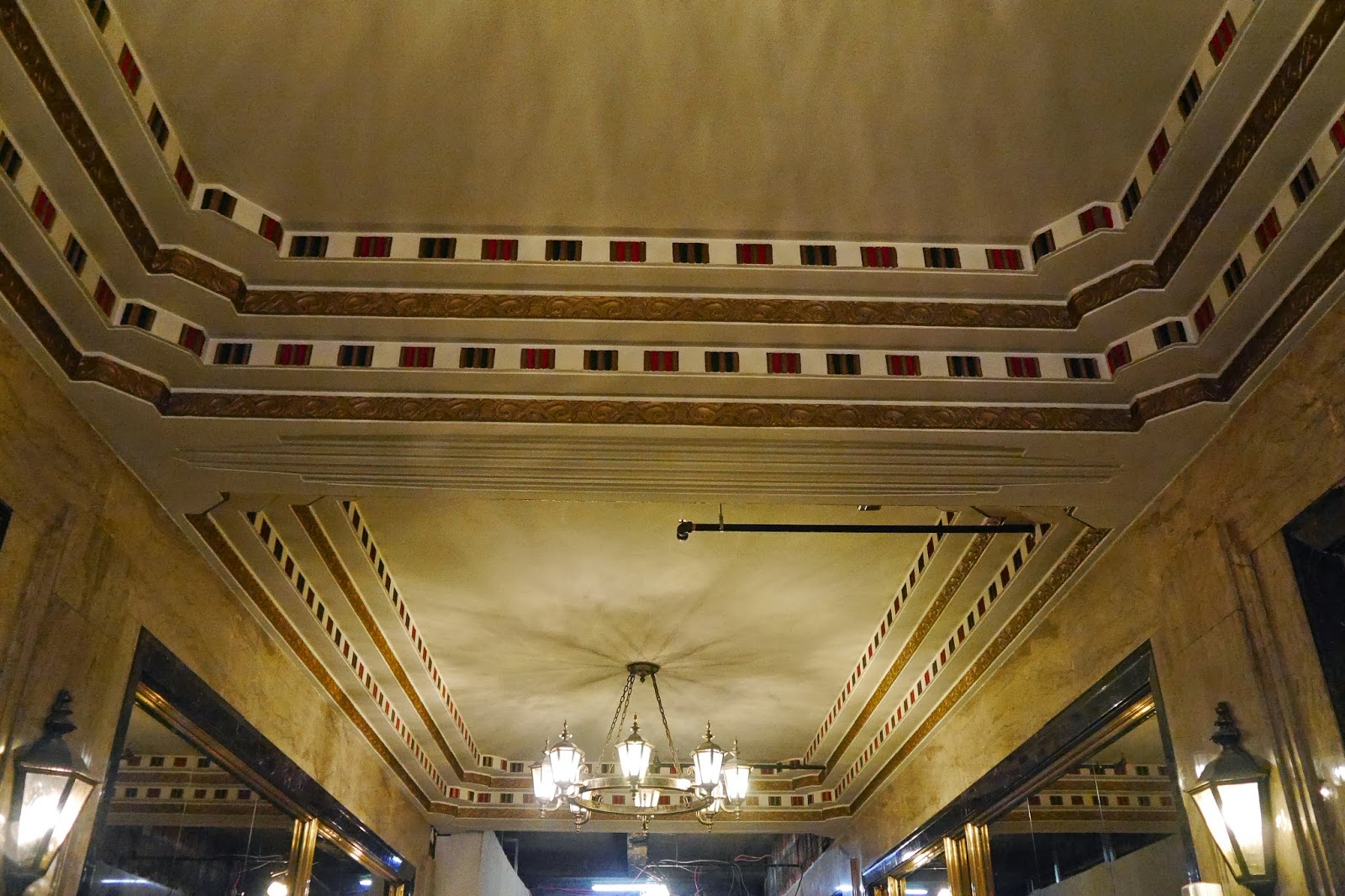
The ground floor was under scaffolding, so we couldn't see what the entrance was really like, but we went into the impressive lobby. I was about to start taking some photos when a stern voice shouted "No photos!" I took a guerrilla one on the way out.
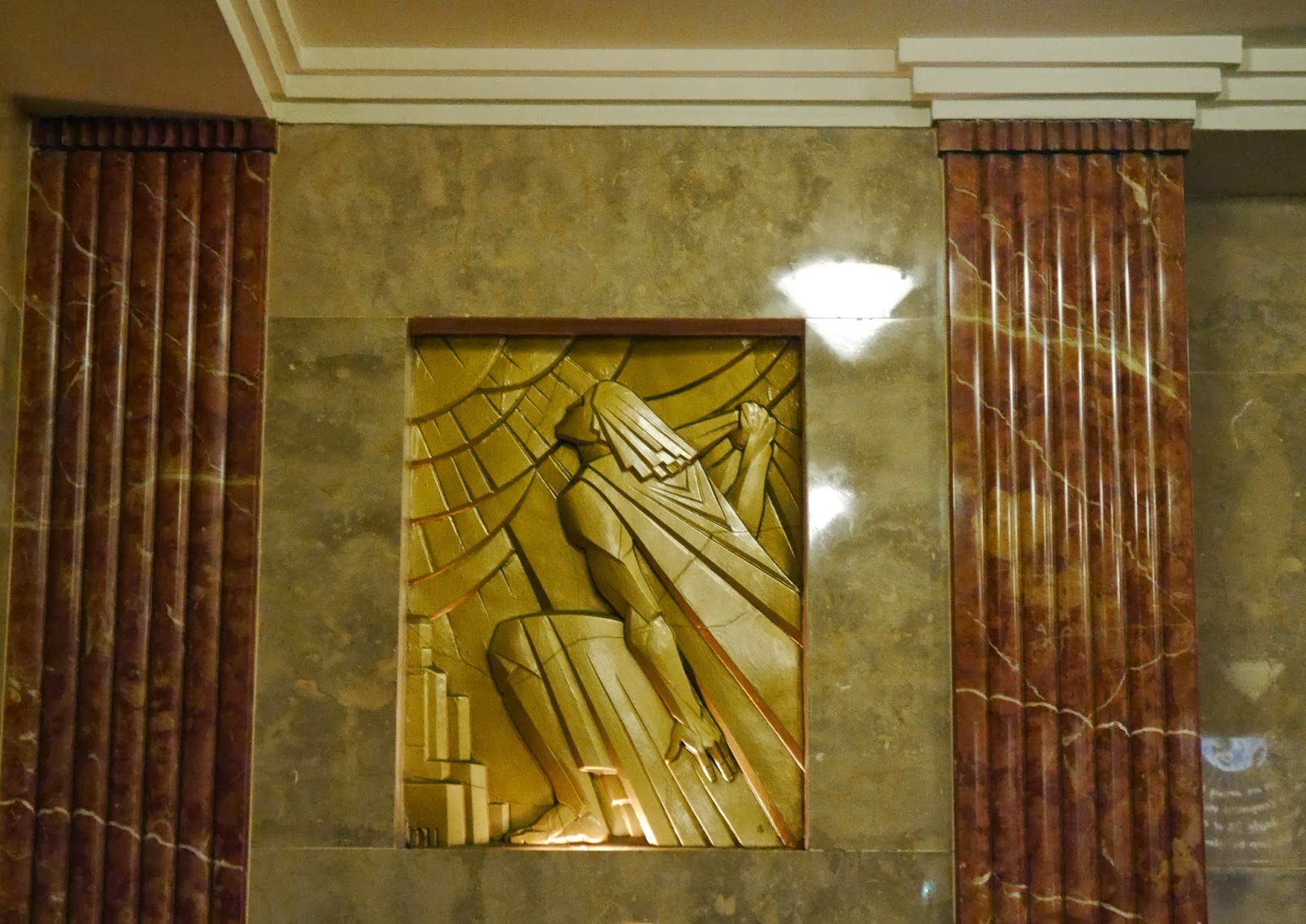

We continued along 42nd past the Chrysler Building, of which more in a moment, to reach the Daily News Building (1929-1930 by Robert Hood, André Fouilhoux and John Mead Howells) near the junction with 3rd Avenue. It has a strong verticality with white bricks being used for the main cladding and brown bricks arranged in a pattern below the windows. NYC architecture images adds the amusing information that the size of the windows -- and thus the width of the window stripes -- was determined by the size of a window that could be effortlessly opened by a single office worker. It was among the first skyscrapers to be built without an ornamental crown. There is fine imagery over the entrance.


The lobby has been modernised, but does retain one marvellous feature: the world's largest indoor globe. Wikipedia says that it has not been kept up to date, but a cursory check revealed plenty of modern country names on the map. Wikipedia also says that this building was the model for the Daily Planet where Clark Kent (Superman) worked.


Retracing our steps brought us face to face with the Chrysler Building. This obviously is the view looking straight up. The projections are gargoyles of American eagles. The building dates from 1928-30 and was designed by William van Alen. For 11 months it was the world's tallest building before being displaced by the Empire State Building.


The lobby is simply staggering - and you can take photos! The walls are of Moroccan red marble ....


... and the ceilings are covered in paintings (by Edward Trumbull) celebrating modern technology and labour. The colour tones are reminiscent of Paul Gauguin.


Perhaps even more extravagant are the lift doors.


After enjoying an excellent lunch in the wonderful Oyster Bar at nearby Grand Central station and admiring the amazing station concourse ...


... we emerged into Lexington Avenue to see the Graybar Building at number 420 (1927 by Sloan and Robertson).


This facade is quite interesting, but apparently on one of the other sides there is more off a nautical theme and sculpted rates. For more on this see here.

In the sleek lobby I managed to photograph the lovely floor tiles ...


... and this beguiling arrangement of lampshades, before being invited not to take pictures.


We continued up Lexington towards the General Electric Building at number 570 (originally the RCA Victor Building) - 1929-31 by Cross and Cross. The crown has an extraordinary combination of gothic spires and lightning bolts.


At street level however the richness of the decoration catches the eye. There is apparently yet another fine lobby, but we were under such sales pressure from the staff of a nearby cosmetic shop that we found ourselves hurrying to get away.


Part of the architects' brief was to ensure that the building complemented St Bartholomew's church at the rear. The church is pretty much dwarfed into insignificance but the colour tones of the skyscraper (on the left) are indeed quite harmonious.


Our final stop was the Fuller Building (1928-9 by Walker and Gillette) at 41-45 East 57th St. The beautifully decorated lower storeys have an almost classical look. The crown has splendid black and white zig zag patterns, but we were too close to be able to see them.


The lobby had gilded lift doors and mirrored walls which produced an extraordinary effect with all the lights.

Conditions: again grey and cool.

Distance: maybe three miles.

Rating: five stars. A real feast of beauty.

Monday, 18 May 2015

New York art deco part one


What better way to start a short break in New York than with a walk to see some its most famous art deco buildings? We are staying in midtown, on Madison Avenue, and just a few blocks away, on 5th Avenue, is the most famous of them all, the Empire State Building (architect William F Lamb). Above is our first sight of it, from the junction of West 33rd St and Madison Avenue. 

It was opened in 1931 and immediately took over from the Chrysler Building as the tallest in the world - it was built by a General Motors executive, John Rascob, with that aim in mind. It was not to lose that title for over 40 years. The exterior is remarkably free of decoration and so the building still looks quite modern. The entrance and lower storeys do have some discreet decoration however.


We didn't go up to the viewing platform on the 86th floor, having done that on our short visit in 2010, but we did have a quick look at the opulent and self-referential foyer.


Now up 5th Avenue and along West 40th St with the impressive New York Public Library on the corner to see the former American Radiator building (now the Bryant Park Hotel) facing the delightful Bryant Park. This grey brick skyscraper (Raymond Hood, 1924) has exuberant gold decoration on the lower storeys and at the very top. Here is the main entrance.


 And here are the upper storeys viewed from the opposite corner of the park. 


In that opposite corner is the rather wonderful Bank of America Tower. It was designed by COOKFOX Architects and has been advertised to be one of the most efficient and ecologically friendly buildings in the world. It is the fourth highest in New York.


The park covers two blocks so we headed along 42nd St to the junction with Broadway in search of our next target, the Brill Building, at 1619 Broadway. It was built in 1931 as the Alan E. Lefcourt Building and was designed by Victor Bark Jr. We battled our way through the crowds and assorted cartoon characters and superheroes to find this smallish white building, currently undergoing some building work. The facade is enlivened by beautiful panels.


We wandered into the foyer and were thrilled by the original 1930s decorative scheme.


Rather than retrace our steps, we walked along West 48th St and literally stumbled on the massive Rockefeller Center, which had been on the plan for a second art deco walk. Construction of the 14 buildings that make up the Center began on May 17, 1930, and the buildings were completed and opened in 1939. The principal architect was Raymond Hood.

We were especially taken by three of the entrances. 


The tableau of rather androgynous figures is just wonderful.

We reached 5th Avenue and headed south, soon stumbling on another building targeted for another day, the gold-facaded Fred F French Building (1927, designed by H Douglas Ives for Sloan & Robertson) at 551 5th Avenue (at 45th Street). This was quite impressive from the outside, with winged griffins the dominant motif ...


 ...  but inside the foyer there was an absolute riot of decoration, which put the lovely Brill Building in the shade.


As we walked away, we looked up to see if there was anything going on at the top level and were thrilled to find the middle stepped section embellished by a beautiful design in red, green and gold.


Conditions: grey, cool.

Distance: about 3 miles.

Rating: five stars.

Part two is planned for the day after tomorrow.

Postscript

Here, for symmetry's sake, is the Empire State building at night.


Friday, 15 May 2015

Ashbury Folly to Round Hill Downs (The Ridgeway 11)

The Ridgeway path

Our recent efforts on The Ridgeway with Merv and Pud have been plagued by rather grey weather and today's stretch was no exception. The wide, straightish path was at least easy walking and pleasantly bordered by dense Cow Parsley.

Russley Downs away to the south east offered a point of view across the high (180m or so) plain


As we passed south of Bishopstone we saw some walkers emerging out of a wonderful curving valley, with what Merv identified as interlocking spurs. It transpired they were testing a walk they planned to do with their walking group the following week.


From here there was a long steady climb to Fox Hill. This was followed by about a mile along a road, which allowed a safe crossing above the M4. We were surprised by how little traffic noise there was and how close to the motorway we were before we really heard it.

On the other side, after a bit more road, we climbed Liddington Hill, but resisted the diversion to see the Iron AGe hill fort at the summit (277m). Instead we headed due south on the high ridge, especially enjoying the view back to north west. We thought we could just make out Lord Wantage's monument which we passed two legs ago in March.


A little further on there was more pleasing countryside.


And just beyond that, more unfolding valleys with some horses or ponies in the foreground.


This beautiful open country gave way to a more typical enclosed path which crossed the road from Ogbourne St George to Aldbourne. The final section was a lane leading to a farm. It was remarkable for the beautiful displays of Bluebells and Stitchwort among the trees to either side.


Conditions: Grey at first, brightening and warming up later, but never really clearing. Not a single butterfly.

Distance: 7.4 miles. Distance now covered 73.8 out of 86.8 miles.

Map: Explorer 170 (Abingdon, Wantage and Vale of White Horse) and 157 (Marlborough & Savernake Forest.

Rating: four stars. Wonderful views of wide-open country.

Thursday, 14 May 2015

Lydlinch Common

Lydlinch Common

We were in Poole, a reasonably sunny day was in prospect and I decided to go off in search of the Marsh Fritillary, a butterfly I have not yet seen. According to David Newland's excellent book, Discover butterflies in Britain, Lydlinch is a reliable site in Dorset. It comprises a rectangle of common land bordered buy the A357 and A3030 roads to the west of the village of Lydlinch.

I parked on the A357 just before the junction and explored the common walking parallel to the A3030. It had become cloudy and nothing much was happening. Reaching the entrance gate on the A3030 which Newland describes as the start point for your butterfly search I was confronted with teh view of the common shown above. Marshy tussocks, scattered trees and occasionally more heavily wooded areas.

By now the sun was out and there were lots of Brimstones on the air. On the ground the dominant flower was Bugle, widely scattered through the tussocks.


On the edge of the wooded areas there were several orchids. This I think is Early Purple Orchid.


Of these two, the one on the right may be Marsh Spotted Orchid, but I don't know the one on the left. Every year when I see orchids I resolve to learn more, but so far without doing so.


There were unfortunately no Marsh Fritillaries, although I did see quite a few Orange Tip, and some Large and Small Whites. Also a few Comma, of which this rather battered and bird-nipped specimen consented to be photographed.


I followed the south east edge of the common back to my car and enjoyed this view towards Lylinch church (Perpendicular, i.e. 14th to mid 16th century, according to Pevsner) with the hills beyond.


I guess the obvious conclusion is that I was probably a little too early: Marsh Fritillaries are usually on the wing in mid May. But the real message is that I should probably check Dorset Butterfly Conservation's website for sightings before setting out. That said, this will be my only chance to visit this site for some while and at least I had a pleasant stroll and have got the lie of the land.

Conditions: alternate sun and cloud, quite windy.

Distance: about a mile and half.

Map: Explorer 129 (Yeovil and Sherborne)

Rating: three stars.

Tuesday, 5 May 2015

Marley Common to Clayton Court (Serpent Trail 3)

Ridge Plantation

We have decided to try to speed up our Serpent Way project with Viv and Giles and have planned a bit over 8 miles today with a picnic in the middle.

We left the car park on Marley Common and rejoined the trail, having carefully noted how to do so at the end of the last leg. I have to admit that before very long we missed a turning on the left and realising we had lost our route backtracked until we found it.

The Serpent Way waymark is a rather pleasing white isosceles triangle with a maroon serpent motif. The triangle is placed on a post with the apex pointing in the desired direction. Mostly this works splendidly, but it does take a bit of study to identify which of the three sides is the apex - perhaps it could be marked with a maroon tip? But also the markers are quiet small and if you are deep in an interesting conversation it seems to be terribly easy to miss one.

We eventually negotiated our way off Marley Common and into the Ridge Plantation. Forest tracks  led us into Linchmere Common and then to Stanley Common where we found some wonderful felled trees which made an excellent picnic spot.


We must have wandered off piste after this because we reached a road where there was no sign to help us. However, skilful map reading enabled us to work out that we had to turn right and soon we were back on track - a long straight one through more woodland and then a golf course.

This brought us to the Liphook to Petersfield Road (B2070) and a pub. Giles and I especially were dismayed to find it was closed. After this we followed a track into more woods and - again! - missed a turn. Again, some good map reading enabled us to work out where we had gone wrong and find a corrective course which would reconnect with the official path at the edge of Chapel Common.

A wide track brought us down to the B2070 again and we followed it into Rake where we did find an open pub and a refreshing drink. From Rake a path led down through Rake Hanger. On the left there were some artificial fish ponds.


The hanger was a really delightful piece of woodland.


At the edge of the wood, the path meets a small road and turns back on itself, in keeping with its name. We continued on a short distance to the car park on the edge of Durford Wood where we had parked the car. Just beside it was Clayton Court, which a glimpse through the fence convinced me might be a fine country house. Perhaps it was once, but it is now apparently a care home.


Conditions: greyish but mild.

Distance: 8.4 miles. Distance now covered 15.7 miles.

Map: Explorer 133 (Haslemere and Petersfield).

Rating: three stars. We had a really enjoyable walk, but in truth it was more about the company than the inherent features of the walk itself. The main issue for me is that there are no views: alternating common and woodland is pleasant enough, but it does tend to merge into a sort of green nothingness. Not a single butterfly either, although that of course is more about the weather.