Showing posts with label walled towns. Show all posts

Thursday, 13 February 2020

Portugal: Évora - walls

The Porta d'Avis: the only remaining gate

We have just arrived in Évora after a cross-country journey from Condeixa Nova and having checked into our hotel wandered into the main square to get some lunch. Over lunch the idea of walking round the city walls took root and so we headed south along rua de Republica to reach the edge of the old city at what is now a park straddling the walls.

As will become clear, the walls date from different periods. The oldest sections are medieval. The total distance around the perimeter is about 5km. The first section had dramatic corner bastions with small lookout positions on the corners.


We first saw these in Dijon, a good few years ago,  although the Dijon ones were more ornamented.

Before too long we passed the Porto do Raimondo (alas just a gap in the walls rather than an actual gate) and now saw serious-looking battlemented walls in a sort of zig-zag pattern. I have included a man for scale.


After this, there battlements with projecting towers, some with little passageways.


Soon after this we passed the Porta Nuova (also just a hole) and approached the wonderful Prata Acqueduct which extended 9 km to the north to bring fresh water from a small river to Évora. The tallest arches are 23m high. It designed by Francisco de Arruda, who was also responsible for Lisbon's wonderful Belem Tower.

The only disappointment is that it dates only from the 16th century, rather than being Roman as we had fondly imagined. It was restored and altered somewhat in the 17th century during the Spanish and Portuguese War of Restoration (1640 –1668), a period of skirmishes between the two countries.


A little further away from the walls (but beside the acqueduct) was all that remains of the Forta de Santa Antonio, which so far as I can establish, was also built during the Portuguese War of Restoration.


Continuing along the outside of the city the walls things now changed: first the first time there were accretions on the outside. We thought they were pretty scruffy and should be removed forthwith.


We reached Porta d'Avis, almost 12 o'clock in relation to our starting point at 6 o'clock. The plaque over the gate reveals that it is the New Porta d'Avis and was opened in 1804.

The next, particularly imposing section, was right next to a dual carriageway.


After this the sequence of walls was broken by the buildings of the University (see my post Portugal: Évora - City centre)

We rejoined the circuit of walls at about 3 o'clock. From here back to our starting point was the least interesting part of the walk as there had been lots of accretions and a large part was now the site of the city's hospital.

Finally we reached our starting point and admired some more corner turrets ...


... and this imposing pink building with a lovely orange grove in its grounds.


Conditions: cool and rather grey.

Distance: 5 km.

Rating: Four stars. Interesting and satisfying, but not a match for some other examples we have seen e.g. Citadella (Italy), Montagnana (Italy), Kotor (Montenegro), Tallinn (Estonia).

Tuesday, 11 February 2020

Portugal: Obidos

The castle and parts of the town walls

We arrived in Obidos last night to start 6 days of sight-seeing in Portugal. Obidos is a attractive small town famous for its walls and castle (now a Pousada or hotel). We started outside the town gate and our attention was quickly caught by the sight of an aqueduct whose columns stretched away into the distance. It was constructed in the 16th century to provide a constant supply of water Obidos. The project was funded by Queen Catherine, who sold her lands that surrounded Obidos to pay for the construction. The aqueduct extends for 3km to the southeast of Obidos, and there is a further 3km of tunnels to the source of the water.


The gate looks recently renovated, although it dates originally from 1380, but it does have a nice craft shop next door - see the woman in the window on the right.


As you enter the gate you are immediately confronted by the wonderful 17th century Oratory of Our Lady of Piety with its  beautiful 18th century tiles. I was moved to check the meaning of an oratory - it is a small or private chapel.


We headed along the winding main street, the Rua Direita, lined with the inevitable gift shops, which somehow seemed less commercialised than usual, to reach St Maria's square. This was dominated by the church of the same name. It was badly damaged by an earthquake in 1535 and rebuilt.


Inside it was a riot of colour, every surface being covering with ceramic tiles, azulejos.


 On the opposite side of the square was the surprisingly ornate pillory of 1513. The pillory was a gift to Obidos, from Queen Leonor, after the queen spent time in Obidos grieving the mysterious death of her only son in 1491. On the pillory is her emblem: fishing nets. It was apparently used to hang criminals.


And on the side of a building to the left of the church was this rather splendid figure.


We continued along the Rua Dereita towards the church of St Pedro - also rebuilt after an earthquake, this time in 1755.


Beyond it lay the castle, with imposing walls and towers ..


...surrounding a large keep which now has the hotel's restaurant on the top floor. A night-time shot felt more atmospheric. The window you can see has been rather crudely inserted into the wall, but as we later found out, offers a great view as you eat your breakfast.


Here are a couple of views from the rear of the keep taken the following morning.


Conditions: pretty grey for the most part.

Distance: a couple of miles.

Rating: four stars. A delightful town.

Sunday, 22 September 2019

Padua: Cittadella

Our first view of Cittadella

We are on our way to Verona airport for the flight home, but we have spotted the opportunity to stop off on the way at the wonderful walled town of Cittadella, about 30 km north of Padua and midway between Castelfranco del Veneto and Vicenza.

We drive north and soon reach the centre of Cittadella, appropriately at the Porta Padova (Padua Gate). We were enormously impressed by the wonderful walls of Montagnana, but in many ways the walls of Cittadella are more impressive - they are certainly higher.


Cittadella was founded in 1220 as a fortified castle, designed to act as outpost of Padua in the Veneto, with the intention of protecting its borders from assault by Treviso and Vicenza. Nowadays. Cittadella is a town of 20,000 inhabitants - most outside the walls.

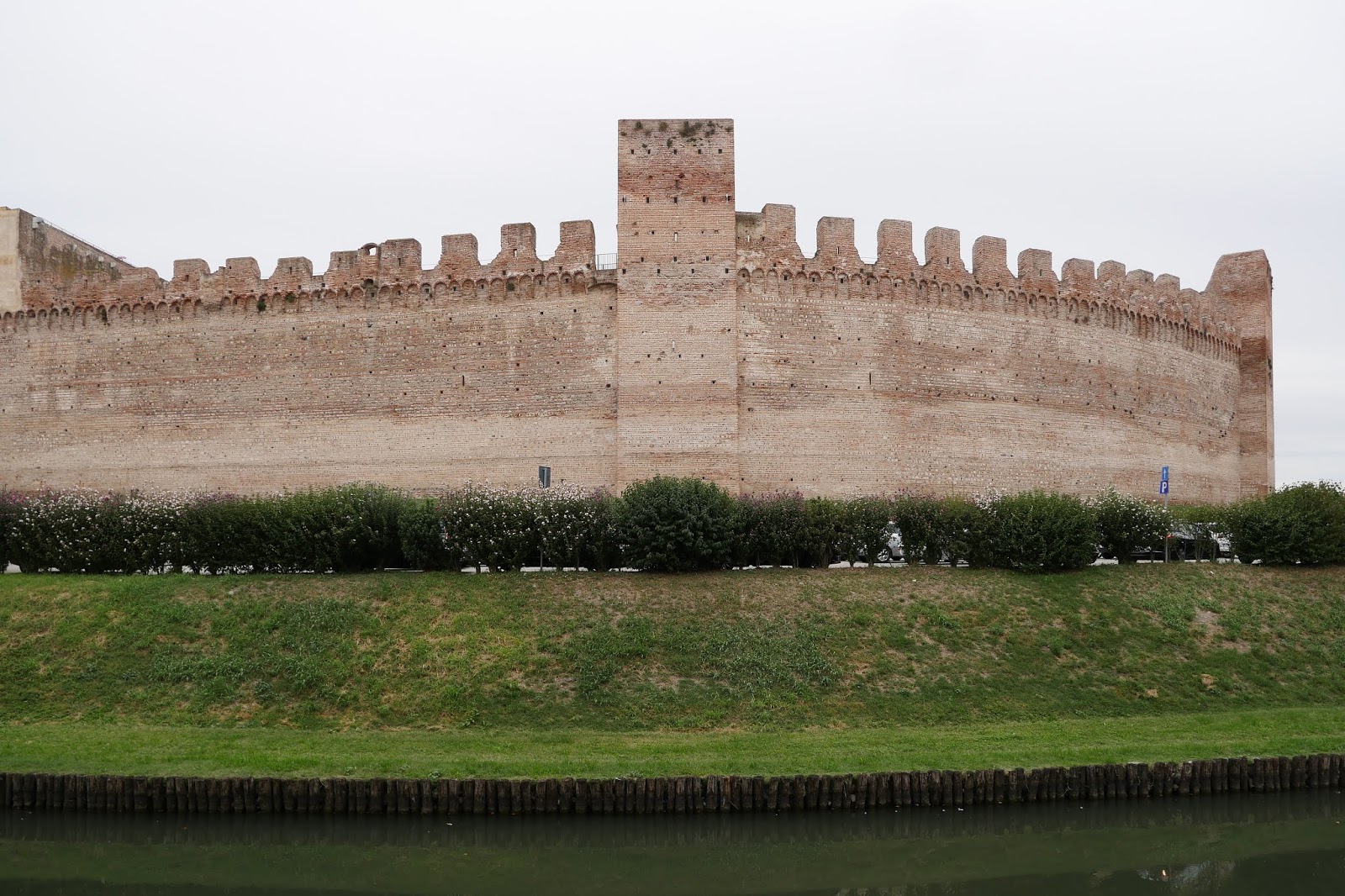
We decided to start by walking round the outside of the walls, to get a proper sense of them, They are basically oval, 1461m in circumference with four gates more or less on the cardinal points. This first section, anti-clockwise from the Porta Padova features a rather incongruous modern section.


We soon arrive at the Porta Treviso, with a substantial barbican.


The next section of walls is equally imposing and my photo features the moat which is fed by spring water and encircles the walls. It was once twice as deep and twice as wide as it is now and as well as being part of the defences it was a useful source of fish.


At the third gate, Porta Bassano we spotted some people on the top of the walls and quickly discovered that this is the main point of entry


We climbed up to the Tourist Office and bought our tickets for the Parapet Walkway, which was only opened in 2013 after 20 years of extensive renovation work. It is just wonderful! This is our first view of the area inside the walls. The main feature is the Duomo, built between 1774 and 1826. You can also see one of the two main roads which connect opposite pairs of gates.


Looking out from the parapets we had a good view of this beautifully frescoed house, which we had noticed as we were on Porta Bassano.


The main focus however is the imposing line of walls seen from the inside.


It was also impressive to see how the walkway passes through a whole series of towers.


This was the final quadrant, between the Vicenza and Padova gates. We were interested to notice the hills in the background.


We carried on around the full circuit (you can bail out at Porta Padova) and returned to ground level after a truly wonderful walk around the walls. We walked towards Porta Padova and at the central crossroads admired the inside view of Porta Treviso. There wasn't much to be said about the Duomo.


We headed onwards towards the Porta Padova, along a very quiet street ...


... enlivened at the end by this jolly statue.


Conditions: a bit grey.

Rating: 5 stars.

Note: According to the very helpful leaflet about the walls, other nearby walled towns include Bassano del Grappa, Marostica, Asolo and Castelfranco Veneto. We have been to Castelfranco, and indeed stayed there, but the others might form the basis of another trip!

Wednesday, 18 September 2019

Padua: Montagnana


The walls of Montagnana

Montagnana, about 70 km from Padua, is a small town with one of the best preserved examples of medieval town walls in Europe. The walls, which are rectangular and are uninterrupted apart from four gates, extend for 2 km.

We parked opposite the southern section and the photo at the head of this post presents the memorable first sight of the walls. The elegant Porta XX Settembre stands in front of us.


A quick look inside the gate reveals that internally the walls are quite battered and lack a walkway between the numerous towers. This was a bit disappointing - it's always great to walk around on top of city walls.


We headed anti-clockwise to reach the eastern gate, the Porta Padova, with a defensive bastion and a large tower.


To the right, the walls and towers stretch away to the next corner.


Opposite is a real bonus, a country villa designed by the great architect Palladio, Villa Pisani. It is a classic example of his style, but looks sadly neglected. Here is the facade which is now on the road ...


... and here is the rear elevation, which looks like it was designed as the front. It is in a very poor state.


We follow the line of the walls and come upon a fascinating information panel. We learn from it that a museum in Rotterdam holds a drawing by Giorgione (one of my favourite artists) which depicts figures with a walled town behind them. It was thought that this was Castelfranco-del-Veneto, but is now regarded as being Montagnana. It is a beautiful drawing, even when copied from an information panel.


We turn left to see the third side of the walls. The slightly larger tower marks the third gate, the Porta Vicenza.


We can't really walk along the road as there is no path so we decide to walk along the grassy path right under the walls. We soon notice that there are many lovely flowers ... and several species of butterflies. What a lovely bonus!

The walls on the final side are the least impressive since the towers which were once there are now just stubs. The final gate - the Porta Legnago - is very impressive and we were delighted to see that it is the process of being renovated.


It is now clear that the south side, which we saw first, has undergone significant renovation.

We now explore the inside of the town. The best bit is the large main square ...


... which is dominated by the cathedral, the Duomo of Santa Maria Assunta.


Inside there is a single high and wide nave with short transepts.


Astonishingly, just inside the door are two frescoes (of Judith and David) which were discovered in the 1930s and are now confidently accepted as the work of ..... Giorgione.


Cloudy at first, but sunny later.

Rating: five stars.