Showing posts with label abbey. Show all posts

Friday, 22 April 2022

Fountains Abbey

We hadn't realised that Fountains Abbey was so near to Ripon - about three miles away. So we decided that before we departed the area we would have a quick walk around the Abbey. Neither did we know that Studley Royal - a World Heritage Site, no less - was adjacent. Reluctantly we decided we would have to forego Studley Royal as our schedule required us to be in Sunderland around lunch time.

Leaving the Visitor Centre we headed towards the Abbey, the top of whose tower could be spotted in the distance. However, the first thing we discovered was Fountains Hall (see above). The house was built by Sir Stephen Proctor between 1598 and 1604. It is an example of a late Elizabethan Prodigy House, perhaps influenced by the work of Robert Smythson. The hall was renovated and modernised between 1928 and 1931 and after the war the hall again fell into a state of dilapidation. The National Trust acquired the Fountains Estate from North Yorkshire County Council in 1983 and has restored the hall. Part of it has been divided into flats, one of which is a holiday let. (Wikipedia)

 The main front is very impressive.

We continued along the path towards the Abbey ruins. The Abbey belonged to the Cistercian order and was founded in 1132. Along with many other similar foundations it was destroyed by Henry VIII in 1539.   The Abbey buildings and over 500 acres (200 ha) of land were seized by the Crown, and sold on 1 October 1540 to Sir Richard Gresham. Gresham stripped some of the fabric of the site (stone, timber, and lead) for sale as building materials to help defray the cost of purchase. In 1597 the site was acquired by Sir Stephen Proctor, who further vandalised the monastic complex for stone to build Fountains Hall.


The bell tower on the left is known as Huby's Tower. It was built by Abbot Marmaduke Huby (1495–1526). Below is the Crossing.

And here is a view looking along the nave.
 

This is the east end of the church.

I am not sure about this picture, but the Romanesque arches are delightful.

And, finally, this wonderful structure is the Cellarium - or larder.

As I have been writing this, I have come to the conclusion that my project to visit all of England's cities should allow me another visit to the Ripon area to have a proper look at Studley Royal (and the nearby William Burges church of St Mary's) - it could be tacked on to a visit to Bradford or Preston say.

Wednesday, 16 February 2022

Chippenham and Lacock Abbey

                                                                The Yelde Hall, Chippenham

Another walk with my friend Merv, on a very grey day. I thought I would start this blog with a picture of the fine Yelde Hall (or Guildhall), built in the15th century. It was variously a meeting place for the Council, a public meeting room, a courthouse, a gaol and a Tourist office among other things. It seems unclear what it should be used for now.

We parked near the station and headed downhill to turn left at The Bridge. We were quite taken by the imposing building on the corner, for all that it looks rather run down.

We headed on into the High Street to reach the Town Hall. It was built in 1833 and enlarged in 1850. The extension, the Neeld Hall, is on the right and housed a corn exchange and Cheese Market. Now the Council's Customer Services occupies the ground floor and the remainder is a community and arts centre.

Coming into the Market Place we encountered the Butter Market (where milk and cheese were sold). It has a surprising history. The original Buttercross stood at the current location of Barclays Bank. In 1889 it was sold and moved to Castle Combe Manor House, where it was used as a garden gazebo. In 1995, the Buttercross was re-erected in the town by Chippenham Civic Society. It looks well in its latest home.

Further into the Market Place is the imposing Angel Hotel.

A little further on we reached St Andrews Church, which Pevsner describes as "quite an impressive church", even though the upper parts of the tower date from 1633 and the interior was rebuilt in 1975-8. 


Opposite the church are these buildings which we first took for almshouses. It is in fact a former church hall, now refurbished and renamed as King Alfred Hall.

At right angles with the hall, and beyond the church, is St Mary's Street has a succession of interesting buildings: in succession a Georgian mansion, a fine red brick and then "one of only two half-timbered houses in Chippenham worth mentioning" (Pevsner of course; the other house is not mentioned again).

We decided it was now time to walk to Lacock. So far as I could see from the OS map it was a relatively straight line from Chippenham to Lacock. I had got it into my head that the route involved a redundant railway line and all we had to do was to get off along the right path. This proved to be much more lengthy and difficult that we could have imagined but after several several false starts we walked across open land to pass the first definitive milestone: Rowden Manor. 

We then had a struggle to find the right path past the Sewage Works, but eventually emerged on the right path to then skirt the Lackham Agricultural College. We passed an interesting WW2 pillar box - they are not usually square ...

... and carried on to reach the fine bridge at Raybridge.

But by now it was raining and when we reached the outsides of the village we sought the sanctuary of a pub. Later we walked along the wide street towards the Abbey.

We entered the Abbey precincts, passing the rather lovely archway. Lacock was founded in 1229 for Augustinian canonesses, led by a strong woman by the name of Ela, who became the first abbess and reigned until 1261. The Abbey was dissolved in 1539 and a little late the house passed to the Talbot family who kept it until1958.  In the 19th century it was the location of W H Fox Talbot's pioneering work in photography.

Before going through the archway we looked at the large and rather picturesque courtyard ...

... and then passed the Great Hall, sadly closed on this day (no reason given).

We walked round the edge of the buildings and into the rather lovely cloister ...

... on the left is the impressive Chapter House.


We completed our visit by looking at the interesting exhibition of Fox Talbot's work. And then decided, that as it was raining, we would get a cab back to Chippenham rather than walk.

Map: Explorer 156 (Chippenham & Bradford-on-Avon.

Distance: The walk from Chippenham to Lacock was supposed to be 3 miles, but Merv's electronic route map suggested nearer 5.

Conditions: Grey and later wet.

Rating: four stars. Chippenham and Lacock were interesting and enjoyable.

Thursday, 10 September 2020

Thorncombe and Forde Abbey


St Mary's church, Thorncombe

We started today's walk from St Mary's church, which was rebuilt in 1866-7. There are, according to Pevsner, wonderful 15th century brasses inside the church.

We headed away from the church towards the north west, being immediately struck by the dramatic countryside.

We followed a series of paths quite comfortably until we reached a very large field where none of the route description in the walk book seemed to apply. We used our skill and judgement and managed to find our way to the Forde Abbey fruit farm and the road which was our target.

We followed the road for a short while then turned right into a massive field of sweetcorn, enlivened only by a pretty set-aside at the end.

We wondered what these (slightly out of focus) attractive blue flowers were.

Now across a field to reach a road and the entrance to Forde Abbey, which we had hoped could be visited as a detour from the walk. We walked up the drive to see in quick succession the dormitory range (or Dorter) ...

... and then the beautiful exterior of the main part of the Abbey.

The Abbey was founded in the 12th century, but like so many others, was in decline by the the time of the Reformation with an abbot and only 12 monks. It was then in ruins until 1649 when it was bought by Edmund Prideaux who created an unusual mansion from former parts of the monastery.

The Chapel (once the Chapter House) is on the right with the Abbot's Hall, the West Dining Room and the Drawing room arranged from right to left. 

The gardens were laid out in the 18th century and include the Long Walk with cheerful flower plantings on both sides, and three ponds. We rather liked these two wart hogs under a tree.

A high point in the gardens offered a lovely lateral view of the main front of the House and part of the Long Walk and Long Pond.

Leaving the Abbey we crossed the River Axe, only a small stream here, with deep banks. 

We followed the river for a while and then headed away from it, passing this curious piece of landscaping. We couldn't work out what was going on.

After this, a narrow path through another large field of sweetcorn, several field paths and a small copse led us back to the village.

Conditions: warm and sunny.

From: 50 walks in Dorset (AA).

Distance: 5 miles, plus the wander round Ford Abbey.

Map: Explorer 116 (Lyme Regis & Bridport).

Rating: four stars.

Wednesday, 10 October 2018

Awbridge to Lee (Test Way 5)


We resumed the Test Way with Viv and Giles after a long break - the result of Viv having a hip replacement. We picked up the walk at Awbridge Village Hall where a massive maple was beginning to come into wonderful autumn colour.

We walked down the road and turned right into a track. We were enjoying a good old catch up and effortlessly overshot the point where we should have turned left. The signs were a bit lacking as well. We doubled back to find the turning and passed a gravel extraction site and then entered the rather lovely Squabb Wood.


Emerging from this we walked across fields, following the route of a circular walk around Romsey that we did two years ago. As we got closer, we had our one and only glimpse of the Norman Romsey Abbey. Here is a better picture from that earlier walk.


A little further on we reached the banks of the Test at Saddler's Mill.


One of the frustrations of the Test Valley Way was has been the limited sightings of the Test, but here at last we could see it in all its glory.


We turned away from Romsey along the strangely named Mainstone and took a left left along a track which marked the perimeter of Broadlands Park. We soon had quite a good view of the house. The building you see now dates from 1767 and was the work of Capability Brown and Henry Holland.


We headed due south, but at Moorcourt the trail doubled back and we found ourselves heading northeast. This did at least bring us right back to a a bridge which gave us another nice view of the river.


From here we left the Test Valley Way to reach the hamlet of Lee where we had left the car. Appropriately enough another fine tree enlivened the end of the walk.


Conditions: mild and sunny.

Distance: about 6.5 miles, although we walked nearer 8.

Maps: Explorer 131 (Romsey, Andover and Test Valley) and OL22 (New Forest)

Rating: three and half stars.

Tuesday, 10 April 2018

Pershore

Pershore Abbey

Another outing with my friend Merv, this time to Pershore in Worcestershire. We parked just off the High Street and walked along Priest Lane in the direction of the Abbey. Opposite the Abbey is the imposing White Horse Hotel, built on a curve and with a fine main door case.


We walked along Newlands past this attractive terrace painted in pastel shades ...


... and this fine timber framed house, The Almonry, on the left.


It was an attractive street with an interesting mix of houses. I especially liked this rather quirky one.


We then retraced our steps to have a proper look at the Abbey. The rather attenuated building you see today is what remains of the third church to be built on the site. It was built in the Norman or Romanesque style between 1090 and 1130. Lime other abbeys it was a victim of the Dissolution of the Monasteries by Henry VIII. The monastic buildings, the Norman nave and two chapels were demolished and their building materials were sold. The parishioners of Pershore bought the monks' choir for £400 to be their parish church. This is a rather similar story to that of Sherborne Abbey which Ange and I visited recently. 

Later, the nave was rebuilt in the Gothic style and the north transept fell which resulted in rather ugly buttresses being installed to prop up the crossing tower. There was also the inevitable 19th century restoration. That said, the interior is quite pleasing with its unusual relationship between the columns and the windows.


The south transept contains this fine effigy of a 13th century knight, which is thought to have once been in the churchyard.


We left the Abbey and crossed the road to head towards the High Street. The view back was attractive with a fine cedar of Lebanon on the left and a redundant church, now a community centre, on the right.


We headed south past a fine Georgian coaching inn ...


... to reach the well-named Broad Street, an eclectic mix of Georgian and Victorian architecture.


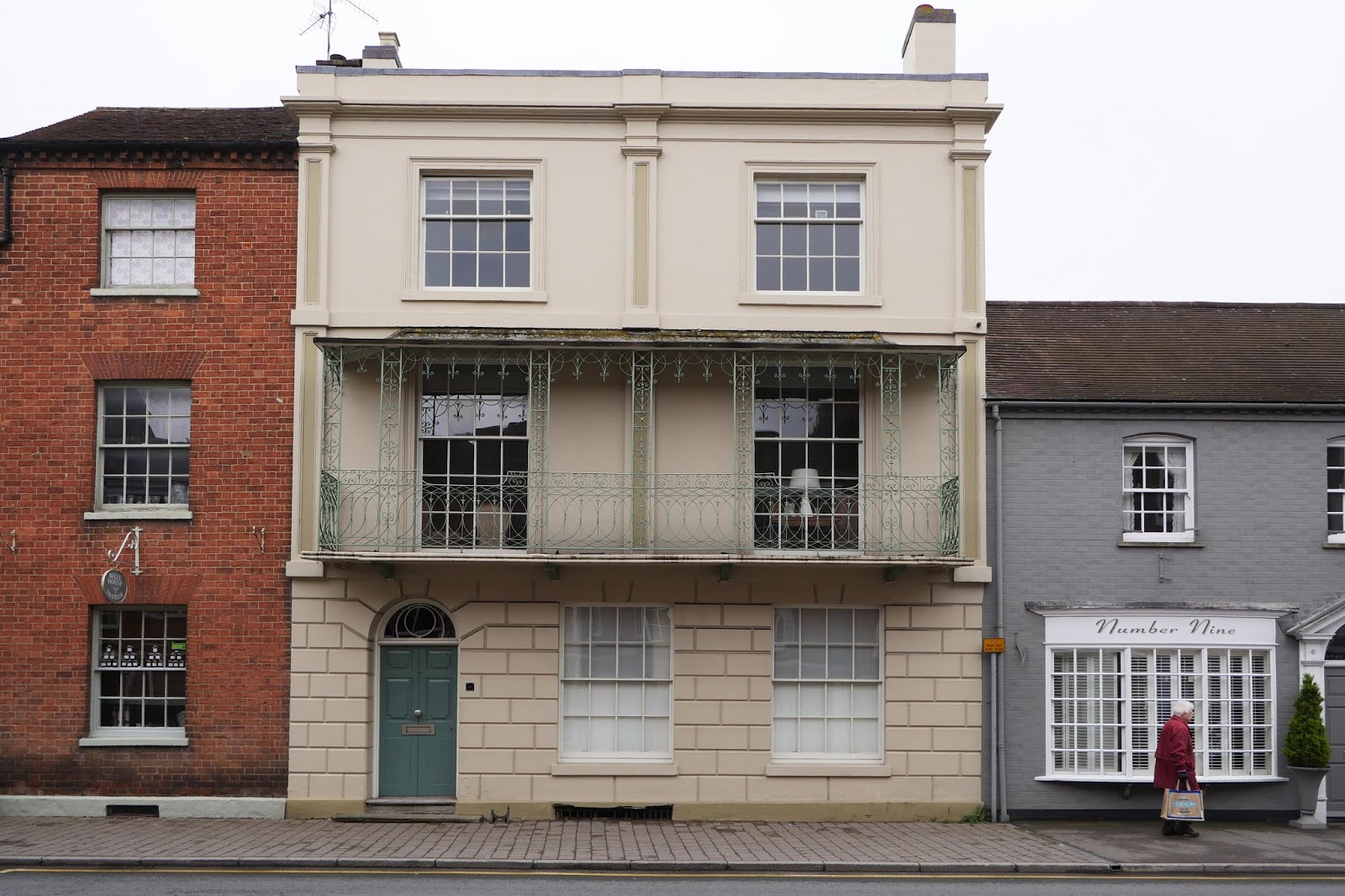
At the end we turned right into the High St which as has an unspoilt character and a large number of Georgian buildings. This house was one of several with lovely wrought iron balconies.


Further along, a grand three story mansion.


And a little beyond, this lovely house with an unusual facade and windows.


I could go on. High St really is a Georgian gem. This is the view looking back from Bridge Street which leads down to the river.


Conditions: grey and cool.

Distance: a couple of miles.

Rating: three and a half stars. A lovely concentration of Georgian buildings and an interesting Abbey. We enjoyed our walk, but in truth there was nothing really outstanding.