Showing posts with label Berkshire. Show all posts

Friday, 14 April 2023

Newbury's Almshouses (revised and updated)


                                                                            St Bartholomew's Hospital

I thought it would be interesting to do an up to date blog of Newbury's numerous almshouses. So far as I am aware the town has the largest number of almshouses of any town in the country.  Stamford would probably be the next highest.  West Berkshire Museum published a book on The Almshouses of Newbury but it seems to be out of print. A useful Timeline of Newbury Almshouses derived from the book can be found on the website of a modern Almhouse charity, the Charity of Mrs Mable Luke founded in 1928.

But what are Almshouses? They grew out of religious foundations, often called hospitals, which provided for the poor, the sick and also pilgrims. After the Dissolution of the Monasteries in the 1530s, almshouses were established funded by well-to-do benefactors to provide housing for the poor and needy. There were often eligibility criteria: age, health, living in the locality (often for a specified time), former members of trades and industries. And almshouses were not all secular: many would have a chapel.

I started at St Bartholomew's Hospital in Argyle St. It is an almshouse originally founded in the 12th century, but whose current buildings date from 1698. It looks a little worse for wear and older photos show a clock above the stone plaque announcing its name.

Carrying on along Argyle St you come to the Essex Wynter Almshouses. Originally a farm, they became the Phillip Jemmet almshouses in 1670 (and his initials can be seen over the door) and were reconstructed by Dr Essex Winter (having become derelict) in 1926. 

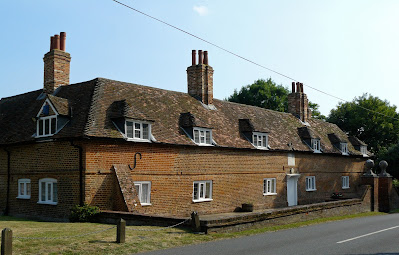
At the end of the road I turned left to pass the Upper Raymond Almshouses of 1826. They consist of a plain brick terrace, but with dramatically large chimneys, gothick windows and a curious shallow stone arch stuck on to the centre of the block. There are a couple of modern (1970) almshouses to the left, out of shot.

I turned right into Newtown Road for a few hundred yards to reach the Newbury Church and Almshouse Charity (described by Pevsner as Child's Almshouses). It is a pleasant U-shaped group dated 1879 and renovated in 1982.


I doubled back along Newtown Road to see the very plain Lower Raymond Almshouses, bearing the date 1796. Another range at right angles to this one was destroyed in by bombing 1943.

I carried on along Bartholomew Street to reach St Nicholas church and then cross the bridge and turning left down a narrow alley to Northcroft Lane where a splendid former almshouse can be found. There is a large white plaque over the doorway, but unfortunately it is almost impossible to read. It is just possible to read the foundation date: 1824.

Retracing your steps and turning right at the bridge brings you to West Mills. This area has several buildings which were once small Almshouses: the Hunt Almshouses at number 11 (1729, rebuilt 1817), Coxedd's Almshouses (1690) at number 15 and Pearce's Almshouses (1694) at number 18.

South of West Mills and off Kennet Road are Kimber's Almshouses (1939) very plain and built of chunky brick. They were originally founded in 1795 in Cheap Street.


I went along Kennet Road then Craven Road where some houses on the left had the classic almshouse appearance, albeit plainer and more modern. I can't find any reference to them in the Timeline of Newbury Almshouses.


The left into Rockingham Road to reach Enborne Road. Tucked away off to the right are the delightful Coxedd and Pearce's Almhouses. They are dated 1884 - although the beautiful sunflower motif might make you think they were a little later - and were built to replaced two of the small almshouses in New Mills referred to earlier. This is a bit out on a limb but you are still only 10 minutes from the station or 15 from the town centre going back along Enborne Road.

A footnote on the Charity of Mrs Mabel Luke: it is still involved in building new almshouses. A devlopment of flats has recently been completed in the centre of Newbury. It may lack the architectural features I so like, but it is wonderful that almshouse charities are still producing what we would now call social housing.


Sunday, 6 February 2022

Almshouses of West Berkshire and Reading (apart from Newbury)


                                                    Estbury Almshouses, Lambourn

This post covers all of the Almshouses to be found in West Berkshire and Reading, excluding Newbury. Most are still in operation as Almshouses, while others have become ordinary dwellings, albeit with historical features such as a tablet.

The Estbury Almshouses are situated to the right of the parish church. The almshouses were founded in 1502 and re-founded (i.e rebuilt) by Henry Hippisley in 1852.

 
If you go past the Estbury Almshouses on your right and turn right down a narrow lane you will find on the right the Hardretts Almshouses, re-founded by Jacob Hardrett in 1625. There is a sign over the door for Hardretts Almshouses, but it is hard to imagine that they are still use as such. The parish church can be glimpsed behind.


All that remains of St Peter's Almshouses in Brimpton is this handsome gateway. The almshouses were founded by the Countess of Falmouth.


Donnington, just north of Newbury, has the splendid Donnington Hospital ...


The hospital was built as a square around a courtyard in 1602 and restored and re-opened in 1822. The enormous chimneys are a dramatic feature.

As you walk down to the village there is another building on the right that looks like it might be an almshouse. Further investigation reveals that it was Abberbury Close (1938), which is also owned by the Donnington Hospital Trust.


Interestingly, the Trust was founded in 1393 by the same Sir Richard de Abberbury who built Donnington  castle. It is the tenth oldest almshouse foundation in the country. The Trust also now looks after Jesus Hospital in Bray (which will be covered in my post about East Berkshire Almshouses) and the more recent Abberbury Close.
 
Heading further east to Aldermaston, we reach  Dixon's Almshouses in Church Road. They were founded by the Rev Robert Dixon in 1706 and improved in 1904 and 1926. They are now private (or perhaps estate) houses.


The final almshouses covered in this post are on the outskirts of Reading in New Lane Hill. 


They are the rather lovely Mary Lyne Almshouses. They were founded in 1832 by Mrs Elizabeth May and Miss Mary Lyne for six poor women, three from Burghfield Parish and three from Tilehurst. They have been completely reshaped inside and are now privately owned.
 
The remaining ones are Vachel Almshouses in Rose Walk, Castle St, in the centre of Reading close to the Oracle shopping centre. They were originally founded by Sir Thomas Vachel in 1634 for the maintenance of six poor men. The original buildings were demolished and rebuilt in 1867 and modernised in 1904 and 1926.


Note: I believe this is a full set of Almshouses in East Berkshire, but additional information or errors to be corrected would be most welcome. Click on the Comments option at the bottom of the post. 

Sunday, 30 January 2022

Almshouses of East Berkshire


This post covers the Almshouses to be seen between Reading and the Easternmost parts of Berkshire. It starts with the Robert Palmer's Cottages (above) in Pearson Street, Sonning, founded in 1850. The post finishes in Langley.

Next we have Barker's Almshouses, in Church Hill, St Nicholas, Hurst. The Inscription over the door reads: "The hospital for the Maintenance of eight poor persons each at 6d per diem for ever was Erected and Founded in ye year 1664 at the sole charge of WILLIAM BARKER of Hurst in the county of Wilts. Esq, who died on ye 25th March, 1685 and lyes buried in... this parish". Henry Fairfax Esq. His Newphew and Heire (sic) M.P."

In Twyford we find the Harrison Almshouses, prominently situated on the A4 London Road. They were founded in 1640. Almshouses were built by Sir Richard Harrison in 1640, for six poor people of either sex.  They were not endowed until 1700 when his granddaughter, Lady Francis Winchcombe, gave the rents from a house and 80 acres of land. Each person was to receive 40 shillings annually and a gown every other year.                                 


Not far away on the outskirts of Wokingham in Holme Green is the Lucas Hospital, founded in 1665.

The Lucas Hospital was founded by Henry Lucas Esq. In his will dated 1663 he requested that his executors establish an almshouse for poor, elderly men who were inhabitants of Windsor Forest. By early 1667 a master was installed and the first 16 residents “of not less than 50 years of age, of sober life and conversation, poor and impotent by sickness or other infirmity” were given a furnished room, a £2 fuel
allowance and a pension of £10 per annum. 

In 1675 the Drapers Company took over the trusteeship of the charity. The Henry Lucas Charity was perpetuated until 2001, when the Charity Commission allowed the building to be sold for use as a private residence. Lucas Hospital is Wokingham’s only Grade 1 listed building.

In Maidenhead, on the London Road, there are the James Smyth Almshouses, founded in 1659. James was a Citizen and Salter of London. The plaque over the main door gives a full picture. It was established in 1661 to house “eight poor ancient men and their wives, inhabitants of Maidenhead or Cookham, each of them to be 50 years at least."


A little further along the road is the Haven of Rest Almshouse which was built in 1895. The central gable is a very effective decoration.

Maidenhead's third Almshouse is the small All Saints Almshouse in Boyn Hill Road,  now a private dwelling. It was funded by donations by the Misses Lamotte and G E Street (the architect of the nearby church).


The imposing Jesus Hospital in Bray is a fine sight. It was built in 1627 and run by the Guild of Fishmongers until 2010 when they decided to sell it. After a vigorous local campaign it was transferred  to the Donnington Hospital Trust and continues to carry out its work.

Continuing eastwards we reach the Windsor Almshouses, Victoria Street, Windsor. It is now known as  Ellison House.


Moving from Windsor to Old Windsor we reach the Penny Farthing Almshouses in Crimp Hill Road.

This picture above shows the original Almshouses which were founded in 1787 and renovated 1969-70. The details are to be found on the three plaques. Additional Almshouses were built in 1970 between the old almshouses and the road. They are also also single storey, but much less picturesque in style.

In Langley we find two sets of old Almshouses close to each other in St Mary's Road.

First are the Sir John Kedermister's Almshouses, above, founded in 1617.


To the right are the Sir Edward Seymour's Almshouses. These Almshouses are a little later: 1679-88. Sir Edward was the Speaker at the time.


Note: I believe this is a full set of Almshouses in East Berkshire. Additional information or errors to be corrected would be most welcome. Wikipedia mentions Almshouses founded in 1839 by William Wild in Horsemoor Green, but I can find no trace of them.

Almshouses of West Berkshire (excluding Newbury, which has its own page already published) will follow shortly.

Wednesday, 1 December 2021

Combe Gibbet and Buttermere

                                                                     Combe Gibbet

There has been a bit of lapse in recent months, largely because my wife had a nasty accident (happily she is largely restored now). When I did resume walking with my friend Merv, we did some walks which were enjoyable for exercise but didn't offer very much visually. Recently however, we have had a couple of walks worthy of being blogged: today's starts near Combe Gibbet at Inkpen. 

The gibbet was erected in 1676 for the purpose of gibbeting the bodies of George Broomham and Dorothy Newman and was only used for them. The gibbet was placed in such a prominent location as a warning, to deter others from committing crimes. Broomham and Newman were having an affair and were hanged for murdering Broomham's wife Martha, and their son Robert after they discovered them together on the downs.  Unfortunately for the lovers, the murder was witnessed by "Mad Thomas", who managed to convey what he had seen to the authorities. A replica gibbet marks the site now.

We parked on the western edge of Walbury Hill and headed west along the ridge. It was largely grey, but suddenly the sun came out allowing this delightful picture of the fields to the north.

A little further on, after passing the Gibbet on the right, there was a lovely view of the closed valley which lays to the south. Sadly, the sun had gone in by now.

We headed west along the ridge, along the Test Way, a fine 44 mile walk which I completed in November 2018. The Test Way head south after a short while, but we continued along the ridge, passing Ham Hill after a bit over a mile and then also heading south. This brought us to the scattered settlement of Buttermere.

Passing the farm, we soon reached the pretty, but tiny, church. 


 Inside the church a plaque provides useful background.

We then followed a track to the south east passing a curious building which looked like a bar (and may therefore account for the success of Buttermere). We followed this by skirting a field full of cows (with horns - was any of them a bull?).

We walked beneath the wonderfully misnamed Sheepless Hill ...


... and then headed north along the Test Way to return to where we started.

Distance: 7 miles.

Map: Explorer 156 (Newbury & Hungerford)

Rating: 4 stars.

Tuesday, 8 June 2021

Woolhampton and Douai Abbey


The Queen Victoria Drinking Fountain of 1897

Another walk with my friend Merv, this time starting at Woolhampton - specifically the Row Barge pub.

We crossed the railway line, wondering why the station was called Midgham, which is some way away. Later we chatted with a local chap doing his garden who explained that it was to avoid confusion with Wolverhampton. Was he pulling our leg or could this bizarre explanation be true? I am voting for it being true.

Now on the left was this fine house. The four storey tower was a later addition in 1897, again according to our friend.

We crossed right to cross the main road and then follow a path on the left uphill towards Elstree School. We could see that it was a sprawling establishment, built around the former Woolhampton House, but could not see enough to form an impression of it.

Next we passed the C of E primary school and St Peter's church of 1861.

Continuing on the same line we reached Douai Abbey, which we skirted. It is a large complex of red brick buildings. Its origins lie in a religious community founded in France in 1615. A new start was made in Douai in Northern France after the French Revolution, but in 1903 the community was expelled as a result of anti-clerical legislation and relocated at Woolhampton. A school was founded as part of the community, but eventually closed in 1999. As of 2020, the community consisted of 23 monks who serve parishes across five dioceses.

Facing the buildings above is this lovely thatched cottage.

We now ventured into High Wood and did well to follow the rather sketchy map without getting lost. One section was beside this beautiful field of buttercups, with just a few pink flowers for variety.

We left the wood and soon arrived at the Blade Bone pub, hoping for a refreshing beer, but it was sadly closed. We followed a meandering path through woodland to emerge at the edge of Bucklebury Common. Now along a lane, part of a walk around Midgham I did in April and then skirting a fine house called Woottens to reach Midgham. We walked across Midgham Park to return to Woolhampton.

On the right was the Gill Campbell Memorial, given by Miss Blyth of Woolhampton House in 1895 ...

... and then back past the Fountain and across the railway to the Rowbarge pub where we did have a refreshing draft. As we left I noticed for the first time - we have often eaten at the Rowbarge of an evening - that the car park contains a large concrete pillbox.

Conditions: bright and quite warm.

Map: Explorer 158 Newbury & Hungerford.

From: Walks in the Kennet Valley and beyond 9West Berks Ramblers).

Rating: 3 stars.

Wednesday, 28 April 2021

Malverleys


A new experience today: a visit to a private garden near Newbury which is open as part of the National Gardens Scheme. We arrived in light rain and, along with 20 or 30 others, started by hearing about the garden from the Head Gardener/Horticulturist, Mat Reese. He is highly regarded in the horticultural profession and has been at Malverleys for 10 years, working with the owner to create an ambitious garden, arranged in a series of separate 'rooms' and areas. He is not finished yet apparently, with further projects in mind.

After the introductory talk we were free to explore the garden (there was no guided tour because of Covid). We started in the impressively large walled garden (above) where the plantings were almost entirely white. In the centre were two  cherry trees housed in purpose-built open pagodas. We had never seen anything like this before - very striking!

We went next to a smaller, but exquisite, walled Italian garden where a cherry tree avenue  bordered a rill with a neoclassical statue at the end. This was a real delight and very popular with the other visitors. I had to sneak back when they had all gone to get a decent photograph

At right angles to this room was another which offered a beautiful view towards the statue.

Next, the cool garden, was another real show-stopper, this beautifully proportioned circular pool with an exquisite metal bowl in the centre aligned with a Greek urn on a pedestal.

We next discovered a classic long border. This was the hot garden (for obvious reasons).  Apparently, the owner prefers the hot garden and his wife the cool garden.

We ended our exploration near the main house - we were told not to publish any pictures of the house, a request which I naturally complied with. I thought a snapshot of the newish family chapel would be OK though.


Conditions: wet.

Rating: 5 stars. A marvellous way to spend a couple of hours. I would love to come back again in the summer to see the gardens in a different season.