Showing posts with label Valencia. Show all posts

Thursday, 29 June 2017

Valencia Art Nouveau: houses


Casa el Punto de Gantxo (Crochet Work House)

We spotted this wonderful building yesterday behind the Basilica of the Virgin of the Abandoned and decided to make it the start of our second art nouveau (modernisme in Spanish) walk in Valencia (see also the Markets and Station walk). It is in Plaza de la Almoina and was the work of Manuel Perris Ferrando. A close up will illustrate the combination of the coloured facade with the extraordinary columns.


From here we headed to the Plaza de la Reina, in front of the Cathedral, where at the southern end are a nice pair of buildings. On the right is Casa Sanchez de Leon (1896, by master builder Luca Garcia).


And on the opposite corner is La Isla de Cuba (1896), with its fine relief figures. The design was also by master builder Lucas Garcia (shades of Ibsen).


We headed along Paz to see this lovely house, about which I can find nothing


At the end we turned into Calle Colon to soon turn left into Jorge Juan which leads to the celebrated Mercado de Colon (see separate post). Immediately we were confronted with the extraordinary Casa del Dragon (1901, by Jose Manuel Cortina).


The facade on the right side has the most impressive dragon coiling at the bottom of a column. I had to omit part of its tail because a large rubbish bin was in the way.


After a thorough exploration of the Mercado, and a nice lunch there, we continued our walk. There were two pleasing houses adjoining each other in Carrer del Comte de Salvatierra at the back of the Mercado. Number 25 with its exquisite circular window was especially attractive.


Then we made a brief left into Carrer Ciril Amoros and enjoyed this lovely building at number 74. The carved roses are spectacular.


Now we doubled back and walked along Ciril Amoros towards Calle Colon, soon reaching, at number 29, the astounding Casa Ferrer (1907-08, by Vicente Ferrer Perez).

Here is a closer view of the rose decorations at the top.


We were lucky enough to find the main door open and so we had a quick look inside.


This was effectively the end of the walk - we headed back towards the city centre. However, I can't resist adding another couple of gems. The first is the Casa Ordeig in Plaza del Mercado, facing both the Mercado Central and the Lonja, or Silk Exchange. It dates from 1907 and was the work of Francisco Mora. Mora was also the architect of the Mercado Colon. The suggestion of battlements is presumably a nod to the medieval Lonja, but there are also some delightful flower motifs.


The site is very cramped and partly obscured by trees, but there are some lovely tiles and stonework on the right side of the building in Calle Ramiletes.


A bit northwest of Plaza del Mercado is this recently renovated house in Plaza del Mercat. I rather doubt that this was the original colour scheme, but the overall effect is excellent.


Conditions: hot and sunny again.

Source: some inspiration was taken from the visit Valencia website, although the pictures are poor and the map illegible. There are also clearly many more good art nouveau buildings than are listed in this document. We stumbled on several, but doubtless there are more in the Eixample area.

Distance: a couple of miles.

Rating: four stars. Some lovely houses, but only two real gems.

Wednesday, 28 June 2017

Valencia: Turia Gardens and the City of Arts and Sciences


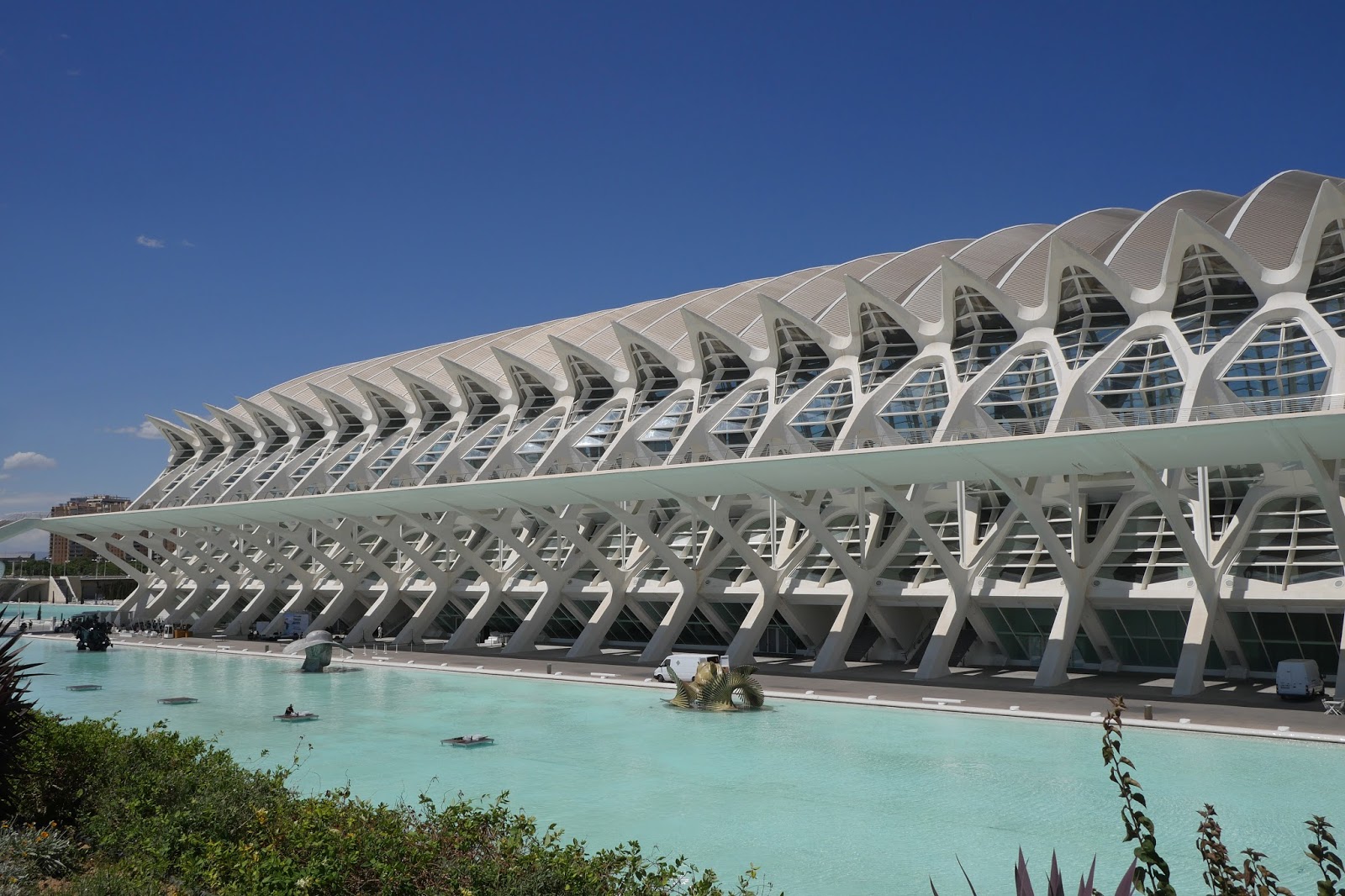
The City of Arts and Sciences: the Science Museum and the Hemisferic

One of the most extraordinary things about Valencia is the Turia Gardens. The River Turia, which arcs around the old town, had repeatedly flooded the city and after a particularly devastating flood on 14 October 1957 it was decided to divert its course some way upstream. It now reaches the sea to the south of the city and the former river bed has been turned into an immense linear park, 9km in length. The gardens were inaugurated in 1986 and comprise areas of a very different character from football pitches to children's play areas. The astonishing City of Arts and Sciences is at the end nearest the sea.

We started our day with a visit to the interesting Bellas Artes Museum. We then passed through the disappointing Royal Gardens, a conventional park, and joined the Turia Gardens at the Royal Bridge. Bridges are a key feature of the park, although the initial effect feels somewhat incongruous.


The park is quite wide at this point are there are several broadly parallel paths you can take. We took a middle line and soon reached the next bridge, the modern and rather striking Puente de la Exposition by Santiago Calatrava.


I had secretly hoped that the park might be home to some butterflies and was delighted when Ange spotted a Swallowtail while I was photographing the bridge. Apart from a few Geranium Bronzes and Whites that was it however.


We passed a funfair to reach the next bridge: the Puente Real, a magnificent affair with a small lake underneath and remarkable canopies housing statues at one end. It was at its most attractive seen through a screen of pine trees. It was rebuilt in 1519.

  
Soon afterwards we came to the large lake in front of the Palau de Musica.


The final bridge was a nice, fairly minimalist, art deco number. Soon afterwards, we reached the northern tip of the City of Arts and Sciences, the braibchild of Santiago Calatrav. We were greeted by the extraordinary Queen Sofia Palace of the Arts, an opera house completed in 2005, but still looking startling and fresh.


We spotted a bar area in the shady overhang and enjoyed a quiet drink there listening to an excellent play list of mainly 60s and 70s music. Ahead of us, seen under a road bridge were two more strange structures. On the left the end of the Prince Felipe Museum of the Sciences and on the right the Hemispheric, a cinema and the first building to be completed of the City in 1998. Everything we could see seemed so futuristic, that we were disappointed there were no robots or androids. Perhaps there were ...

Here is a side-on view of the Hemisferic, which houses a cinema, planetarium and a laserium.


Here is one of the Museo de les Ciences (2000). Its design is supposed to evoke the skeleton of a whale.


We thought the way in which all the buildings were connected by and to water was really interesting. It seems to reference the fact the site was once a river, but also serves to enhance the buildings.

Beyond the Science Museum was the wonderful l'Assut d'Or bridge designed by Santiago Calatrava, shown here with the purple Agora, a covered venue for concerts and sporting events, behind it.


The remaining buildings are the Umbracle (2009), an open structure enveloping a landscaped walk with plant species indigenous to Valencia and a sculpture walk …


… and the Oceanografic (2003), designed by Félix Candela. It is the largest oceanographic aquarium in Europe.


Conditions: sunny and very hot, 34 degrees.

Distance: about 3 miles - we took a taxi back to our hotel.

Rating: 5 stars. The Gardens are a delight but the City of Arts and Sciences is truly astonishing.

Monday, 26 June 2017

Valencia: Medieval and later

The Town Hall

Valencia has a wonderful history: founded by the Romans in 138 BC, captured by the Moors, recaptured by El Cid in 1096 (you drive into the city from the airport on the Avenida del Cid), recaptured by the Moors and only made definitively part of Spain in 1238 by Jaime I, the Conqueror.

We started our walk at the main square, Plaza Ayuntamiento, whose dominating feature is the 18th century Town Hall. We headed along Avenida Maria Cristina to reach La Lonja de la Seda (the Silk Exchange) in Plaza del Mercado, opposite the wonderful art nouveau Mercado Central (see separate post). It was built between 1482 and 1498.


It has four parts: the main Tower, the Consulado del Mar (Maritime Consulate) on the left, the Patio de los Naranjos (Orange tree courtyard), and the vast Contracts Room.  The Contracts room is a vast space with numerous twisted columns, some of which are half set into the walls. The twisting ribs go straight into the roof without the usual capitals to intervene.


We headed east then to the strangely named Plaza Redona (round square). It was designed in 1837 and has recently been refurbished.


We walked past the handsome 18th century tower of Santa Catalina, a landmark in Valencia. (The church itself is much older and tucked away in a small square.)


This led us to the Plaza de la Reina where we encountered the extraordinary Cathedral (or Seu). It was consecrated in 1238 by the first bishop of Valencia, Pere d'Albalat, on the site of the Moorish mosque, which in turn had been raised in place of the former Visigothic cathedral. It is very hard to photograph, but here is the facade at the far end of the Plaza. The Miguelete (or Micalet) belltower is on the left, with the Baroque main door in the centre and the Chapel of the Chalice (of which more in a moment) on the right.


Once inside, we were struck by the fine, simple, nave, although with jarring baroque chapels at the apse end ...


 ... and the extraordinary Chapel of the Chalice, which is claimed to house the chalice used at the Last Supper. The wall that houses it is overwelmingly gilded, but the ceiling with its wonderful ribs and bosses is a great sight. The chapel was originally the Chapter House.


Further round in the same direction on the outside is the original Romanesque door, a thing of great simplicity and beauty.


Behind the sprawling Cathedral is the Plaza de la Virgen with the splendid Basilica de la Virgen de Los Desemparados on one side. It was built between 1652 and 1667 by Diego Martínez Ponce de Urrana, it is the only church in the old part of the city that was built new from the foundations up, and not on an existing parish church or convent.


Inside is a baroque oval church with small chapels on the outside. From the far side of the square there is a nice view beyond the fountain to the rear of the Cathedral and its bell tower, .

We walked along Navellos and Muro de Santa Ana, passing the Borja House, now the seat of the city government. Then we turned left at the ring road which runs inside the Turia Gardens (Jardines del Turia) which now occupy the river bid of the Turia river (see separate post). Soon we reached the astonishing Torres de Serranos. This great gate was completed in 1391 and was the main gateway to the city when it still had walls. It is said to be the largest Gothic city gateway in Europe.


We followed the Blanquerias and Guillem to Castro to reach the IVAM (Institut Valencià d'Art Modern) musuem. It is housed in a rather plain box shaped building which is more interesting inside. We diverted to have a look around and especially enjoyed the exhibition in the basement of work by Valencian artist Ignacio Pinazo (1849-1916). The other great delight of the basement was this section of the city wall uncovered during construction work and splendidly incorporated into the museum.


Continuing along the west edge of the old town we came to the late gothic Torres de Quart. The gates were Napoleon's point of entry into the city and the marks of his cannon balls can still be seen.


Now through some small streets to return to the Plaza Ayuntamiento, whose other great building is the Post Office. It was designed by the architect Miguel Angel Navarro and built between 1915 and 1922. It is an example of the eclectic style.


Conditions: hot (32 degrees) and sunny.

Distance: about 3 miles.

Rating: five stars.