Showing posts with label UNESCO. Show all posts

Wednesday, 11 March 2020

Stonehenge

Stonehenge

I last visited Stonehenge when I was a boy, but having passed by a few times on the A303 in recent years, I have been nurturing a desire to see it again. Our son Will was staying for a few days and I persuaded him (quite easily) to join me.

You arrive at the Visitor Centre and car park. The Visitor Center consists of two elements: a very good museum, which sets the scene very well and the inevitable shop. It is actually quite an interesting building, best seen from the back.


We decided to eschew the shuttle bus in favour of walking the mile and a half to the site. This led us part the re-creation of a Stone Age village which was quite interesting.


We followed the road to the site and because of a large tour party to our left decided to circumnavigate the site anti clockwise.

Below was our first clear view, from the south west, more or less on the line of the Summer and Winter solstices. The tall stone in the centre is known as the Tenon and the slab resting on two pillars on the left is a Trilothon. To the right of the Tenon is the sarsen horseshoe and on the extreme right is a sarsen circle.


Off to the left (taken from close up) was the 40 ton Heel Stone.


There are two types of stone: bluestones and sarsens (the sarsens are bigger). When you see them up close the main question is inevitably "how on earth did they get the sarsens to near Salisbury?" The sarsen stones are thought to have come from the Marlborough Downs, 19 miles away, but nearest source of bluestones is in the Preseli Hills in west Wales, 150 miles away.

As we walked round it was interesting to see how different Stonehenge looks from different angles. Here is a different perspective, with the Tenon on the left.


We also noticed a number of isolated smaller stone standing outside the main circle. All these have names. The Heel Stone has already been mentioned but there were also the Slaughter Stone and the Station Stones. The Slaughter Stone sounds grim and prehistoric but is only an imaginative Victorian name for a stone which was once upright but is now more or less flat.

Here, finally, is an aerial view. The sarsen horseshoe is especially clear.


As we completed our circuit I spotted this milestone and realised that the route from the visitor centre to here was the original road.


We headed back across a large grassy area flanked by a number of Round Barrows.


These are scattered all around the edges of the site and were used for burials.

Distance: about three miles.

Rating: five stars. A real wonder.
  

Saturday, 15 February 2020

Portugal: Lisbon - Belem


 The Belem Tower

We are trying something different again today – a mixed bus and walking tour focusing on the Belem district, down by the River Tagus. We pick up the Yellow Bus at the Liberadores stop in Praca Dom Pedro IV and make one intermediate stop at the Calouste Gulbenkian Foundation. The Foundation was built to house Gulbenkian's collection after his death in 1955 and opened in 1969. It offers a wonderful journey through art history from Egyptian and Roman artifacts, through medieval and Renaissance painting up to the Impressionists, with tiles, furniture and items by Lalique as well. 

Unfortunately, photos were not allowed inside the gallery, but this fantastic piece in the foyer could be. It is a called La Primavera: A homage to Jean Goujon and was sculpted by Alfred-Auguste Janniot between 1920 and 1924. Janniot does not seem to be well known, but we thought it was a wonderful price of work.


We got back on the bus and followed quite an interesting route down to Belem, which included an aqueduct and the gaol. We learned that Portugal was the first country to end capital punishment.We enjoyed this view over the Tagus.


 The first main sight of course is the Belem Tower. Here is a detailed view.


It was built in 1519 as a defence for Lisbon. A matching fort was built on the other side of the Tagus, but there is no trace of it now. The Tower is a UNESCO World Heritage Site.

We took advantage of a wonderfully entrepreneurial venture: Wine a view. It was a sort of mobile wine bar with a wide selection of wines served in plastic glasses which you keep. A small number of chairs were placed by the retaining wall of the river, or you could sit on the wall if they were full. We enjoyed a delightful interlude sipping wine and enjoying the warm sunshine (!). This is one aspect of the view.


After a while we strolled along the riverside promenade towards the magnificent Monument to the Discoverers. On the way we passed this curious brick lighthouse, seemingly derelict.


Soon after we reached the magnificent Monument to the Discoveries …


The monument was conceived in 1939 by  architect José Ângelo Cottinelli Telmo, and sculptor Leopoldo de Almeida, as a temporary feature of the Portugese World Exhibition opening in June 1940. The building you see today was completed in 1960 and formed part of the of the 500th anniversary of the death of Henry the Navigator. He is the leading figure, more easily seen in the close up below. Vasco de Gama, the only other Portugese discoverer I can think of, is behind Henry on the other side of the monument.


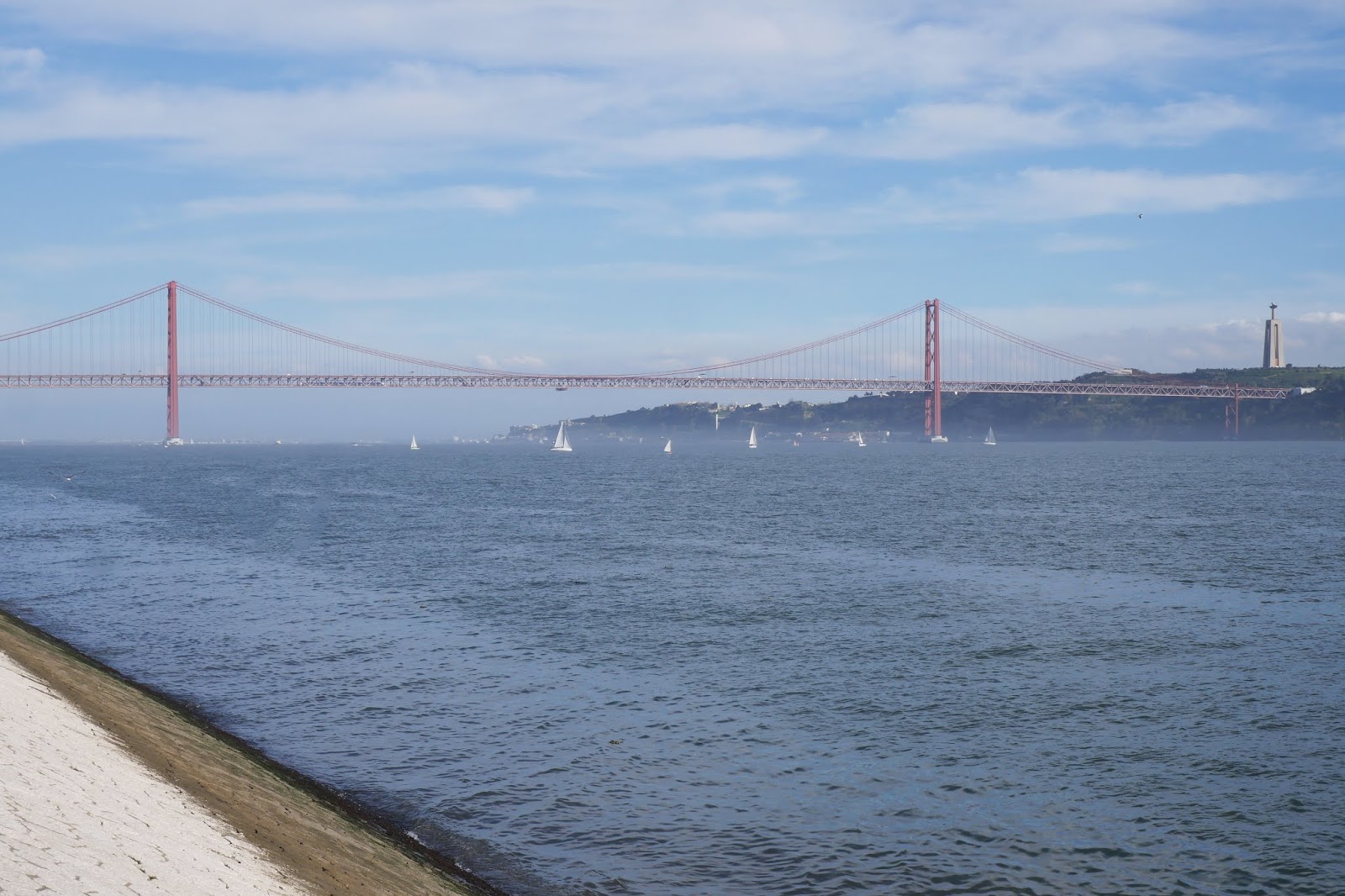
Beyond it was the splendid 25th of April Bridge which we had driven across on our way into Lisbon the previous day. We discovered later that a railway line runs underneath the roadway.


On the far bank was the statue of Christ the King – in the style of the more famous Christ the Redeemer in Rio di Janeiro – towered impressively. It was consecrated in 1958 and was built in thanks for Portugal avoiding the horrors of World War 2, although this possibly owed more to the policies of the Portugese dictator, Salazar.

Now we headed away from the river to take the underpass beneath the road and railway which leads to St Jeronimo's Monastery, which is also an UNESCO World Heritage site. This enormous structure consists of two parts, the Monastery on the left hand side which now seems only to host exhibitions (and the ticket machines for the cloister) …


… and the church and cloister on the right (the cloister is behind the church).


The complex was built to fulfill a promise made by the King of Portugal to do so if Vasco de Gama returned from his inaugural voyage of 1498 to India. Happily he did. Construction began in 1502 in the Manueline style. Vasco's tomb lies inside the church.

The ceiling of the church has beautiful vaulting.


You leave the church and enter the Cloister by its separate entrance (where your machine-produced ticket is validated by a man with a pen). The first sight of the two storey cloister was extremely impressive, especially with the late afternoon sun illuminating the far side. (We had been here before, 26 years ago, but it is still capable of making a tremendous impression.)


The whole thing is on a grand scale: this is one side of the downstairs section.


A staircase leads to the upper section which also offers a view towards the church highlighting its dome.  


Finally, we enjoyed the former refectory with its tiled walls and vaulted ceiling.


It remained only to catch the Yellow Bus back to Rossio square. 

Conditions: mainly warm and sunny.

Rating: five stars.

Friday, 14 February 2020

Portugal: Évora - city centre

The Roman Temple

Having walked around the walls of Évora yesterday, today we are seeing some of the main sights of the city, starting with the most astonishing, the Roman Temple. It used to be known as the Temple of Diana, but this is now seen as incorrect. It has fourteen columns in the Corinthian style and dates from the first century AD. It is the only such building in Portugal.

To the left is the Palace of the Dukes of Cadaval. The grand doorway leads into the Palace's Church of St John the Evangelist, a rather lovely building whose walls were all covered in azulejos.


The museum next door had quite an interesting medley of contents. We especially liked these Chinese figures.


Next we had a brief look at the University of Evora, the second oldest in Portugal after Coimbra. It was founded in 1559 by the Jesuit order and closed in 1779 when the Jesuits were suppressed. It was only reopened as a university almost 200 years later in 1973. (It seems that the buildings were used for educational purposes in the interim.) The main building has a rather severe look from the outside ...


... but the main entrance at the far end is rather lovely and inside is a beautiful Renaissance cloister.


From here we headed towards the Cathedral or Sé. It was begun 20 years after the Christians defeated the Moors in 1165. The facade is similar in appearance to the Sé of Coimbra.


The great surprise is that you can climb a steep staircase and walk on the roof.


It was a bit hazy for views of the city, but there was an interesting view of the cloister - we thiought it rather heavy-handed.


On the way down there was this fantastic view of a a series of finials.


From the Cathedral we wandered through the narrow streets to reach the 16th century Square of the Moura Gate. It was difficult to appreciate it properly because the central fountain was under restoration and part of the square was cordoned off to store materials. The central fountain was intriguing.


To conclude our exploration found our way through more narrow streets to the Praca de Giraldo, the city's main square. It is a large a spacious area surrounded by pale coloured buildings.


At the far end is the attractive 16th century church of Santa Antao with its fountain. The square is effectively a monument to Fearless Geraldo Geraldes, the man who conquered Evora from the Moors in 1165.


We had by no means exhausted Évora's charms at this point, but we felt that we had gained a good sense of the city. It was time to head to Lisbon to see how it compared to our visit of 1993.

Conditions: sunny at first, but quickly clouding over.

Rating: five stars.

Thursday, 13 February 2020

Portugal: Évora - walls

The Porta d'Avis: the only remaining gate

We have just arrived in Évora after a cross-country journey from Condeixa Nova and having checked into our hotel wandered into the main square to get some lunch. Over lunch the idea of walking round the city walls took root and so we headed south along rua de Republica to reach the edge of the old city at what is now a park straddling the walls.

As will become clear, the walls date from different periods. The oldest sections are medieval. The total distance around the perimeter is about 5km. The first section had dramatic corner bastions with small lookout positions on the corners.


We first saw these in Dijon, a good few years ago,  although the Dijon ones were more ornamented.

Before too long we passed the Porto do Raimondo (alas just a gap in the walls rather than an actual gate) and now saw serious-looking battlemented walls in a sort of zig-zag pattern. I have included a man for scale.


After this, there battlements with projecting towers, some with little passageways.


Soon after this we passed the Porta Nuova (also just a hole) and approached the wonderful Prata Acqueduct which extended 9 km to the north to bring fresh water from a small river to Évora. The tallest arches are 23m high. It designed by Francisco de Arruda, who was also responsible for Lisbon's wonderful Belem Tower.

The only disappointment is that it dates only from the 16th century, rather than being Roman as we had fondly imagined. It was restored and altered somewhat in the 17th century during the Spanish and Portuguese War of Restoration (1640 –1668), a period of skirmishes between the two countries.


A little further away from the walls (but beside the acqueduct) was all that remains of the Forta de Santa Antonio, which so far as I can establish, was also built during the Portuguese War of Restoration.


Continuing along the outside of the city the walls things now changed: first the first time there were accretions on the outside. We thought they were pretty scruffy and should be removed forthwith.


We reached Porta d'Avis, almost 12 o'clock in relation to our starting point at 6 o'clock. The plaque over the gate reveals that it is the New Porta d'Avis and was opened in 1804.

The next, particularly imposing section, was right next to a dual carriageway.


After this the sequence of walls was broken by the buildings of the University (see my post Portugal: Évora - City centre)

We rejoined the circuit of walls at about 3 o'clock. From here back to our starting point was the least interesting part of the walk as there had been lots of accretions and a large part was now the site of the city's hospital.

Finally we reached our starting point and admired some more corner turrets ...


... and this imposing pink building with a lovely orange grove in its grounds.


Conditions: cool and rather grey.

Distance: 5 km.

Rating: Four stars. Interesting and satisfying, but not a match for some other examples we have seen e.g. Citadella (Italy), Montagnana (Italy), Kotor (Montenegro), Tallinn (Estonia).

Wednesday, 12 February 2020

Portugal: Coimbra

The Paco das Escolas (University Palace)

Today we are visiting Coimbra (pronounced Qweem-bra), Portugal's fourth largest city (after Lisbon, Porto ... and Braga) with a population of 140,000. It is principally famous for its ancient university.

We decided to start our visit however on the left bank of the wide Mondego river by visiting the Mosteiro Santa Clara a Velha (the old Santa Clara Monastery - there is a much newer one nearby. The monastery was completed in 1330 under the sponsorship of Queen Elizabeth of Aragon. It consisted of a Romanesque church with side aisles of the same height as the nave and a large Gothic cloister. Unfortunately, it was built on low ground near the river and was immediately flooded. the ground floor was raised repeatedly and in the 17th century a higher floor had to be built inside the nave. Soon after the nuns relocated to a new convent on higher ground and the monastery was abandoned.

This is what it looks like now after significant renovation works in the 20th century.


 There are some beautiful capitals.


And here is a view along the nave showing the upper level. I have never seen a church like it.


The site is now insulated from further risk of flooding by a curtain wall and is effectively an archaeological site accompanied by an interesting Interpretation Centre (sadly with labels in Portugese only).

Next we crossed the river to get our first view of the University buildings high on a hill on the right bank ...


... with also a nice view along the river towards the new Pedestrian Bridge, with a new road bridge beyond it.

We made the climb up to the magnificent Paco das Escolas - it is a UNESCO World Heritage site - with impressive buildings on three sides (the fourth is left open and offers a view over the river. The university was originally in Lisbon but was transferred to Coimbra in 1537.

On the left side is the Old (or Joanine) Library (it is dead centre in the view above) which dates from 1711. From the outside it looks fairly austere ...


... however a tour takes you in via the basement, enabling you to see the Academic Prison (used up to 1832 for naughty students) - apparently the most severe punishment was reserved for destroying a book. The third floor reveals an astonishing interior divided into thirds with elaborate gold decorations and ceilings. Photography is not allowed, hence this postcard. One very surprising discovery was the library is home to a colony of bats whose mission is to eat insects and especially moths this helping to  preserve the books.


Nearby is St Michael's chapel, which dates from the 11th century but was renovated in the 16th. The organ of 1733 is said to be its outstanding feature, but we preferred the azulejos (tiles). Again no photos are allowed, so here is another postcard.


The other great feature of the Paco das Escolas is the imposing statute of King Joao III who founded the University in 1537 in what was then the royal palace. It is hard to avoid the comparison with his contemporary, Henry VIII.


To conclude our visit we went to see the (old) Cathedral, or Sé. It was built in an austere, fortified romanesque style and was consecrated in 1184 on the site of a 10th century basilica destroyed in 1117. The north facade has an attractive, if discordant, remaissance portal.


It has an imposing romanesque cloister with many carved capitals located at an odd angle to the church. It dates from 1218.


Inside the cathedral, there are some lovely azulejos, painting from various periods and a renaissance chapel from the 16th century.


Conditions: grey, about 16 degrees.

Distance: about 3 miles in all from where we parked near the Santa Clara Monastery.

Rating: 5 stars.