Showing posts with label garden. Show all posts

Monday, 8 August 2022

Minterne House Gardens

This post features an entertaining piece of serendipity. We decided to go to Minterne House, well known for its fine Gardens, for an afternoon excursion. When we got there we realised it wasn't long since our previous visit (we had mixed it up with another house), but we decided to continue anyway. 

The gardens were much the same, but this time there were a considerable number of fairies and strange creatures scattered among the plants and trees. It was all rather lovely. Certainly, the kids who were there were having a great time. I have no idea who was responsible or why, or how long it will last.


Friday, 11 June 2021

Keyneston Mill

We have started to develop an interest in looking at gardens, inspired by recent visits to the Sir Harold Hillier Gardens and Malverlys. We found Keyneston Mill on a list of the best gardens in Dorset. Its website tells us that "Keyneston Mill is the creative home of Parterre Fragrances. Here you can explore the Scented Botanic Gardens and surrounding 50-acre working estate, where we grow, harvest and distil unusual plants and ingredients for our luxury perfumes."

After parking the first thing you see is the Long Barn, a combined shop and tea room, with loads of the beautiful cistus flowers above to catch your eye.

There is no sign of an actual Mill, but the gardens are set out in three main areas. The first is the Padua Garden, inspired by the Orto Botanico in Padua, the first academic botanical garden in Italy. It contains plants from the Floral Perfume family, such as roses, nicotiana, stocks, many of which are scented.

This gives way to the Fougere (Fern, from French) Garden.

Beyond that lies the Spice Garden, which contains ingredients associated with oriental perfumes. We loved these massive angelica plants.

At the end of this sequence there is the Geodome and Cocktail Garden. Sadly it was not open!

To the right there are perfume crops fields, while to the left lies the River Stour. We have an affection for the Stour as we did the Stour Valley Way some years ago. (A delightful walk, but we didn't see all that much of the river.)

Here and by the nearby river meadow there were loads of Dragonflies, in particular the dark blue Beautiful Demoiselles.


We enjoyed our visit and wish Parterre Perfumes every success.

Conditions: warm and sunny.

Map: Explorer 118 (Shaftesbury and Cranfield Chase).

Wednesday, 28 April 2021

Malverleys


A new experience today: a visit to a private garden near Newbury which is open as part of the National Gardens Scheme. We arrived in light rain and, along with 20 or 30 others, started by hearing about the garden from the Head Gardener/Horticulturist, Mat Reese. He is highly regarded in the horticultural profession and has been at Malverleys for 10 years, working with the owner to create an ambitious garden, arranged in a series of separate 'rooms' and areas. He is not finished yet apparently, with further projects in mind.

After the introductory talk we were free to explore the garden (there was no guided tour because of Covid). We started in the impressively large walled garden (above) where the plantings were almost entirely white. In the centre were two  cherry trees housed in purpose-built open pagodas. We had never seen anything like this before - very striking!

We went next to a smaller, but exquisite, walled Italian garden where a cherry tree avenue  bordered a rill with a neoclassical statue at the end. This was a real delight and very popular with the other visitors. I had to sneak back when they had all gone to get a decent photograph

At right angles to this room was another which offered a beautiful view towards the statue.

Next, the cool garden, was another real show-stopper, this beautifully proportioned circular pool with an exquisite metal bowl in the centre aligned with a Greek urn on a pedestal.

We next discovered a classic long border. This was the hot garden (for obvious reasons).  Apparently, the owner prefers the hot garden and his wife the cool garden.

We ended our exploration near the main house - we were told not to publish any pictures of the house, a request which I naturally complied with. I thought a snapshot of the newish family chapel would be OK though.


Conditions: wet.

Rating: 5 stars. A marvellous way to spend a couple of hours. I would love to come back again in the summer to see the gardens in a different season.

Wednesday, 19 April 2017

Chelsea

The Royal Hospital, Chelsea

We met up with our friends John and Anne to do a partial walk around Chelsea and then have an early dinner. The walk started from Sloane Square, but the first point of note was the Royal Hospital Chelsea. It was founded by Charles II in 1662 for retired soldiers on similar lines to Les Invalides in Paris (completed 1674 under Louis XIV). The architect was Sir Christopher Wren. I hadn't realised that it was open to the public, but apart from a minor grilling at the closed gate you are made very welcome.

The Hospital is an independent charity and relies partly upon donations to cover day-to-day running costs to provide care and accommodation for veterans. Any man or woman who is over the age of 65 and served as a regular soldier may apply to become a Chelsea Pensioner (i.e. a resident), if they need and  "of good character". They must not, however, have any dependents and former Officers must have served at least 12 years in the ranks before receiving a commission.

The magnificent main building is shown above. There is also a new addition off to the left, dated 2008 ...


... and a less recent one to the right.


The central portico is flanked by two identical wings: the one on the right is the dining hall, while that on the left is the chapel (the beautiful interior is also by Wren). The painting of the Resurrection in the half dome is by Sebastiano Ricci.


Behind the main facade is an imposing courtyard, Figure Court, open on the side nearest the Thames. In the centre is a massive statue of Charles by Grinling Gibbons. It was re-gilded in honour of the Queen's Jubilee in 2002 and now looks very golden indeed.


Looking down towards the river (the area was closed today so we couldn't get any closer), we suddenly realised that we were looking at the redevelopment of the Battersea Power Station site.


We headed along Royal Hospital Road and turned left into Tite St, passing the house where Oscar Wilde lived from 1884-95 and where, at a dinner party, he met his future lover Lord Alfred Douglas. The house is not itself very distinguished. But further down the street on the other side is a house where the great painter John Singer Sargent lived - and this has a bit more visual interest.


We turned into Swan Walk to visit the Chelsea Physic Garden (or Chelsea Psychic Garden as my son's partner thought it was called). Before entering I took a picture of this classic 1930s appartment block on Royal Hospital Road


The Chelsea Physic Garden occupies 4 acres and was established by the Worshipful Society of Apothecaries (pharmacists) in 1673. In 1722, when the Society was in financial difficulties, the Lord of the Manor of Chelsea, Sir Hans Sloane, gave the Society a perpetual lease on the site for a rent of £10 per annum (now paid to the Cadogan Estate). Sloane's statue (well actually a reproduction) stands in the centre of the garden.


The garden was an absolute delight to explore and we also had a very informative and interesting guided tour by a volunteer guide. Most of the plants are there for their pharmaceutical value and we learned that the many plans whose Latin name included officialis were so-named by Linneus to denote their medicinal properties.

Among the non-medicinal plants we enjoyed this Judas Tree in full flower ...


... and the unusual Handkerchief Tree.


We returned to the embankment and admired the Peace Pagoda on the edge of Battersea Park. It was opened in 1985 and the permission to build it was the last legislative act of the Greater London Council.


On the street side this large red brick house with swan motifs was very striking.


Now into mansion land in Cheyne Walk. Perhaps the most interesting was this one, once the home of the painter Dante Gabriel Rosetti and also the poet Algernon Swinburn. (Algernon is an ancient name which apparently drives from the Norman French aux gernons, meaning "with moustaches". You don't hear it much nowadays, do you?)


Food was calling now and we headed north towards the excellent Wright Brothers Oyster Bar near South Kensington tube. I was very taken by St Luke's church in Sydney St. It was built in the 1820s, before Gothic revival churches had to be true to medieval principles. It is very striking, but seems too narrow for its height.


Conditions: surprisingly warm and sunny.

Distance: About three miles.

From: London's Hidden Walks by Stephen Millar vol 2 (Metro Publications)

Rating: four stars.

Sunday, 19 February 2017

Venice: San Marco to San Pietro di Castello


 People in Carnevale costumes

Rather foolishly, we have come to Venice during the second weekend of Carnevale. Everywhere there are people dressed in traditional Carnevale costumes. They seem universally patient about being photographed.

Our general idea for today's walk was to keep away from the centre and we decided to do this walk which according to our book begins at Giardini. As we headed east along the Riva della Sciavone, vast hordes were going the other way towards San Marco.


We headed inland a bit to see the Gothic church of San Giovanni in Bragora. It was beautifully plain and simple.

Inside, there were several chapels with fine artworks, but unfortunately we had no sooner got in than we had to leave as it was closing for lunch. (It would reopen 3 1/2 hours later.)


Soon we were at the canal which leads to the Arsenale, the massive former shipyard which underpinned Venice's maritime power.


Just after that we reached the start of the official walk at the Camp di San Biagio and continued along the riva which runs alongside the Canale di San Marco. The first notable sight was Via Giuseppe Garibaldi. This was built in 1808 by Napoleon, who liked large boulevards, by filling in part of the Rio di Castello. It is the widest street in Venice and quite atypical.


Further along we came to the Giardini Publici, pretty much the only green (-ish) public space in. Venice. Nearby is the site of the Venice Biennale, which I had hoped we could explore. It was unfortunately closed. On the edge of the Gardens was the Arco di San Michele, all that remains of a 16th century church demolished by Napoleon.


I rather liked this art deco memorial to an airman.


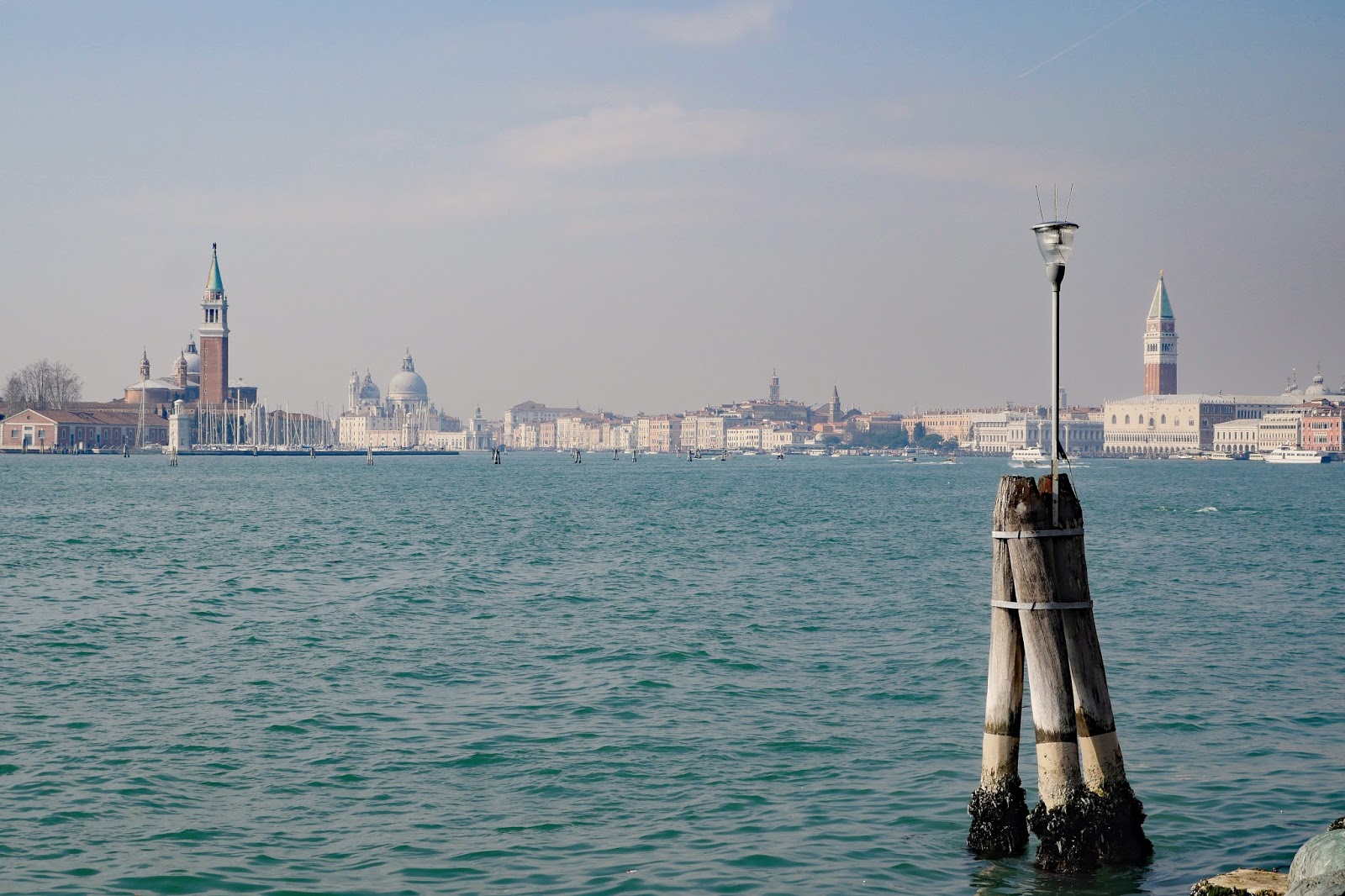
There was a great view back from the Giardini vaporetto stop with several of Venice's greatest landmarks all in view at once: from the right, the Doge's Palace and campanile of San Marco, the Dogana (Customs House), the churches of Santa Maria della Salute and San Giorgio Maggiore.


Deeper into the Giardini was the earliest building associated with the Biennale, this rather lovely greenhouse, now restored and used as a cafe.


Nearby, off the Via Guiseppe Garibaldi, was the 1885 monument to the great man.


We headed along the Via towards the island of San Pietro to find the church of San Pietro di Castelo. This was Venice's cathedral until 1807, when the role shifted to the Basilica of San Marco. It dates from the 11th century, but was several times rebuilt until the 17th century. The facade, rather weakened by the horizontal section above the main pediment, was designed by Palladio, two of whose churches we saw on our walk from Accademia to San Giorgio Maggiore.


The church faces the eastern end of the Arsenale, which features a number of rather lovely brick towers and turrets.


Conditions: a lovely sunny day.

Distance: About 5 miles including the walk back.

From: Venice. History. Mystery. Walks (AA publications).

Rating: four and half stars.