Showing posts with label Venice. Show all posts

Sunday, 19 February 2017

Venice: San Marco to San Pietro di Castello


 People in Carnevale costumes

Rather foolishly, we have come to Venice during the second weekend of Carnevale. Everywhere there are people dressed in traditional Carnevale costumes. They seem universally patient about being photographed.

Our general idea for today's walk was to keep away from the centre and we decided to do this walk which according to our book begins at Giardini. As we headed east along the Riva della Sciavone, vast hordes were going the other way towards San Marco.


We headed inland a bit to see the Gothic church of San Giovanni in Bragora. It was beautifully plain and simple.

Inside, there were several chapels with fine artworks, but unfortunately we had no sooner got in than we had to leave as it was closing for lunch. (It would reopen 3 1/2 hours later.)


Soon we were at the canal which leads to the Arsenale, the massive former shipyard which underpinned Venice's maritime power.


Just after that we reached the start of the official walk at the Camp di San Biagio and continued along the riva which runs alongside the Canale di San Marco. The first notable sight was Via Giuseppe Garibaldi. This was built in 1808 by Napoleon, who liked large boulevards, by filling in part of the Rio di Castello. It is the widest street in Venice and quite atypical.


Further along we came to the Giardini Publici, pretty much the only green (-ish) public space in. Venice. Nearby is the site of the Venice Biennale, which I had hoped we could explore. It was unfortunately closed. On the edge of the Gardens was the Arco di San Michele, all that remains of a 16th century church demolished by Napoleon.


I rather liked this art deco memorial to an airman.


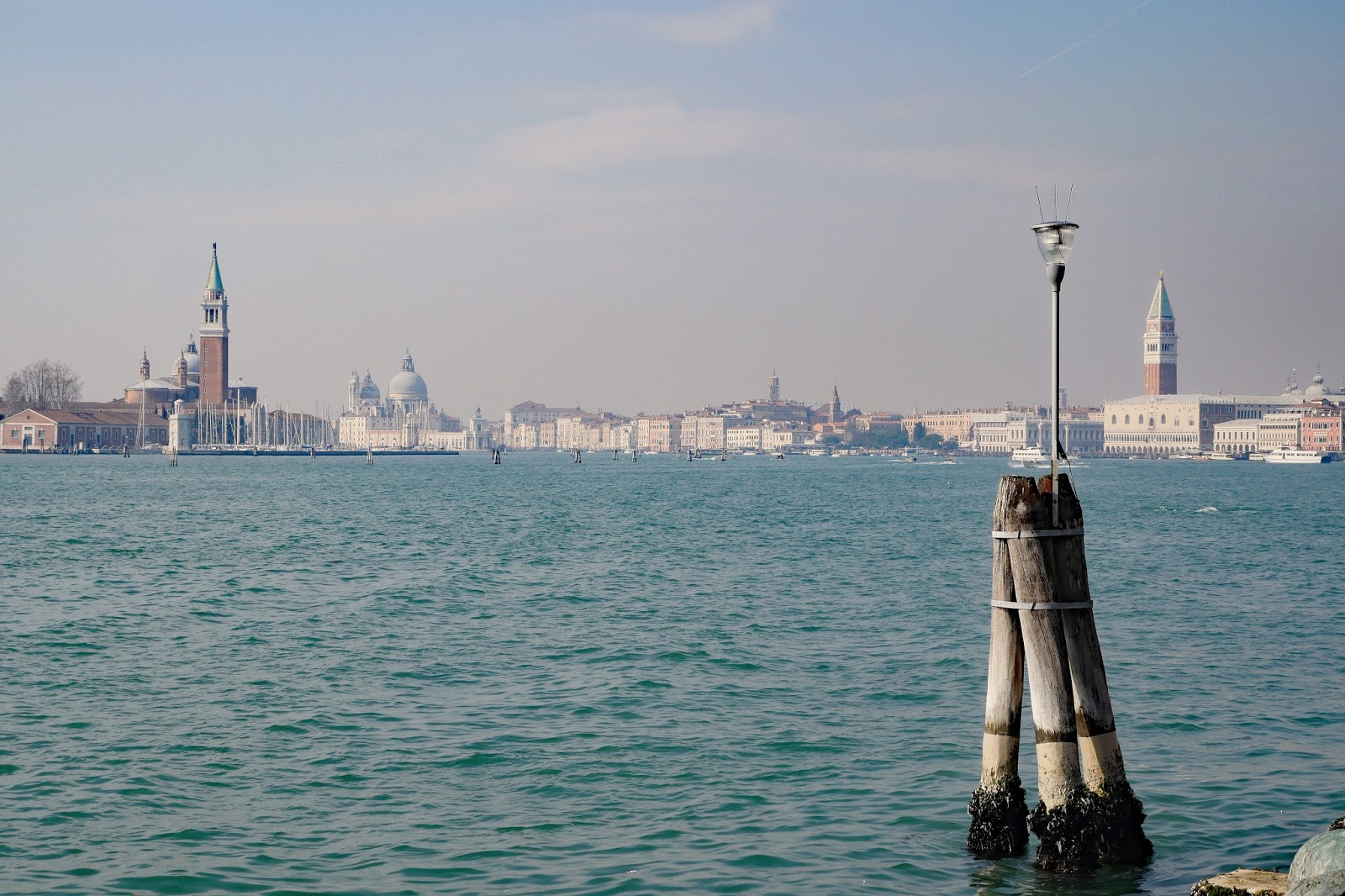
There was a great view back from the Giardini vaporetto stop with several of Venice's greatest landmarks all in view at once: from the right, the Doge's Palace and campanile of San Marco, the Dogana (Customs House), the churches of Santa Maria della Salute and San Giorgio Maggiore.

Deeper into the Giardini was the earliest building associated with the Biennale, this rather lovely greenhouse, now restored and used as a cafe.


Nearby, off the Via Guiseppe Garibaldi, was the 1885 monument to the great man.


We headed along the Via towards the island of San Pietro to find the church of San Pietro di Castelo. This was Venice's cathedral until 1807, when the role shifted to the Basilica of San Marco. It dates from the 11th century, but was several times rebuilt until the 17th century. The facade, rather weakened by the horizontal section above the main pediment, was designed by Palladio, two of whose churches we saw on our walk from Accademia to San Giorgio Maggiore.


The church faces the eastern end of the Arsenale, which features a number of rather lovely brick towers and turrets.


Conditions: a lovely sunny day.

Distance: About 5 miles including the walk back.

From: Venice. History. Mystery. Walks (AA publications).

Rating: four and half stars.


Saturday, 18 February 2017

Madonna dell'Orto to Santa Maria dei Miracoli

Madonna dell' Orto

Madonna dell'Orto (Our Lady of the Garden) is one the great Gothic churches of Venice and we thought we would start today's walk here and link it to one in our walk book. It was begun in about 1399 and the wonderful portal, by the great stone carver Bartolomeo Bon was begun in 1460. Inside there is wonderful array of paintings including a number by Jacopo Tintoretto, of which our favourite was The presentation of Mary at the temple (1552), a wonderful composition.


The house where Tintoretto lived is nearby: here is the wonderful statue on the bottom of the facade.


A similarly striking one, now with a metal nose, is on a nearby corner.


We returned to the long Fondamenta della Misericordia ...


... and headed away from this bridge in the direction of the Campo Santi Apostoli. This involved walking along the crowded Strada Nuova. This street was originally named for the King of Italy, Vittorio Emanuele II, when it was cut through a warren of streets and houses in 1871. It is the longest and probably the widest in Venice (it's only rival would be the Via Giuseppe Garibaldi where we plan to walk tomorrow).

The Campo Santi Apostoli houses the ancient church of the same name which has a wonderful campanile, rebuilt in 1672, with a fantastic sun dial. This was the start of our walk-book walk.


We left the  square and passed the church of San Giovanni Crisostomo to then go through small streets, Corte Prima dei Millione and Second dei Millione. Millione was the nickname of Marco Polo who was born in this vicinity, although precisely where is not known.

Soon we were in Campo San Marina near to where Casanova lived. We left the square by a small bridge with the imposing Palazzo Pisani on the right and Palazzo Dolphin along the canal on the left.


Further along there was this lovely Palazzo, name unknown, with a traditional chimney and fine exterior decoration.


Calle de le Erbe brought is to another great Gothic church, that of Santi Giovanni e Paolo, second only to San Marco. It was built by the Dominican order between 1246 and 1430 and has a magnificent portal by the same Bartolomeo Bon who did the one at Santa Maria dell'Orto.


Inside the church is higher (32m) and more massive than is apparent from outside. The soaring apse is the culmination of this. From the middle of the 15th century the funerals of Doges took place here and there are several monuments to individual Doges.


At right angles to the church is the exquisite Scuola Grande di San Marco. In Venice a Scuola Grande was the headquarters of a charitable confraternity - perhaps Rotary might be a secular modern equivalent. It is one of the finest Renaissance buildings in Venice.


The tromp l'oeil marble carving by Pietro and Tullio Lombardo is a particular delight.


Just round the corner is our favourite Venetian church, Santa Maria dei Miracoli, tucked into a small space beside a small canal. It was built in 1481-9 by Pietro Lombardo to hold an image of the Virgin Mary which had become the object of veneration and was believed to have occasioned miracles.


It is a simply exquisite building. Here is the inside, again with all surfaces covered in marble - and the altar unusually on a higher level than the nave. The coffered barrel vault is also pretty special.


Conditions: a lovely sunny day.

Distance: About 3.5 miles including the walk back.

From: (in part) Venice. History. Mystery. Walks (AA publications).

Rating: five stars.

Friday, 17 February 2017

Venice: Accademia to San Giorgio Maggiore


The Doge's Palace and San Marco campanile from San Giorgio Maggiore

Today's walk is derived from one in our walk book with some extra bits. It was cold and grey so we decided to start with a focused visit to the wonderful Accademia art gallery. It was a bit disorientating at first as there had been a major rearrangement since our last visit, but we soon found the 14th and 15th century masterpieces we wanted to see, notably Giorgone's The Tempest and one of the best of Bellini's Madonnas. However, the two most dramatic pictures we saw were a Madonna del Parto by an unknown Master (we saw Piero della Francesco's famous one at Monterchi a few years back) ...


... and San Crisogono (c 1375-1410) by Michele Giambono, a painter we had never previously heard of.


The inspiration for today's walk was Andrea Palladio, the great architect whose buildings we explored on a past holiday in the Veneto. One wing of the Academia complex is by Palladio and here is a view through a reasonably clean window - you can't unfortunately get out into the courtyard.


We headed along Rio Tera Antoniao Foscarini (Rio Tera denotes a canal which has been filled in to create a wide path) to reach the Fondamente Zattere, where we turned left to photograph Palladio's great church of the Redentore on the opposite side of the Guideca Canal. The church was the result of a vow to honour Christ the Redeemer made by the Venetian Senate in 1576 at the height of an outbreak of plague which killed 30% of the population.


We took the vaporetto across the canal and began the route from our walk book, turning right to reach the odd-looking, and much altered, church of Sant' Eufemia.


There was a nice view along the adjacent canal canal, reminiscent of those on the outlying islands of Burano or Murano.


We turned left and were passing the former convent of Santi Cosima e Damiano when we noticed an open door. It was undistinguished from the outside and has now been converted into apartments, but inside there was a quite beautiful cloister - a quintessentially Venetian moment.


We returned to the Fondamenta San Giacomo to soon reach the the Ponte Lungo with a fine view down its canal.

Not long after this we reached the Redentore for a close up of the facade.


 The interior was simple but impressive.


We continued along the Fondamenta to reach the Zitelle vaporetto stop where we made the short hop avross the Guiudeca canal to San Giorgio. From the boat there were nice, but misty, views across to the Dogana and Santa Maria della Salute. The facade of San Giorgio, also by Palladio, is similar to his later church of the Redentore but more monumental. The church was begun in 1566, but the facade was not erected until 1607-11, 25 years after Palladio's death. It was however precisely as he designed it.


The interior is quite austere, but grand.


 We headed towards the campanile, noting this lovely sculpture of an angel on the way.


The views from the top were most enjoyable, even if constrained by the mist. Perhaps the best were down to the cloisters ...


... and over the dome towards the Dogana (Customs House).


Back at ground level, and after a restorative grappa, there was a lovely view of one of the two lighthouses across the Basino of San Marco.


One final vaporetto took us across the Basino of San Marco and we couldn't resist a tourist shot of the celebrated Bridge of Sighs which linked the Doge's Palace to his prison.


Conditions: cold and grey.

Distance: about 3 miles.

From: Venice. History. Mystery. Walks (AA publications).

Rating: Five stars.

Thursday, 16 February 2017

Venice: The golden triangle - Accademia, Rialto and San Marco

The Basilica of San Marco

We have just arrived in Venice for a short break and we are staying at hotel midway between San Marco and Santo Stefano, so we set out to reacquaint ourselves with the city by doing a favourite triangular walk. We were soon in Santo Stefano, the large campo (square) named after the lovely Gothic church. Outside is typically red brick and white marble details.


Inside there is a famous - and almost unique - Ship's keel Roof.


We made the short detour to the Accademia bridge, one of only two across the Grand Canal. There is a great view towards the mouth of the Canal with the church of Santa Maria della Salute on the right and the Dogana (Customs House) beyond it.  


We headed off towards Rialto quickly reaching Campo S Anzolo, where there were a couple of classic palaces and the traditional well-head fed by an underground cistern.


Looking back you can see the leaning campanile of Santo Stefano, one of the tallest in Venice.


A sequence of narrow streets leads to the Rialto bridge. It is difficult to photograph from the right bank so we crossed over to the other other side to see it more clearly. It is always entertaining to remember that it was the work of Andrea da Ponte.


Now we doubled back to Campo St Bortolomio where there is an exquisite group of windows.


 We followed the narrow winding Merceria to reach San Marco where the facade of the Basilica was illuminated by the late afternoon sun.


So too was the adjoining Doge's Palace.


The 15th century Clock Tower however was in the shade.


There was, finally, a fantastic view across to the island church of San Giorgio Maggiore.


It remained only to head toward Accademia and return to our hotel So, all very touristy, but a great way to re-connect with the unique city that is Venice.

Distance: a couple of miles.

Conditions: bright and sunny.

Rating: 5 stars.