Showing posts with label Northamptonshire. Show all posts

Sunday, 24 April 2016

Lyveden New Bield and Oundle

Lyveden New Bield

Ever since we visited the extraordinary Rushden Triangular Lodge almost two years ago, we have wanted to see Lyveden New Bield, also the work of Sir Thomas Tresham. Tresham was a devout Roman Catholic who lived during the reign of Queen Elizabeth I. Catholicism was repressed in that era and Tresham was imprisoned for twelve years on account of his faith. Rushen gave coded expression to his beliefs and Lyveden, also built as a Lodge, was in the same mould.

The house you see today is not so much ruined as incomplete: work started in 1595, but Tresham died in 1605, deeply in debt, before it could be completed. The builders, who could see they weren't going to be paid, simply downed tools and left - and who could blame them. It is remarkable that the house survived.

Rather like Rushden, the house is laden with symbolism, with shield-like panels in sets of three (symbolising the holy Trinity) forming a frieze at ground level and a continuous frieze of seven repeated symbols, each representing aspects of the life of Christ above the first floor windows. The excellent audio guide also mentioned the number five as well (symbolising grace) and the five windows in each bay may be an example.


The house is perfectly symmetrical and is shaped liked a Greek cross, with curving bays at the end of each arm. The cross shape is easier to infer from this photo taken on an angle.


You enter through a servants passage (bottom left in the photo) and arrive in the basement which housed kitchens and other service functions. Looking up it was a surprise to see that the upper floors contained Renaissance doorways - but perhaps Catholics looked to southern Europe more than Protestants did.


It was possible to climb to one of the first floor windows and enjoy the view over the relatively flat Northamptonshire country side. The filed has apparently been sown by the National Trust as a flower meadow, and the mown bits will presumably be paths.


We walked from the house to explore the pleasure gardens starting with this attractive spiral hill surrounded on three sides by a moat.


A path led towards the old Manor House, owned by the National Trust but not open for visiting. You could just glimpse it through a hedge. It looked like the sort of building that might have inspired Charles Rennie Mackintosh: especially the rectangular windows, placed irregularly.


We walked around the edge of the orchard and reached another section of moat, with the house frame between the trees.


After this we simply retraced our steps to the car park and headed off to Oundle for lunch in the Talbot Inn. Oundle is a charming stone town, not quite as imposing as Stamford, but full of character. We parked near Paine's Almshouses (early 17th century) in West St, admiring the obelisks and pinnacles over the entrance door.


At the end of West St, a left turn into New Street brought us to the imposing Talbot Inn, with the buildings of Oundle School beyond.


Up on the right is a further part of the school, looking like an Oxbridge College, which was no doubt the model.


Conditions: bright but quite cold at times.

Distance: maybe a mile and a half - one of the shortest walks I have blogged.

Rating: four stars. Fascinating. It would have been good to have had time to explore Oundle more fully.

Thursday, 19 November 2015

Northampton

The Guildhall

Northampton is the second largest town in England (after Reading) and seemed a worthy target for an outing on the first dryish day for a while. I followed the Northampton Heritage Trail available on the Borough Council's website.

The walk starts at the Church of the Holy Sepulchre (1103), the oldest church in the town and one of only four surviving round churches in the country. The tower was added in the 15th century and the church was further enlarged in the 1860s.


These churches were built by returning Crusaders on the model of the Holy Sepulchre church in Jerusalem. The others are: Temple in London, the Round Church (correctly also Church of the Holy Sepulchre) in Cambridge and St John the Baptist, Little Maplestead, Essex. Having now seen three, I can feel a trip to Essex coming on.

Now you walk down to the very large Market Place, where the market was in full swing. My eye was drawn to this house in a quiet corner. It is the Welsh House, which dates from 1595 and survived the great fire of 1675. The facade was recreated in 1975 when the adjoining Grosvenor Centre was built.


At the bottom the Market Square I turned into pedestrianised Abington St which had a wide variety of building types including this rather wonderful art deco one.


And at the top of the road this even more splendid former cinema (it opened as the Savoy in 1936).


A right turn led to St Giles Church and across the churchyard in St Giles St were very grand early victorian houses. None of these last three were mentioned in the heritage trail leafle.


I followed Cheyne Walk and glanced at Becket's Well in Bedford Road before crossing the road into Derngate to encounter the greatest surprise and delight of the whole walk: number 78 is a house remodelled in 1916 by the great Charles Rennie Mackintosh, apparently his only work in England. The client was W.J Bassett-Lowke. And even more wonderfully, it is open to visit. The front is undistinguished, but the rear elevation shows evidence of Mackintosh's work.


You enter the house via the remarkably unspoiled kitchen and climb the narrow stairs to the fabulous living room at street level. There is wonderful stencilling on the front wall ...


... and equally marvellous coloured glass on the opposite wall, with the staircase behind.


At the end of Derngate is the extravagant Guildhall (see photo at the head of this post) by E W Godwin., completed in 1864. Next door is the 1992 extension. According to Wikipedia, it "was made to be sympathetic to the style of the rest of the building and the final choice made by public ballot from a list of several alternatives". I think it tones in very well.


Further on, you pass the Theatre, Museum and Session House to reach the imposing All Saints church. It was built after the great fire of 1675 to replace All Hallows church which was destroyed in the fire. The portico was added in 1701.


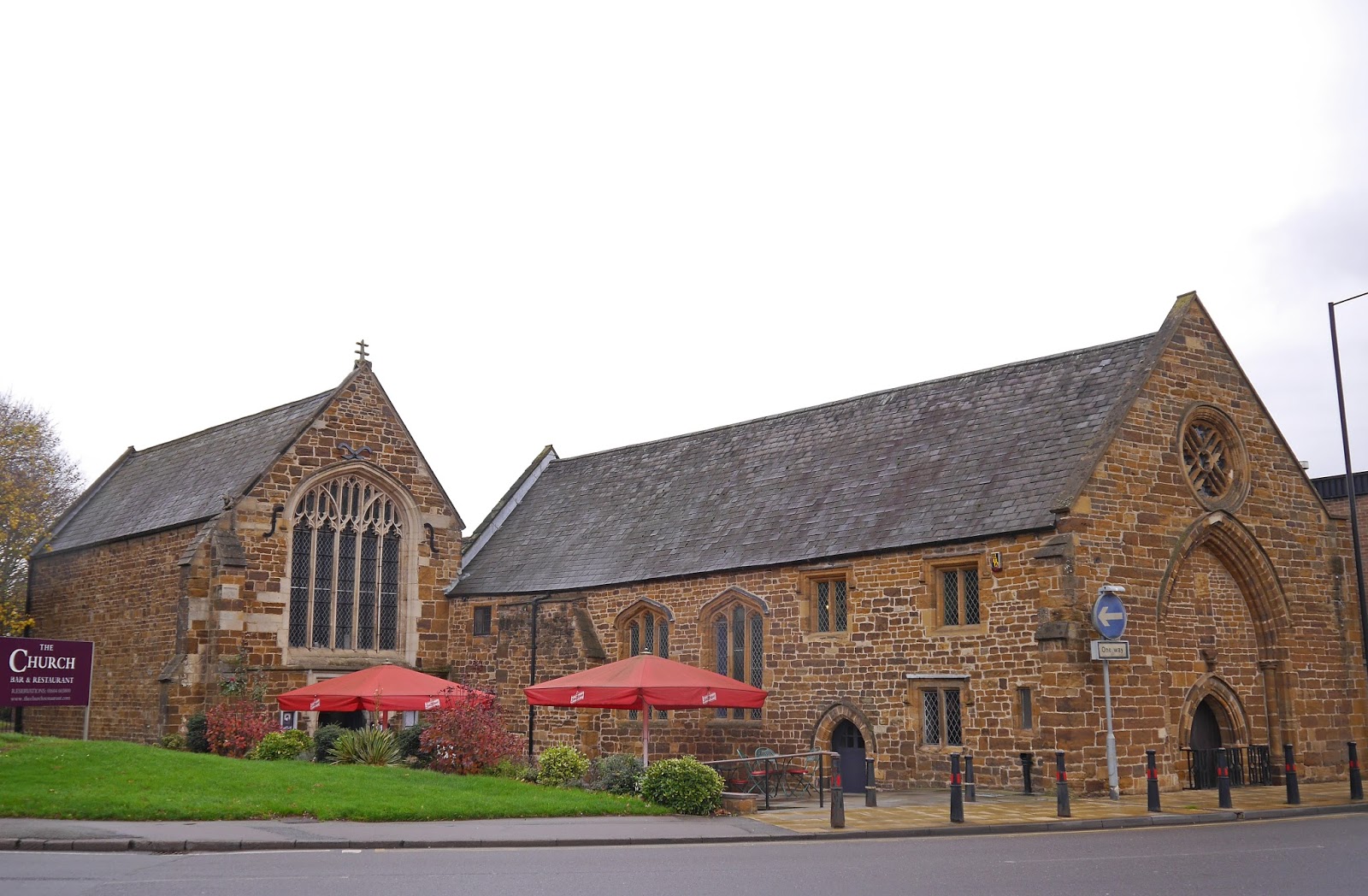
Now along Bridge St to reach the former St John's hospital and church, now a restaurant.


I now embarked on the optional excursion, involving an alleged 20 minutes walk to the south to see Delapre Abbey and Queen Eleanor's Cross. You cross the river Nene (not very pretty) and pass the Carlsberg brewery to then reach the entrance to Delapre Park. The Abbey lies at the end of long drive and is one of those quite numerous country houses built on the site of a dissolved abbey - Lacock Abbey or Mottisfont Abbey would be other examples. Unfortunately, it is being comprehensively restored and although I prowled all the way around the perimeter this was the best I could do:


Back to the road and up a steepish hill brought me to Queen Eleanor's Cross in Hardingstone. This is one of the 12 crosses erected by Edward I when his wife Queen Eleanor of Castile died in 1290. Eleanor died near Lincoln and the crosses marked the overnight stops of her funeral procession on its way to London. (I was interested to learn while researching this that the best-known cross, Charing Cross, just outside the station, is a Victorian replica. The original stood in Whitehall, not far away, and was destroyed during the Civil War.)


The long trudge back took more like half an hour, but it was good exercise and great to have seen one of only three of the original crosses still standing. And, according to a helpful plaque, this one had fallen down by 1713 and was then restored.

Back in the centre, I walked along Gold St into Marefare passing Hazlerigg House, an impressive Elizabethan building of 1580.


At the end was one last gem: the beautiful St Peter's church of 1160. Unfortunately, the churchyard and the church itself were both closed so I could not explore further. This may because the church is now redundant.


Conditions: grey and showery at first, becoming brighter later.

Distance: 5 miles including the diversion, more like 2 otherwise.

Rating: four stars. Very interesting and varied,

Friday, 23 May 2014

Rushton and Rothwell

Rushton Triangular Lodge

We owe today's outing with Sally and Malcolm to a TV programme about the English Renaiassance. The presenter, James Fox, described the extraordinary Rushton Triangular Lodge and it came to me that I could base a walk around it.

The Lodge was the work of Sir Thomas Tresham a devout Roman Catholic who lived in nearby Rushton Hall (now a luxury hotel). He was imprisoned for his faith for 12 years under Queen Elizabeth and when finally released he constructed this extraordinary building as an expression of his faith. The principal theme of the building is the Holy Trinity and this is reflected at numerous levels: the Lodge has three sides, and internally three floors, each side has three gables and three sets of windows, the windows have trefoil or triangular patterns. There are also various inscriptions, symbols and numbers, not all of which are understood. It dates from 1593-6.

We arrived just after a party of schoolkids and we were delighted that they were inside while we wandered round the exterior and marveled at it.

At length we began the walk over to nearby Rothwell along an roughly straight path across fields, crossing the tiny river Ise on the way.


Rothwell is a charming market town, but it was the ideal destination because of its most notable feature: the Market House. (Unfortunately unavoidably photographed directly into the sun.)


It was designed by William Grumbold for - yes - Thomas Tresham. It dates from 1578 and also incorporates trefoils, Tresham's coat of arms and inscriptions, but no religious motifs. It is a most impressive small building, looking a little run down now.

Just behind the Market House is the large and imposing Holy Trinity church. We liked the warm colours of the local stone of which it is built.


It is mostly 13th century although the tower dates from the 1170s. The church has one of only two known bone crypts or charnel houses in the country, containing the remains of around 1,500 people.

And just beyond the church lies Jesus Hospital, a lovely set of almshouses founded in 1586 by Owen Ragsdale.

The two buildings which project forward are linked to the main building at the back: an unusual variant on the common E shape for almshouses. The left one has a date stone 1835 and the right one 1855. Perhaps they were sympathetic Victorian additions or renovations.

Conditions: warm and sunny

Distance: four miles

Map: Explorer 224 (Corby, Kettering and Wellingborough)

Rating: Four and a half stars