Showing posts with label Liguria. Show all posts

Thursday, 17 September 2015

The Cinque Terre: Overview


 Vernazza
Introduction

Recent posts have described our wonderful walks in the Cinque Terre: Monterosso to Vernazza, Vernazza to Corniglia, Manarola to Riomaggiore, and also Levanto and Genoa. In this post I will try to summarise what we learned. Our experience was that it was hard to find detailed information before we arrived and several things remained mysterious the first day or two we were there. Hopefully this will be helpful to other would-be visitors. (Disclaimer: these are my personal observations, which I believe to be accurate, but I cannot accept responsibility for anybody relying on information which proves to be erroneous.)

About the Cinque Terre

The Cinque Terre are five pretty villages (in order from north to south: Monterosso, Vernazza, Corniglia, Manarola, Riomaggiore) located along a stretch of the coast of Liguria in Northern Italy linked by an 11km walking trail, the Sentiero Azzurro (Blue Trail). The section between Corniglia and Riomaggiore is known as the Via Amore (Street of love) and is said to be wheelchair-friendly; the rest of the trail is rocky and involves steep ascents and descents. A unique feature is that the villages are linked by rail: trains on the Sestre Levante to La Spezia line stop at each one.

Is the path open?

We knew that the path was closed in 2011 after torrential rain caused mudslides, but we found it hard to establish what its current status was. The Latest News page of the Cinque Terre portal, which you would expect to be a definitive source, has no information more recent than 2002 (!), while Wikipedia's page refers only to it being partly closed in 2012. There probably are more up to date websites. When we arrived we found a map in the Cinque Terre Office at Levanto railway station which had a handwritten amendment showing that the path was in fact still partly closed: the Corniglia-Manarola-Riomaggiore stretch has not yet (as of September 2015) reopened.

I am not going to speculate why this information is so hard to come by, but it is also worth noting that the signposts, which are generally very good, have not been altered either. As you arrive in Corneglia, for example, there are still signs pointing the way to Manarola and causing confusion and frustration.

Corniglia

Does it matter?

Not really. It is frustrating for completists like me, but it really does not detract from what remains a great experience. Corniglia-Manarola-Riomaggiore is the least interesting section to walk, the villages themselves are still accessible by train, there is a straightforward inland alternative from Manarola to Riomaggiore (just over 1h) and a more demanding one from Corniglia to Manarola (2.5h).

Access

As well as the coastal path, there is a network of paths in the mountainous area inland from the coast (the mountains reach 700 km above sea level). Access to the inland paths is not controlled, but to walk the coast path you have to purchase a one- or two-day Cinque Terre Card (from the Cinque Terre Point at railways stations). These come in two forms: walking only and walking plus train, the latter allows unlimited travel on the trains. There are checkpoints at or near the start of each section of coast path and you can pay here as well.

Manarola

Trains and maps

The train links provide great flexibility in planning your walks. Most people know that you have to validate your ticket before travel (i.e. have it stamped at a green machine located at various points on the station). The same also applies to the Cinque Terre Card, although it only has to be done once.

When you buy a Cinque Terre Card you are also routinely given a timetable and a very good map (we foolishly bought one which was inferior in a bookshop).

One thing which foxed many people us included was the two screen information displays showing arrivals and departures. It only made sense once we clocked that each train service in Italy has a unique number and by comparing these you can see exactly what is going on.

Temporary path closures

One day we were there the coastal path was closed because of the threat of thunderstorms. We were trying to buy tickets for the next day at the Cinque Terre Point when we found out. I am not sure if there is a system for publicising these closures, but we did find that the excellent Accuweather weather forecast site had information on weather warnings, so this would at least alert you to the need to check.

Where to stay

We stayed in the pleasant town of Levanto, one stop to the north of Monterosso, and travelled in by train each day. This worked very well although lots of other people had the same idea and on the sunniest day there was a long queue for tickets (we bought a train ticket from the machine and a walking card at our destination, which saved some time).

 Levanto station: the train was late

We liked Levanto, which has a nice beach and some good restaurants, but I can't make a comparative judgement over the other villages.

Levanto

North-South or South-North?

I suppose because we were staying to the north of the Cinque Terre, we decided to walk North-South, but clearly plenty of people were coming the other way. One key factor to bear in mind is that at Corniglia there is a massive ascent (said to be 358 steps) from the train station to the village. It certainly makes better sense to finish a walk there than to start one!

Steps down at Corniglia

Wednesday, 16 September 2015

Genoa

Castello Mackenzie

We're on our way home from the Cinque Terre, but we have an afternoon to explore Genoa, Italy's sixth largest city, but not a major tourist destination. A particular objective was to see the Castello Mackenzie. We set out from our hotel near the Piazza Principe station to soon reach via Garibaldi, famous for the Rolli Palaces. This a group of 16th century palaces, built in Genoa's golden age which were recorded in the register or rolls (rolli) of the noble families who aspired to host distinguished visitors to the city. They were declared a Unesco World Heritage Site in 2007.

At the entrance to the surprisingly narrow street, we were immediately struck by a riot of colour and decoration, and by the green palace on the right whose exterior was actually painted, and by the facade which was in need of restoration.


 We looked at the beautiful interior courtyard of the Palazzo Rosso.


 And further on we admired the extravagant exterior of the Palazzo Nicolosio Lomellino ...


... and ventured in to see the extraordinary nymphaeum. 


At the end of via Garibaldi we turned left up via Interiano to reach Piazza del Portello and take the lift up to the Spianiata di Castelleto, a celebrated viewpoint over the city. The top of the lift tower and the entrance area below have lovely art nouveau details.


It was a bit hazy from terrace at the top, but we could see in the port area the celebrated medieval lighthouse, the Torre della Lanterna ...


... and look down over the palaces we had just walked past to the tower of the cathedral beyond.


We caught the lift back down (good value at .90 euros) and began our major detour to see Castello Mackenzie, which probably doesn't loom large on most itineraries around Genoa. We reached Piazza Corvetto and headed uphill along via Assarotti. At Piazza Manin we climbed some steps by the Esso garage and turning left at the top soon reached the Castello. It was built between 1893-1905 for Evan Mackenzie a Scottish insurer by the architect Gino Coppede. Here is the main facade and a detail of the exterior decoration.


 Now we wandered inside and asked if we could possibly have a look around. After a moment's uncertainty and a reference to someone unseen in a back office, the man behind reception very generously gave us a guided tour! We could hardly believe our luck. The Castle is now used for auctions by Cambi, a company specialising in the fine arts, and the rooms were mostly full of stock, but it was just wonderful to see inside. We were especially struck by the arched entrance hall ...


... and the stairway with its stained glass and renaissance-style fresco including a depiction of Evan Mackenzie briefing his architect.


The chapel was also very impressive, as was the library. We were also shown a gallery at the base of the main tower where there was a moving memorial tablet to Evan Mackenzie's son Mario, a pilot who was killed in 1917.

We now made the long trek back down into the city centre, passing the delightful art nouveau shop, Finollo, now (perhaps always) selling ties.


Our next destination was the 12th century Porta Soprana, once part of a very extensive set of town walls.

In front of the gate and to the right was the exquisite cloister of the lost convent of Sant'Andrea, now merely a nice place for a picnic.


From here we headed towards the magnificent cathedral. On the way we passed the magnificent 16th centre Palazzo Ducale, or Doge's palace (who knew that Genoa once had a Doge as well as Venice?). It reminded us of the Winter Palace in St Petersburg, I suppose because of the number of columns.


Then we came to the cathedral with its superb symmetrical black and white facade. (The symmetry is lost higher up as there is a tower on the right side but not the left.)


The inside similarly dramatic at the west end ...


... but more baroque at the east end. It is like being in two different churches.

By now we were tired and ready to head back to the hotel, but there was one final unexpected delight: the church of San Pietro in Banchi, with its frescoed facade including painted balusters, mirroring the real ones in front of the building.


Conditions: warm but cloudy, at least the threatened thunder storms did not materialise.

Distance: we walked about 5 miles in total. There was still much we did not see.

Rating: four and half stars.

Tuesday, 15 September 2015

Manarola to Riomaggiore (Cinque Terre 3)

Manarola

We took the train to Manarola and walked down a tunnel into the town, then downhill through the initially crowded to the coast path from Corniglia. This offered a great view of the village as it clings to the rocks.

Continuing round the headland, there is clear view of the path running horizontally across the hillside and you can clearly see where there have been landslips and where the path is interrupted. We did wonder why it has not been repaired ...


Now it was a case on of onwards and upwards to fond the alternative inland route, because the coast path also remains blocked between Manarola and Riomaggiore. We headed up the main street, surprised to find small boats parked there opposite the tourist shops.


The main street winds upwards to open put into a small square opposite the church of San Lorenzo (1338). The facade is marvellously simple, but the interior has been given the baroque treatment.


Opposite the church is a fine capanile. Our guide book offers no date and observes, mysteriously, that "it probably had a defensive function".


Just beyond the church is a path junction and we turn right and then immediately left to begin a strenuous and steep climb up the hill at the back of the village (see the picture at the head of this post). Pausing part of the way up, I was able to take this picture of the upper town seemingly surrounded by terraced vineyards.


Eventually you almost reach the top, with worryingly tired people stumbling towards you on the descent. The top itself is a fairly level stretch of perhaps a hundred yards ending in a small copse of trees, where I saw the first butterflies of the day: Red Admiral, Clouded Yellow and this wonderful Two-tailed Pasha, one of a mating pair.


Now we began the descent, which was mercifully shorter and less steep. We just loved this light railway system, where the driver seemed to have to keep a screwdriver firmly pressed onto some contact to keep the motor running.


Then there was our first view of the final village of the Cinque Terre, Riomaggiore. It seemed less dramatic and picturesque than the others and in danger of being hidden by the cloud which had been getting lower and lower as the walk progressed.


We headed downhill and followed the road into Riomaggiore, walking first of down to the lowest level to locate the station. We then started to walk through a tunnel towards the village centre when we spotted a lift to the upper town. We took this and headed towards the church passing the Municipale, which had fading, but wonderful, wall paintings all over the outside. This is a small sample.


The nearby church of San Giovanni Battista dates from 1340 (in fact all the Cinque Terre churches date from the 14th century), although it was enlarged with a new facade in 1870.


It remained only to follow the main street downhill and have a refreshing drink at a nice bar overlooking the marina.

Conditions: warm, but ofetn cloudy.

Distance: we probably only walked about 4 km in total.

Rating: four stars.

Monday, 14 September 2015

Vernazza to Corniglia (Cinque Terre 2)

 Leaving Vernazza

The path out of Vernazza is right across the street from where we arrived yesterday afternoon. Off we go up steps to soon be high enough above the village to take a view back over it showing the castle on the left and the church of Santa Margherita di Antiochia on the right. Monterosso is in the background.

We eventually emerge onto a more level area and are surprised by the number of cactuses with their orange fruits.


We think we have maybe reached a level but this proves to be naive and we climb a long series of steep stone steps to eventually emerge at a point where we can see our destination, Coniglia, for the first time. Almost immediately we arrive at a bar, in the middle of nowhere, straddling the path as it turns inland for a bit. We stop for a fresh orange juice and to enjoy the view ahead.


The next phase involves a steady descent along a very rocky path towards Coniglia. At one point there is a great view back towards a hill-top village, which I think is San Bernardino from the map.


We descend steadily and are soon on the outskirts of Coniglia, the only one of the Cinque Terre not at sea level, with multi-coloured houses arranged all up the hillside.


When we reach the village we discover that one narrow main street winds between the tightly packed houses, just opening out for a small central square. We are very taken with this statue.


 At the end of the narrow, winding street there is a belvedere over the sea: this is the view back.


We retrace our steps and visit the church of San Pietro, which dates back to the 13th century. The beautiful rose window is from 1351.


The inside has a more baroque feel and is richly painted. We loved this, presumably quite modern, stained glass in the east end of the church.


We had seen signs for Manarola and were hoping against hope that the next section of path was therefore open - even though we had been told yesterday that it was closed as a result of the landslide of 2011. Gradually it became clear that it was closed - why weren't there some signs we wondered? The route would have been down 375 steps to pass beyond the station and along the mid-cliffside path to Manarola, no more than 25 minutes away.

The only alternative was a 2.5 hour hike up into the mountains and along a parallel route at high level. We just did not feel we had the stamina for this and so made the switchback descent to the station instead.


With the aid of my zoom lens, I did at least manage a nice view of Manarola from the station platform.


Conditions: warm (25 degrees), still quite humid.

Distance: it is only 3.45 km between the edges of the two villages, plus whatever walking you do in them. The official map suggests one and a half hours for the main walk. We took a bit longer with pauses for rest and photography.

Rating: four and half stars. A varied and interesting section, with more open views than yesterday's

Saturday, 12 September 2015

Monterorosso to Vernazza (Cinque Terre 1)

Monterorosso

Today we start to walk between the five villages of the Cinque Terre. We catch the train from Levanto, where we are staying, to the most northerly village, Monterosso. We had naive hopes that the main tourist season might have passed, but the train is crowded and when we arrive at Monterosso the area around the station, which is on the promenade at the far end of the beach, is absolutely heaving. Oh no, we fret, are we going to be shuffling along the famous coast path?

We walk to the end of the promenade and observe most people carrying on through a tunnel under a rocky headland. Our South West Coast Path ethos kicks here and we studiously walk round the headland to emerge in the main part of the village, where we are delighted by the loggia at the back the church of San Giovanni Battista (rebuilt at the end of the 13th century)


We continue along the back of a smaller, quieter beach and follow a rising path at the end. There is a steady stream of other walkers, but we have left the real crowds behind.  There is soon a lovely view back over the town and you can see the rocky headland which divides it. The tower nearest the sea is described as being "in the style of 1500" and is presumably therefore Victorian.


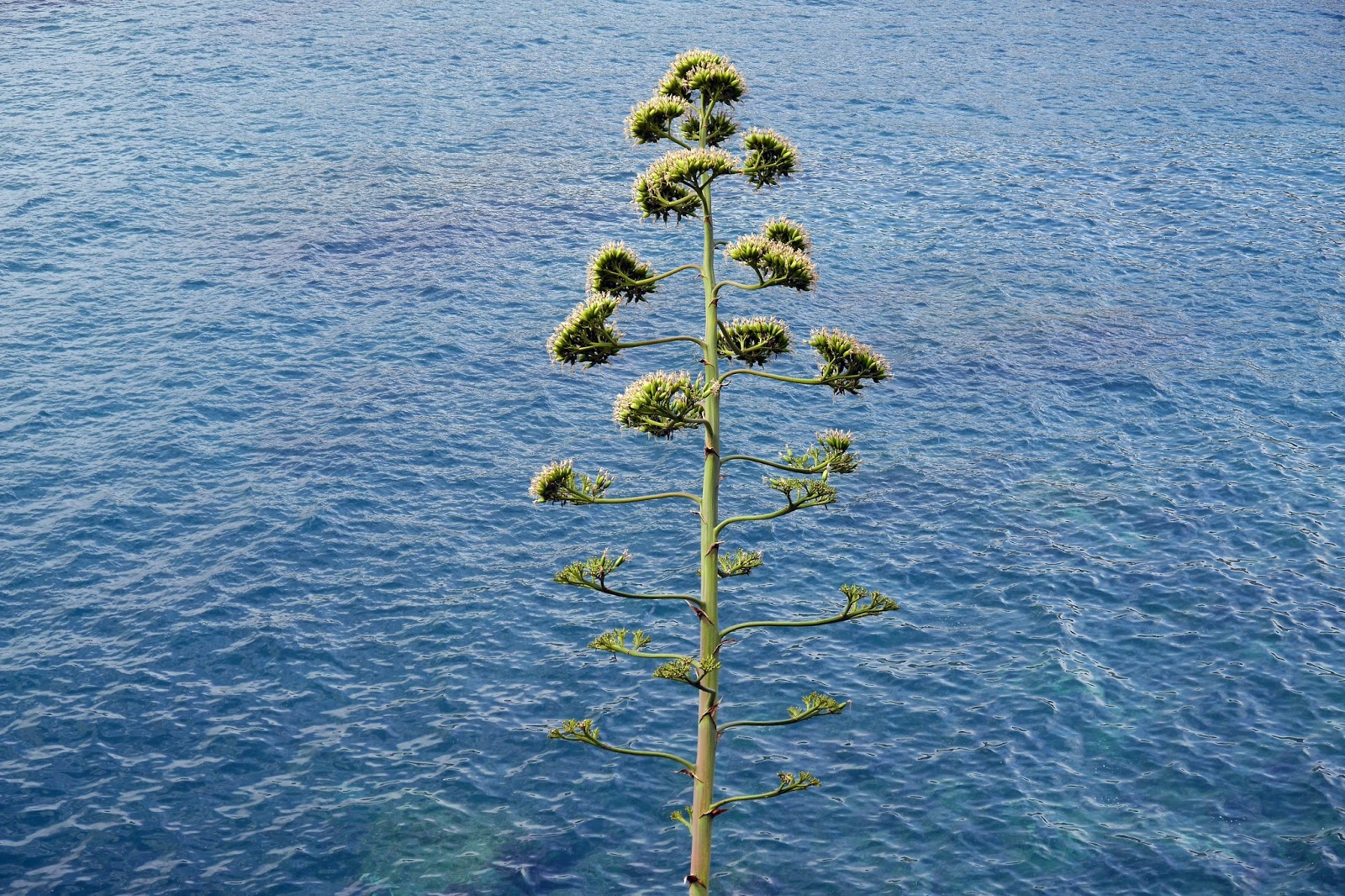
There are several of these dramatic plants leaning out over the sea. We have seen the same thing on the Costa Brava in Spain,


We continue to climb as the path becomes steeper and more rocky, passing the control booth where you have to show (or buy) your day pass to walk along the coast path. Many more steps bring us to a short level stretch of path behind a terraced vineyard.


The path is very narrow in places and there is a significant traffic of people in both directions. It is a bit frustrating to constantly have to stop to let others pass. Gradually the numbers thin out a bit, but you are seldom alone for more than few moments. It's the same for all of us of course.

At some point we passed a headland and the views from now on are ahead only. We came to a viewpoint from which the whole of the Cinque Terre stretched out ahead.


A bit more climbing brings the first clear view of today's destination, Vernazza, far below.


The path follows a fold in the coast and where a small stream crosses it there are a few butterflies. I took this picture of what I think must be a Purple Hairstreak which has been subject to a bird attack and lost the orange spots and tails at the base of the hindwings. (These are actually a defence mechanism as they look like a head. It looks as though the defence worked.)


Suddenly there is a quiet section and we are walking along on a level, enjoying the peace and the easier walking. Ange says "isn't it nice to be able to see the clear path ahead and not be following perspiring Americans". Before I can respond, I voice from behind me pipes up "What about Canadians?". I say that we love Canadians and we walk along enjoying a pleasant chat for a while. This only ends when Vernazza springs into view in all its glory and I stop sharply to take some photos - our Canadian friends carry on.


Now the inevitable long descent continues until we enter the village via a narrow street. We turn right at the end and head down to the waterside to admire the church of Santa Margherita di Antiochia (13th century).


We had spotted that the highest point of the village was the ancient fortress and we had also noticed a large canopy which we thought must denote a restaurant. We found a sign for the Ristorante Castello and plodded up some steps to a narrow street leading to another set of steep steps (just what we needed!) to enjoy an excellent lunch in a prime position looking back toward Monterosso.


Conditions: warm (25 degrees), quite humid and, yes, we did perspire ourselves.

Distance: it is only 3.6 km between the edges of the two villages, plus whatever walking you do in them. The official map suggests two hours for the main walk. We took a bit longer with pauses for rest and photography.

Rating: four and half stars.