Showing posts with label tower. Show all posts

Friday, 12 May 2023

Lille: From south East quarter to the Place de Theatre

Arriving in Lille, we took a taxi to our hotel. It was a bit of surprise as it was previously the Faculty of Medicine and Pharmacology  It proved to be a spacious building with a couple of quirky features to greet us ...


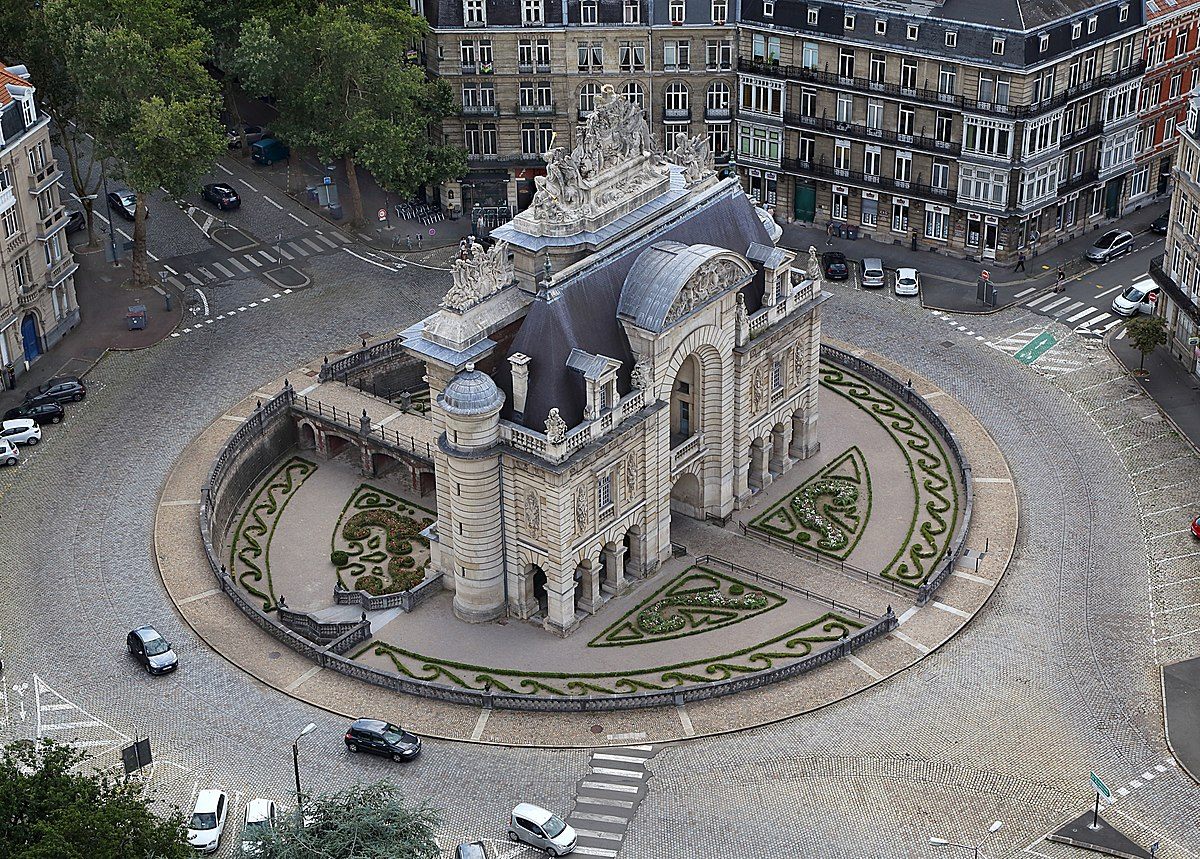
We began our exploration of the city by turning left out of the Hotel. Our first major sight was the beautiful Porte de Paris. It was built in the 17th century to commemorate Louis XVI's capture of the city.


This aerial photo gives a much clearer idea.


We headed towards the Town Hall, with its slender belfry in the art deco / Flemish style. It is 104m tall.
 

Sadly, it wasn't possible for us to get to the top, but we enjoyed this stonework at the bottom of the tower.

 
Over to the left was the Hospice Gantois founded by Jean de la Cambe  in 1462 and extended in 1664 and 1672. It remained a hospital until 1995. It is a 5 star hotel.

                        File:Lille hospice gantois.jpg

Heading away from the Hospice, we reached the imposing St Sauveur church.

Further to the east is the Noble Tour, a rather unprepossessing structure. It is what remains of of a fortification built during the 100 Years' War by Philip the Bold, Duke of Burgundy. When Lille became French in 1667, Vauban converted the tower into a half-buried powder supply depot. Within the three-metre thick walls, are two superimposed rooms; one has a vaulted ceiling with intersecting ribs, the other has a low dome of brick, illuminated by three small openings: they are reached by a staircase in a tower. 


From here, we eventually reached the Place du General de Gaulle. This is the Opera.


And here is the famous Morel et Fils. It was once a lingerie shop and later a bookshop. Nowadays it is a popular cafe.

Nearby, the CCI, The Chamber of Commerce of Lille is an important landmark in the city. The clock tower plays popular songs in the Theatre's square.

 
The final photo in this part of the city shows the Carlton hotel, where we stayed on a brief visit many years ago.

Finally, we passed the Palais de Beaux Arts on our way back to the hotel. Sadly we had run our of time to explore its delights including works by Monet, Rubens, Goya, Breughel, Van Gogh ....


Thursday, 15 September 2022

Sissinghurst

We are fulfilling a long-held wish to visit Sissinghurst. There was a house here in Saxon times, but what you see today (notably the Tower) dates from the 16th century and later. During the Seven Years War (1756-63) it was used as prison camp for captured French sailors and thirty years later as a work house for the poor.  New owners made improvements in 1839, but much of what you see today was the work of Vita Sackville-West and Harold Nicholson who bought the castle in 1930. They laid out the gardens and and transformed the stables into the Long Library.

You go through the archway ...


.... and are immediately confronted by the Tower. We climbed up the steep spiral staircase, passing Vita's writing room, and emerged onto the top of the tower.


 There is a great view looking back towards the Long Library, with the Oast Houses in the background.


There is also a nice view of a section of the gardens.


Returning to ground level, we explored the grounds ...

... and some of the lovely Gaura flowers, a new one for me.

Then we headed off for refreshments, passing the Elizabethan Barn on our way.


And finally, as we departed, we had a good close up of the handsome Oast Houses.


Thursday, 9 September 2021

St Peter Port ("Town")


                                                       Castle Cornet from our hotel

We started this walk from our hotel, Le Fregate, and followed the narrow lane to turn left at the end and discover the Priaulx Library (once known as Candie House) built in the 1780s.


Then left into Candie Gardens where we found a fine statue of Queen Victoria (an exact copy of the one by the Houses of Parliament in London). Nearby is the Guernsey Museum and Art Gallery, which we enjoyed wandering round.

Next we went to the wonderful Victoria tower nearby. It was built in honour of a surprise visit to Guernsey undertaken by Queen Victoria and Prince Albert in 1846. It was the first ever visit by a reigning monarch and it was decided to build the tower, funded by public subscription. The foundation stone was laid in 1848.

Rather wonderfully, access to the tower is controlled from the Museum. Would-be visitors have to get the key and hand it back when they have finished. It was a stiff climb to reach the top, which offered a very nice panorama over the town as far as Castle Cornet. 

We headed downhill, passing Elizabeth College. It was founded in 1563, but the main buildings date only from 1826. The architect was John Wilson, who built a number of buildings in St Peter Port. As a sometime Sociologist I was delighted to see a sign towards the Social Science wing.

Down the hill from Elizabeth College was the church of St James-the-Less, built in 1818 to provide an English-speaking C of E church for the British Garrison. This too was the work of John Wilson.


We continued downhill to reach the Harbour and St Peter Port Parish Church (known generally as Town Church). It dates from at least 1040, but the church you see today assumed its present-day appearance around 1500. The nave, tower and chancel are out of alignment, possibly due to the cramped sit.


Behind the church are the handsome and imposing former market buildings.

We now headed uphill to see Victor Hugo's House, Hauteville House. Victor Hugo lived there in exile for 15 years (1855-70) during the regime of Louis Napoleon. The house is now a museum, but was sadly not open.

We were struck by the blue post box on the wall opposite.

We retraced our steps to the harbour and walked out along Castle Pier to reach Castle Cornet, which was developed as a defence as soon as King John lost Normandy to France in 1204. This is what the approach looks like now ...


... and here is an earlier version, when the Castle was on an island. The magazine in the Castle keep was struck by lightning in 1672 and never replaced.


It is a complicated and rather unlovely structure with buildings from different dates jostling with each other. I thought this was one of the most atmospheric parts.


I was also rather taken by the Gaol.

To concluded our walk we followed the harbour side to the Albert Pier, from which we would later depart on the Condor ferry, to photograph the Liberation Monument which commemorates the end of the German occupation of Guernsey.


Conditions: warm and pleasant. 

Distance: 3 miles.

Walk done on September 9.