Sunday, 5 September 2021

St Peter Port, Fermain Point, Sausmarez Manor and Fort George


Castle Cornet, seen from our hotel balcony

We arrived last night in Guernsey and settled into our hotel in St Peter Port, the largest town in Guernsey. Our main plan today is to to walk some of the Guernsey Coast Path and at some later point explore the town of St Peter Port.

We head down to the harbour side and walk south, passing the Parish Church with the wonderful former market behind it (these will feature in the town walk at some point). The surprising factor this morning is that an unexpected sea mist has blown in and everything is very hazy. We walk past the entrance to Castle Pier and we are unable to see Castle Cornet at the end of it. The entrance to the underground Military Museum is less hazy.

The next section overlooks Havelet Bay (not that we can see it). We pass an area of bathing pools which some hardy people are enjoying only to discover that the route we are following has been closed. We retreat and find an alternative, higher, route. They might have warned us!

We soon pass the handsome rear entrance to Fort George (of which more later).


We are now into proper walking, lots of ups and downs, largely in woodland. We reach Clarence Battery which was built as a defence against the French and was one of the outliers of Fort George. It was known originally as Terres Point Battery, but was renamed in honour of George III's son 1815. The basic idea was for this battery to be able to provide cross-fire with the guns as Castle Cornet.

As we approached Fermain Point we emerged into a street with houses on the right and an incredible display of Buddleia on the seaward side. There were an incredible number of Red Admirals in flight, and a lone Painted Lady. I suppose I should have taken a photo, but I have loads already, so I didn't.

We continued through more woodland and emerged overlooking Fermain Bay. The pretty Bay couldn't be seen clearly, but the Pepperpot Tower stood proud through the murk and surrounding sun umbrellas. 

It is one of a series of 15 towers built between 1778 and 1780 (12 of which remain). The loopholes provided a defence against any possible approach while cannon could be fired from the roof. The primary purpose was to defend against the French.

We enjoyed a light lunch from the beach cafe and headed inland to find our way to  Sausmarez Manor, inland without the sea mist. This is Guernsey's only stately home and now offers all sorts of amusements for its visitors. It is however a very attractive building.

We then set out to walk back to St Peter Port.We passed this fantastic Victorian building, now a care home ...

... and admired a church conversion into four houses.


We soon reached Fort George and went through the imposing gateway.

Sadly, inside the walls there is almost no trace of the former military establishment, just this impressive enclosure with a modern house inside. 


The rest of the site is housing.

We walked around the outside of the walls and then rejoined the original path out.    


Sunday, 29 August 2021

Swanage and Durlston Country Park


We are making a flying visit to Poole and decided to take a local walk starting from Swanage. We first did this walk in February 2011 when it formed the third stage of the South West Coast Path. We parked in the long stay car park overlooking the pier and the first thing of notice was the pair of Ionic columns, which mark the entrance to Prince Albert Gardens. They date from the early 19th century and were brought to Swanage by John Mowlem.

The gates were quickly followed by an obelisque. 


This turned out to be one that was erected to commemorate the life of Prince Albert and is believed to be the first in the country to be built after his untimely death at the age of 42 in 1861. It was located in the High Street, next to where the British Legion is now, but was taken down in 1971 to make way for a new row of houses. Permission has been given permission to be rebuilt in Prince Albert Gardens, although the work is not yet complete. It overlooks Swanage Bay, close to Peveril Point where the prince is said to have disembarked from the royal yacht in the 1850’s.

 Next there was a nice view of the Pier with Ballard Down behind.


Now we passed a rather beautiful tower, which we had looked at from afar in 2011. 


The Wellington clock tower was originally built in 1854 in honour of the Duke of Wellington near London Bridge, but was soon found to be impeding the traffic and taken down. George Burt, a nephew and business partner of John Mowlem,  removed the stones to Swanage and rebuilt the tower in its present location. The clock never followed, and a spire was removed in 1904 as it had become unsafe. 

 We headed towards Peveril Point and then enjoyed a nice view along the Coast Path toward Durlston Castle.


As we got closer to Durlston we could see that a lot of improvements have taken place since we were last here: the fairly basic path is now chanelled by low stone walls on either side, with occasional places to sit and admire the view. Well done to Durlston Country Park!

We paused for some ice cream and to admire Durlston Castle. 


The Castle's website explains that it was built as a restaurant by George Burt (who we have heard of before) and was part of his grand plan to create an exclusive housing estate on his land as part of his dream of transforming Swanage into a fashionable resort. On this occasion we didn't visit the wonderful stone Globe, also installed by the indefatigable Gorge Burt.

We now headed along the Coast Path towards the Lighthouse at Anvil Point.


Looking back there was a great view of Tilly Whim Caves.


We passed the Lighthouse and headed inland to locate a pleasant country path which was parallel with Durlston bay and which led us all the way back into Swanage. We loved this gargoyle (one of several) as we passed by ...

At the end we turned into the High Street towards to the town centre and admired several of the buildings: the Congregational Chapel, now United Reformed Church  ...

... the imposing Purbeck House Hotel ...

... and the Town Hall. This is essentially an unremarkable building to which has been added a superb facade by Sir Christopher Wren no less. Inevitably it was George Burt who rescued it from the Mercers' Hall in London's Cheapside.


After this we quite soon returned to our starting point.

Map: Explorer OL15 (Purbeck and South Dorset).

Book: 50 walks in Dorset (which we also used in 2011).

Rating: four stars.

Sunday, 22 August 2021

Tollard Royal and Ashcombe House

 St. Peter ad Vincula

We are on our way back home from a visit to Poole and it seemed like a good idea to do a walk on the way. This 4.5 mile walk from Tollard Royal, just in Wiltshire, seemed the perfect choice. We parked by the interesting church of St. Peter ad Vincula (St Peter in Chains") which dates from 1469, with later alterations. It is one of only 15 churches in England with this dedication, which is taken from the Basilica of San Pietro in Vincoli in Rome.

Nearby is King John's House. It has nothing to do with King John and is instead a former manor house which was later a farmhouse, and has at its core a 13th-century hall house. Remodelling in the 16th and 17th centuries added wings, in part timber-framed. Augustus Pitt Rivers restored and extended the house, and opened it to the public around 1890 as a museum, but by 1907 it was again a residence. (Information from Wikipedia.) You can get a glimpse of half timbering, but nothing more.

The village is charming and a delightfully whimsical programme is clearly underway to enhance it. The first house we passed had this delightful workman suffering a slight mishap. 

Across the main road is the village pond and here a gnome seems to be fighting off a large snake. There were several other examples.

Now we started the walk proper and walked up path to the left of the pond and then forked left to follow a delightful track at the bottom of a sloping hillside.

There were innumerable Meadow Brown, White and Common Blue butterflies.

Further along we began to diverge from the hillside and some very attractive open country lay before us.

Soon we encountered a series of path junctions and after some deliberation managed to work out the right route heading north along a ridge. We walked through the wide-open spaces to reach a decision point. "Cross a stile and turn right along the byway" said the walk book, but we could not locate these vague descriptions. We spotted a trig point which gave us confidence to head off to the right and we followed a path which had other people heading towards us, though not close enough to intercept.

This route led us skirt the edge of Ashcombe House, of which we could see nothing at all. There have been several buildings on the site and according to Wikipedia, the current Ashcombe House was originally part of the much larger mid-eighteenth century structure, and is an L-shaped three-bay survival of the eastern wing.

Once we emerged from the wooded grounds we found difficulty in finding the route back to Tollard Royal. We followed a tarmac road which meandered through the countryside confident that we were on the right route.

Near the end of the road we realised that we had somehow missed a turning as we were back at the "delightful track at the bottom of a sloping hillside" as described earlier. Chastened, we followed the track back to the village pond.

Conditions: very pleasant.

Distance: 4.5 miles.

Map: Explorer 118: Shaftesbury & Cranborne Chase.

Rating: four stars.

Source: 100 walks in Wiltshire (The Crowood Press). The walks in this book are very inviting, and we have done several of them, but the walk descriptions seem always to be lacking in precise detail. We have several times got lost.

Thursday, 19 August 2021

Dunster Castle and town

The Gatehouse

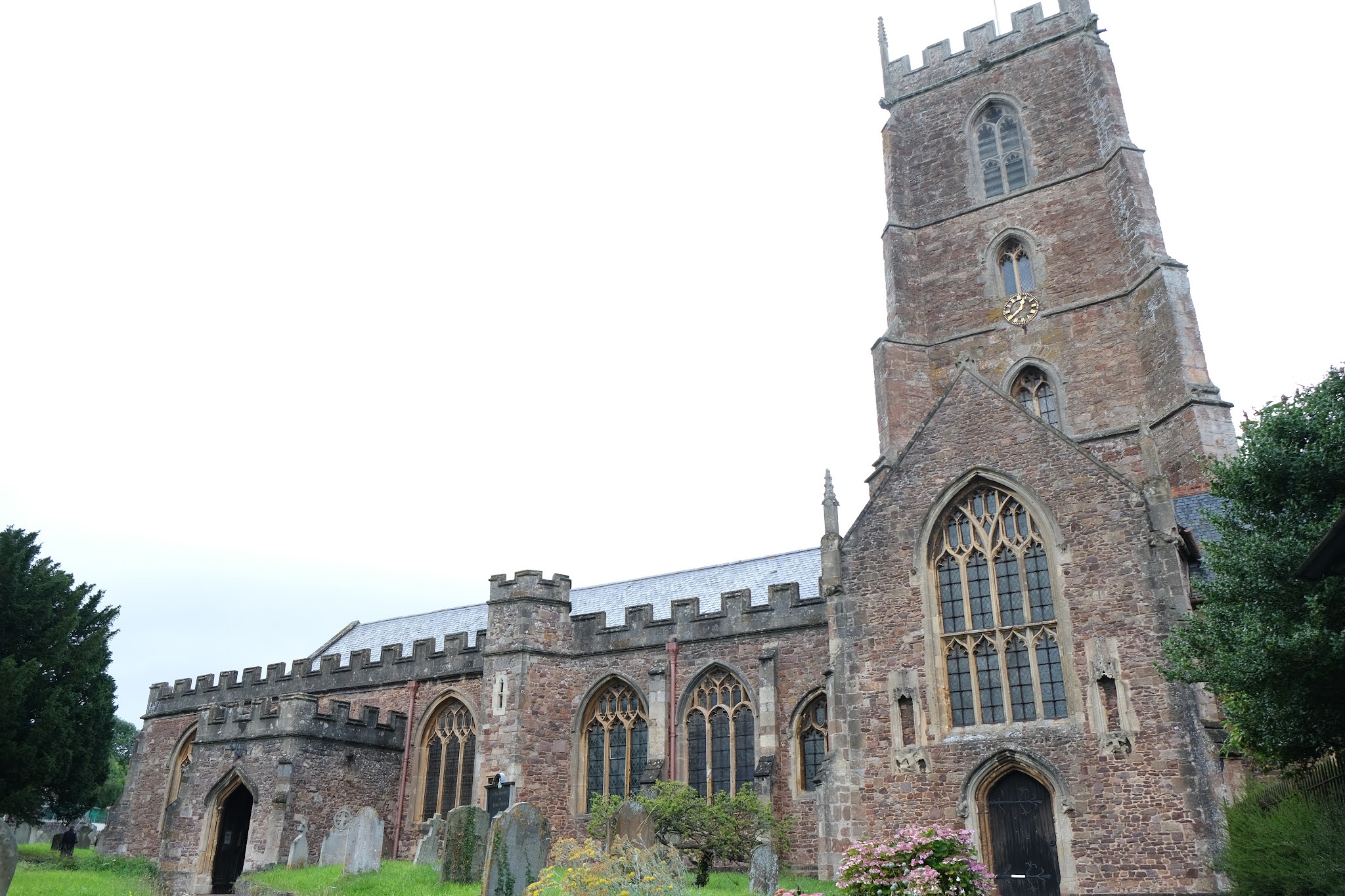
On our way home from Lynton we decided to stop off at Dunster Castle, near Minehead. We had passed by the entrance several times in the past as we returned home from visits to North Devon, but there never seemed to be the right moment to stop.

The first castle on the site was built - of wood - just after the Norman Conquest by the De Mohun family. According to the Dunster website,  the De Mohuns sold the castle to the Luttrell family in 1376 and they were responsible for most of what we see at Dunster today. They built the gatehouse in 1420, created a Jacobean mansion in 1617, defended and saved the castle during the English Civil War and updated the castle in the Victorian era. The Luttrells lived there for 600 years until 1976 when the property was gifted to the National Trust.

Nowadays visitors go through the massive Gatehouse and then reach the 13th century lower level gateway with its massive iron-bound oak doors.


You emerge at the top into a large grassy area with the facade of the house before you. George Luttrell commissioned Anthony Salvin to remodel Dunster Castle in 1868-72. Luttrell employed the prolific architect Anthony Salvin, to redesign the castle and create a comfortable Victorian family home. Salvin had worked on many other castles and country houses including Alnwick, Caernarfon and Windsor Castle. At Dunster he altered the building’s exterior, demolishing the chapel on the south front, building two new towers and adding battlements emphasising its medieval origins.

We went inside to have a look. The rooms were very Victorian and perhaps you could say were quite cosy. The most striking room by far housed a set of 17th century leather wall hangings of Antony and Cleopatra. They are believed to be the largest and most complete of their type in the world. We were certainly impressed.


Emerging into the area in front of the castle we were very taken by this delightful structure, Tenants Hall. It was built on the upper storeys of the Gatehouse in 1764.

We decided - perhaps wrongly - to give the celebrated 18th century watermill a miss and instead have a brief look at the village of Dunster. We started by walking down to the very attractive West St, with its pastel-painted houses.

From there we walked back to the imposing Priory church which mainly dates from the 15th century.


A little further on, on the left, was the Dunster Village (or Secret) Garden, a delightful walled area managed by local residents.  Above the garden looms the Conygar Tower. It was commissioned by Henry Luttrell and designed by Richard Phelps. It was built in 1775 and was designed to be about 18m high so that it can be seen from Dunster Castle on the hill opposite. It was just a folly: there is no evidence that it ever had floors or a roof.

A little further on we came to this unusual and interesting building. It looks to be half-timbered with a slate-hung facade. There seems to be no evidence that it was ever used by nuns.

Turning into the High Street we headed to the top to see the splendid Yarn Market which was built for the wool trade in the 12th century,


Conditions: greyish and a bit wet.

Rating: four stars. A very interesting and enjoyable stop off. We doubtless have spent more time exploring the the castle, the village and its environs.

Wednesday, 18 August 2021

Lynmouth and Watersmeet

The East Lyn River

Today Jim and Em are taking us on a walk to see Watersmeet. We walked down from Lynton to reach Lynmouth and our first sight on this trip of the East Lyn River. This was famously the location of the devastating 1952 flood which resulted in 32 lives lost. A substantial programme of remedial works  successfully prevented a repeat.

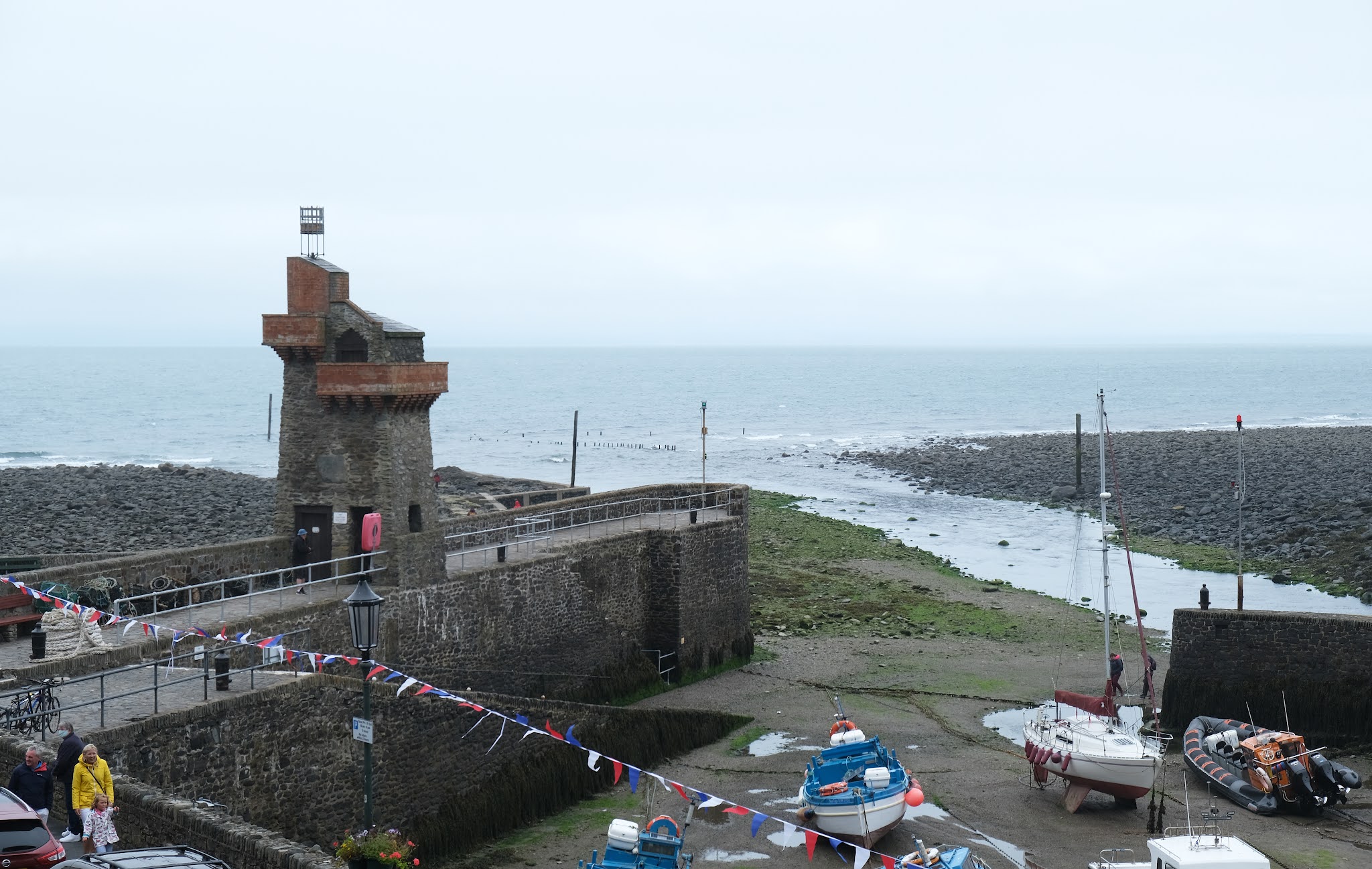
We passed the harbour with its delightful Rhenish tower (c 1860 by one General Rawdon), rebuilt after the 1952 flood. It is a pity the tide was out.

We continued along the right bank of the river and then cross to the left where we had a nice view of the church of St John the Baptist (1869, with later additions in 1908 and 1921).

 
Soon we saw this delightful creature climbing up the right bank ...
 

... while on the left we spotted a new horror: artificial hedge! It looked truly awful. I couldn't bring myself to take a picture.

Soon we left Lynton behind and crossed the rather lovely bridge to enter the woodland.
 
 
We followed a climbing path through the woods with the pretty river on our left. Quite soon we started to spot Grey Wagtails with their characteristic nodding (or perhaps I should say wagging) behaviour.
 

 As we got nearer to Watersmeet the river became more rock-strewn.
 

Watersmeet marks the joining of the East Lyn and Hoar Oak rivers. The house usually provides a cafe and loo, but sadly not today.
 
 
We headed back along the opposite - and rather quieter - bank, admiring another shapely bridge.
 
 
Further along, these trees stood out along the hillside ...
 

... and a little further on this fallen tree had been embellished by banging coins into the wood. I would love to know whose idea it was and what was its purpose.


We carried on back to the start. My arthritic knee was beginning to play up so we thought about taking the the funicular up to Lynton. When we got to the entry point we quickly realised that this wasn't a viable option as there was a long queue ahead of us. I gritted my teeth and plodded slowly up the hill.

Conditions: grey, but mild.

Map: OL9 (Exmoor).

Distance: about six miles in all, including the descent from and climb to our base in Lynton.

Rating: four stars. Delightful.