Monday, 12 January 2015

Colonia del Sacramento

The main gate

Today we are on a day trip from Buenos Aires to Colonia del Sacramento in Uruguay, a Unesco World Heritage site. The town was founded by the Portugese in 1680 and ceded to the Spanish in the 1770s. The Barrio Historico is largely unchanged since the colonial era.

After the one hour crossing of the massively wide River Plate, we ambled towards the Barrio Historico along a grassy track with the air full, for some reason, of dragon flies. After 15 minutes or so we reached the recently restored gate of the town.

The immediate impression is the wide, grassy tree-filled Plaza Mayor with scattered low buildings around. We decide on a clockwise meander and headed left and right to follow a wide road parallel to the river.

On the right is the Calle de los suspiros (street of sighs) with rough cobbles and colonial houses from the Portugese era.


On the left this beautifully coloured house.


After this we walked down the side of the river to investigate a restaurant (where we later had a very pleasant lunch). These blue flowers were lovely in the sunshine.


Soon we came to - and climbed - the lighthouse. The lighthouse was started in 1845, but not finished until 1857, work being interrupted by the Great War. (This would be the one between Uruguay and England on the one hand and Argentina on the other.)


The view from the lighthouse is a bit disappointing: you can't see the town for trees, but the beaches further along the river are clearly visible.


 We wend our way towards the far end of Plaza Mayor and then walk towards the river 


which we follow for a while. It is wide and brown and looks thoroughly uninviting, although there are some people on a small beach who are frolicking in it. We keep calling it the sea as we can't see the far bank.

We cross the wide tree-lined Avenida General Flores and walked along a quiet street hedged with bourganvillea ...


... to turn up a narrow street towards the basilica.


On the right a parked car served as a rather stylish flower planter.


The church has two lovely towers and a beautifully proportioned interior.


It can be better appreciated as a whole from the plaza to its south.


On the corner of the plaza was an art shop, with a sort of art deco facade. It looked lovely, but when we get close we saw that the decoration was bits of batten on top of felt. It was both ingenious and effective.


After a leisurely lunch we ambled back to the ferry terminal in brutal late afternoon heat.

Conditions: Sunny and very hot.

Distance: maybe four kilometers.

Rating: four stars. A quiet and charming old town.

Sunday, 11 January 2015

Buenos Aires: Plaza San Martin


We emerged from the Subte (metro) in the corner of the Plaza and headed for the rather over-the-top statue of General Jose de San Martin for whom the square was named. The General is a national hero in Argentina for leading the army in the armed struggle which gained Argentina's independence from Spain in 1816. (Independence was asserted in the revolution of May 1810).

Over to the right was the Circulo Militar, once a private house but now the headquarters of the society of retired military officers - a much more important body in Argentine society than it would be in ours. The gates were both imposing and impressive.


Along past the Circulo Militar is the neo-gothic Palacio Haedo, looking rather run down with its scaffolding and the clumsy arrangement to catch falling roof tiles. It was clearly once an imposing edifice however.


 We now walked across the square to enjoy a view of the Torre Monumental.


This lovely Edwardian clock tower was a present from the English expatriate community in 1916. It was originally called the Torre de los Ingleses, but was officially renamed after the Falklands War.

Crossing the eastern side of the Plaza offers an excellent view of the Edificio Kavanagh.


It was built in the 1930s in the modernist style and was for a while, at 120m, the tallest building in South America. It put us in mind of the Chrysler Building in New York, although without the art deco flourishes.

Walking along Calle Florida, the only pedestrianised street we have so far seen, brought us to the Galerias Pacifico.


It was built in 1899 as a department store and remodelled in 1945 and then again in the early 1990s to create a modern shopping mall.

Under the central rotonda there is currently an extremely kitch artificial Christmas tree (don't they know it's bad luck to leave it up after Epiphany?) covered in world's greatest concentration of Swarovski crystals. It was so awful, I couldn't resist a picture.


The rotonda itself is covered with frescoes painted in 1945 by celebrated Argentinian painters. Here is one example.


We left the mall on the opposite side into Calle San Martin to see the lovely Convent of St Catherine of Sienna, unfortunately closed today. 


Further along the street as we returned to the Plaza, was this wonderful art deco apartment block.


There were so many delightful details.


Conditions: hot and sunny.

Distance: a couple of kilometres.

Rating: four stars.

Saturday, 10 January 2015

Buenos Aires: Plaza de Mayo

Plaza de Mayo from Evita's balcony

Today's short walk explores the Plaza de Mayo which is named for the Revolution of May 1810 against imperial Spain. It is the main square of Buenos Aires. We approached the square from the west (Avenida de Mayo) and once you enter the square you can turn round to see the Cabildo de Buenos Aires.


This rather lovely building has the distinction of being the first building in the city to be built completely from bricks (a cabildo was the seat of a Viceroy in the Spanish empire). It dates from 1772-1822 and is now a museum.

Just behind and to the left of the Cabildo is the Legislatura (Council chamber) of Buenos Aires. This building of the 1930s is chiefly notable for its wonderful octagonal tower.


Turning now round to the right you see the Cathedral Metropolitana. Built between the 16th and 19th centuries, it has a classical revival exterior and a baroque interior. A combination which I personally really dislike.


I did like the floor tiles however.


The Cathedral houses the mausoleum of General Jose de San Martin, the revolutionary hero who designed the national flag. A measure of its importance is that soldiers are always on guard.


Having completed our examination of the building at the west end we now advanced into teh square itself. In the centre is the Piramide de Mayo commemorating the Revolution. In the background can be seen the banners of the Mothers of the Plaza de Mayo who continue to protest the disappearance of an estimated 11,000 people during the "Dirty War" of 1974-83 by the right wing military government.


Beyond the Piramide lies the Presidential Palace, the Casa Rosada. It was built between 1862 and 1885 on the site of the city's main fort. Its pink colour came initially from the use of lime and oxblood as a preservative, now it is painted.


Because we had skilfully chosen to visit on a Saturday, it was possible to take a guided tour. In some ways this was a bit over the top: one section featured a parade of photos of famous Argentinians and we briefly saw the very big but otherwise uninteresting President's office. We did gain a valuable insight however into how patriotic Argentinians are as we heard about the three symbols of national identity: the flag, the national anthem and the coat of arms.

The other big benefit of the tour was to see this exquisite Renaissance style courtyard. We were also whisked through the balcony where Evita spoke to a mass rally of 2 million people in 1951 when she announced her candidature for Vice President.


Conditions: very hot and sunny.

Distance: maybe a mile - this may be the shortest ever walk featured in this blog.

Rating: four and a half stars.


Thursday, 8 January 2015

Buenos Aires: San Telmo

 Plaza Dorrego

We started this art nouveau based walk in the lively Plaza Dorrego, where there is always a couple displaying their tango skills.  We had just finished our first tango lesson nearby and were discovering first hand how hard it is to master. The walk itinerary came from the website of the Art Nouveau Association of Buenos Aires, although sadly we only had the time and energy to do part of it in the blazing heat.

The first building marked on the itinerary was in the square itself, the narrow Hotel Boutique, which did not seem especially art nouveau to our eyes.


We walked along Defenza where on the right there was an impressively ornate pink facade above a shop. 


Further up on the left an antique shop had a wonderfully distressed facade


While to its left (we had unawarely walked beneath it) was a building in an Art deco style with Spanish details.


Now we turned left into Estados Unidos to pass the San Telmo Mercado (Market) of 1895.


A right turn into Chacabuco brought us to the simply fantastic Casal de Catalunya, the highlight of this walk. The smaller building on the right is the Teatro Margareta Zurgu. It was built between 1886 and 1927 and seems to have been a Catalan cultural centre. It now houses a restaurant.


Here are some more detailed views of the facade. The first one shows St George killing the dragon: he is the patron saint of Catalonia, as well as of England, Portugal, Lithuania and many others.


We made a slightly disappointing detour along Chile to turn into Piedras where just round the corner stood a tall building with elaborate surface decoration. I suppose the flower motifs qualified it as art nouveau.


Back to to left into Chacabuco. On the corner of Venezuela was a lovely building which reminded us of the so-called Spanish Colonial version of art deco we saw in Napier in New Zealand. 


At the top we turned right into Belgrano with the extraordinary Edificio Otto Wulf on the left. It was started in 1913 and was designed by the Danish architect, Danish Morten F. Rönnow. 


The colossal figures at the base of the columns, apparently called atalantes, represent craftsmen who worked on the building. I had thought they would be figures from mythology.


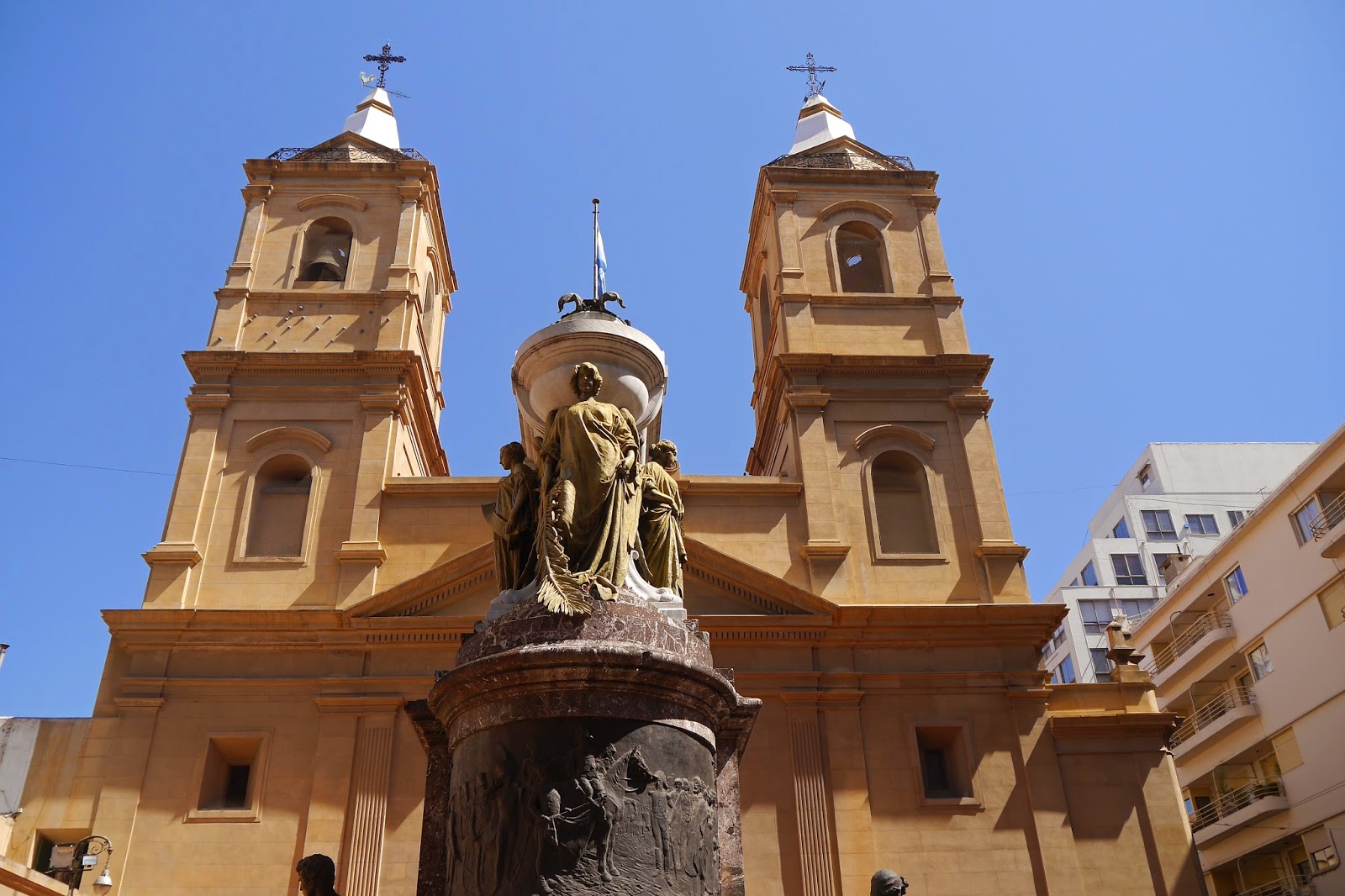
Further along on the right was the Santo Domingo basilica with a massive monument to Belgrano in front. He is known mostly as a military commander in the wars of independence and also as the creator of the Argentine flag, but was also an economist, lawyer and politician.


The walk ended in Av Paseo Colon at an undistinguished office with a beautiful door of the kind you could find in Nancy or Paris.


Conditions: Very hot. About 26 degrees, regarded as cool here.

Distance: about 3 km.

Rating: four stars

Wednesday, 7 January 2015

Buenos Aires: Palermo Soho to the Eva Peron museum


 A leafy street in Palermo: Guatemala

We have just arrived in Buenos Aires and, although tired from the long overnight flight, we started to explore this enormous city. We are staying in Palermo Soho, a very European neighbourhood of boutiques and restaurants. It also reminds us a bit of the Hell's Kitchen neighbourhood of New York: I suppose it is the combination of grid-pattern streets (one way in alternate directions), low rise buildings and plentiful trees. The picture above is looking along Guatemala.

We headed north along the suprisingly named Thames to immediate see a couple of cheerfully coloured houses with exquisite plaster work.


Walking nine or ten blocks brought us to Plaza Italia from which we entered the Jardin Botanico Carlos Thays. This is a lovely green park, full of trees and sculptures, which was designed by the French landscape architect and designer Carlos Thays and opened in 1898.


There is of course a greenhouse, but we made for the butterfly garden, first passing this intriguing structure. It is apparently a weather indicator, donated by the local Austro-Hungarian community in 1910.

The butterfly garden is very attractive and a good selection of butterflies could be seen in flight. But unfortunately for me it was fenced off.


I prowled around the edge spotting a few species which I already new: Monarch, Gulf Fritillary and, surprisingly, Painted Lady. I was pleased however to get a nice photo of the very attractive Mangrove Buckeye, taken through the fence.


We walked through the park to find our way to the Eva Peron museum, a elaborately decorated building enlarged in 1923.


Inside there is a sort of shrine to Eva, where as with her grave, admirers bring fresh flowers every day, as apparently they do at her tomb in the cemetery at Recoleta.


We know Evita as the subject of a musical, but it was interesting to hear her described as "one of the most important women of Argentine history". The museum takes you through her life and brings out her extraordinary role as a pioneer of social reform. This culminated in the Maria Eva Duarte de Peron Social Aid Foundation purchasing this house in 1948 as a sort of refuge for women from the Provinces who had come to Buenos Aires. It is easier to understand now why she is seen as a national hero.

The building itself also surprised us with its delightful Spanish patio in the middle of it.


By now rather weary, we made our way back to our hotel via the Jardin Botanico. I had no better luck with spotting new species, but this slightly battered Monarch did pose very nicely for me.


Conditions: hot and sunny.

Distance: two or three miles.

Rating: four and half stars.