Friday, 13 July 2012

Honfleur

The Vieux Bassin

We had two goals in coming to Honfleur: to see the Boudin Museum and of course to walk around the old town, especially the old port, the Vieux Bassin. It is a popular place: we saw an information panel which asserted that in 2003 it was the 21st most popular destination in the whole of France.

We parked near the Jardin Public and started by visiting the museum. It was thoroughly enjoyable and gave a good sense of Boudin's life and role (an influence on Monet no less), with a selection of his smaller, but probably not best, works. We also discovered other local artist like Dubourg and Cals. Over the course of his career Boudin painted more than 300 pictures of people, usually groups, on the beach. He was also a master of painting clouds.


We then walked down the narrow cobbled street into the centre of the town.


And soon found ourselves in the Place Ste-Catherine, where the first thing to catch the eye is the late 15th century wooden Bell Tower.


Nearby is the astonishing timber church. It dates from the 15th and 16th centuries and was built by shipworkers after the end of the Hundred Years War,


Inside, the church is vast and spacious, with twin naves and small aisles.


The Place Ste-Catherine, looking back, makes a charming ensemble. The chimney to the left of the Bell Tower has the figure of a cat on the top.


We left the square to walk down towards the docks. The first thing you see is the back of the Lieutenancy, when the King's Lieutenant, i.e.Governor, once lived. Into it has been set the 17th Caen Gate, which was once part of the town walls.


We walked round to its left to see the Ste-Catherine quay with the Hotel de Ville and St Stephen's church (now the Maritime Museum).


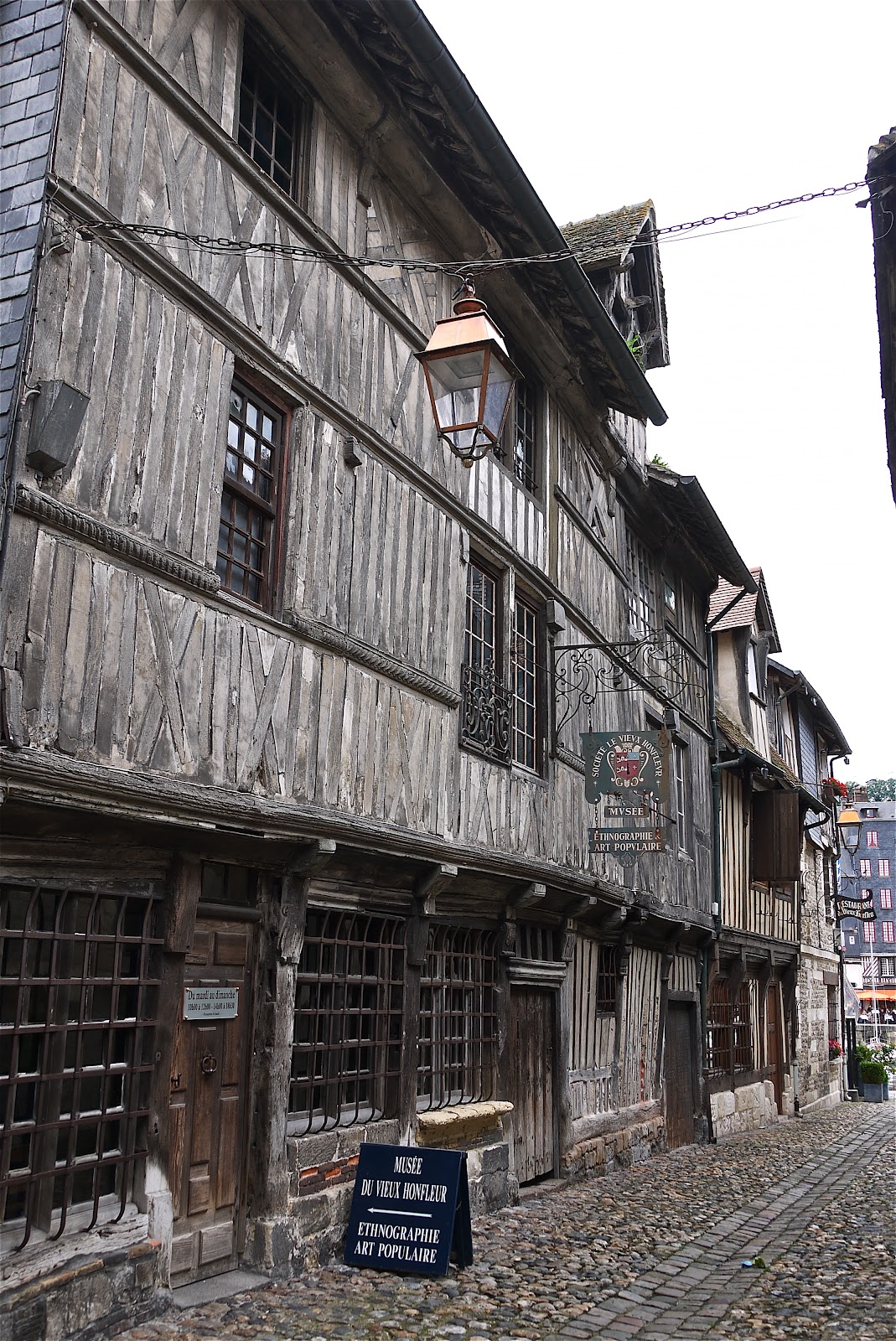
Beside the church we turned into rue de la Prison, with a beautiful group of old timber-framed houses, and beyond them the 17th century salt warehouses.

Back on the quay, there was a wonderful view across the dock (constructed by Colbert in the 17th century), towards the seven-storey houses of the Ste-Etienne quay and the Lieutenancy.


After a pretty ordinary lunch in one of the innumerable restaurants lining the quay, we followed the rue du Puits, lined with more handsome timber-framed houses ...


... and at the top climbed a surprisingly steep path to reach the Mont Joli, where there were fine views over the town to the river Seine beyond and the striking new bridge.


From here, a section of road brought us round to the pretty Notre Dame de Grace sanctuary chapel of 1600-1615.


From here we wended our way downhill to pass the museum and return to the car.

Conditions: cloudy, but quite warm; just a single shower

Distance: about three miles

Rating: four and a half stars. Full of interest and variety.

Wednesday, 11 July 2012

Butterflies by Matthew Oates

The Peacock: Britain's favourite butterfly


I happened on this book in a National Trust shop: it is in series of books published by the Trust which includes Apples, Beekeeping and Hedgerows among the other titles. There is no author's name on the cover, but when I opened it and found that it was by the Trust's renowned butterfly expert Matthew Oates I had high hopes. Oates was one of the key experts who helped Patrick Barkham achieve his goal of seeing all 59 British butterfly species in a single year, as reported in his deservedly popular book The butterfly isles.

Oates's book is subtitled "spotting and identifying Britain's butterflies", and it does both more and less than this would suggest. His real aim is obvious from the first chapter: it is to hook readers into appreciating "the wonder of butterflies". "We all need a conduit into nature", he says "... butterflying can fulfill that need". And I can personally vouch for his comment that it is "highly addictive".

To provide a context for the material on specific butterflies Oates reviews the history of butterflying, the key characteristics of butterflies (life cycle, flight seasons, mating and so on). He provides helpful general guidelines on identifying butterflies: master the easy, showy ones first; take account of habitats, food plants and flight periods; use binoculars. The last is very sound advice, and if offered with a humorous but unnecessarily defensive aside, "It also makes people think you are a birder, and not a weirdo." There are some specific suggestions for places to see butterflies and it turns out that with one exception every resident butterfly breeds on National Trust land.

Then there is an excellent short chapter on photographing butterflies which is full of very practical tips. You can almost feel the weight of experience that underpins it. There is even material on gardening for butterflies. And finally there are thoughts about the future, especially the impact of climate change and the weather: this dreadful wet year will surely turn out to be one of the worst for British butterflies.

In the midst of all this there is a directory of British butterflies, which also covers a few day-flying moths. Each butterfly gets half a page and there is a fold-out section with paintings of some of the most common. The commentaries on each are pithy and informative, but it is hard to see how you could really use this book as a practical guide to butterfly identification. For that you need more detail and photographs of both the upper wings and under wings of each species.

So this is a delightful, informative little book - all of the above is packed into less than a hundred pages - which is well worth reading by anybody with any level of interest in butterflies. I wish the NT had marketed it a bit better, rather than publishing it semi-anonymously in an interesting but slightly eccentric series. But more than that I wish that some publisher would commission Matthew Oates to produce the magnum opus on butterflies that he clearly has in him.

Matthew Oates - Butterflies (National Trust, 2011)

Sunday, 8 July 2012

Bournemouth

Bournemouth Pier with Ballard Down beyond

We have walked along the full length of the Bournemouth coastline (Sandbanks to Bournemouth Pier and Bournemouth Pier to Mudeford Spit). The obvious next step was to explore the town itself. I couldn't find a ready-made city walk, so I designed my own mainly relying on the Council's directory of Listed Buildings and of course Pevsner.

We started at The Square, having caught the bus from Poole, and walked through the Lower Gardens. The Gardens were constructed in what was Bournemouth Chine i.e. the steep-sided valley by which the River Bourne reaches the sea. The river flows now in a concrete channel on the left of the gardens as you walk down.


A more modern attraction is the Bournemouth Eye, a tethered hot air balloon which offers excellent views over the town and surrounding area.


Further on we passed people "enjoying" a desultory round of crazy golf. We then walked past the well-known, but architecturally unexciting, Pavilion and headed left at the sea front, with the Pier ahead of us. We walked up the hill past the Royal Bath Hotel, Bournemouth's oldest and turned into Russell-Cotes Road in search of the Russel-Cotes Museum. It was built as a private house, East Cliff Hall, by Sir Merton Russell-Cotes and presented to his wife in 1901

The front of the house is very strange ...


... but the entrance, off the coast path, is much more imposing. But really it does not amount to much externally - Pevsner goes so far as to call it "debased". Inside however it is a wonderful riot of late Victorian design, with some lovely 19th century paintings, including works by Rossetti, Albert Moore and Evelyn de Morgan.


We retraced our steps, crossed Bath Road into Upper Hinton Road to walk round to St Peters Church. This dates from 1841 but was substantially enlarged by the architect G E Street between 1853 and 1879.

In what looked like a Italian-style baptistery an Orthodox service was going on. In fact this small building is the Resurrection Chapel of 1926, built as a war memorial and mortuary chapel. The architect was Sir Ninian Comper


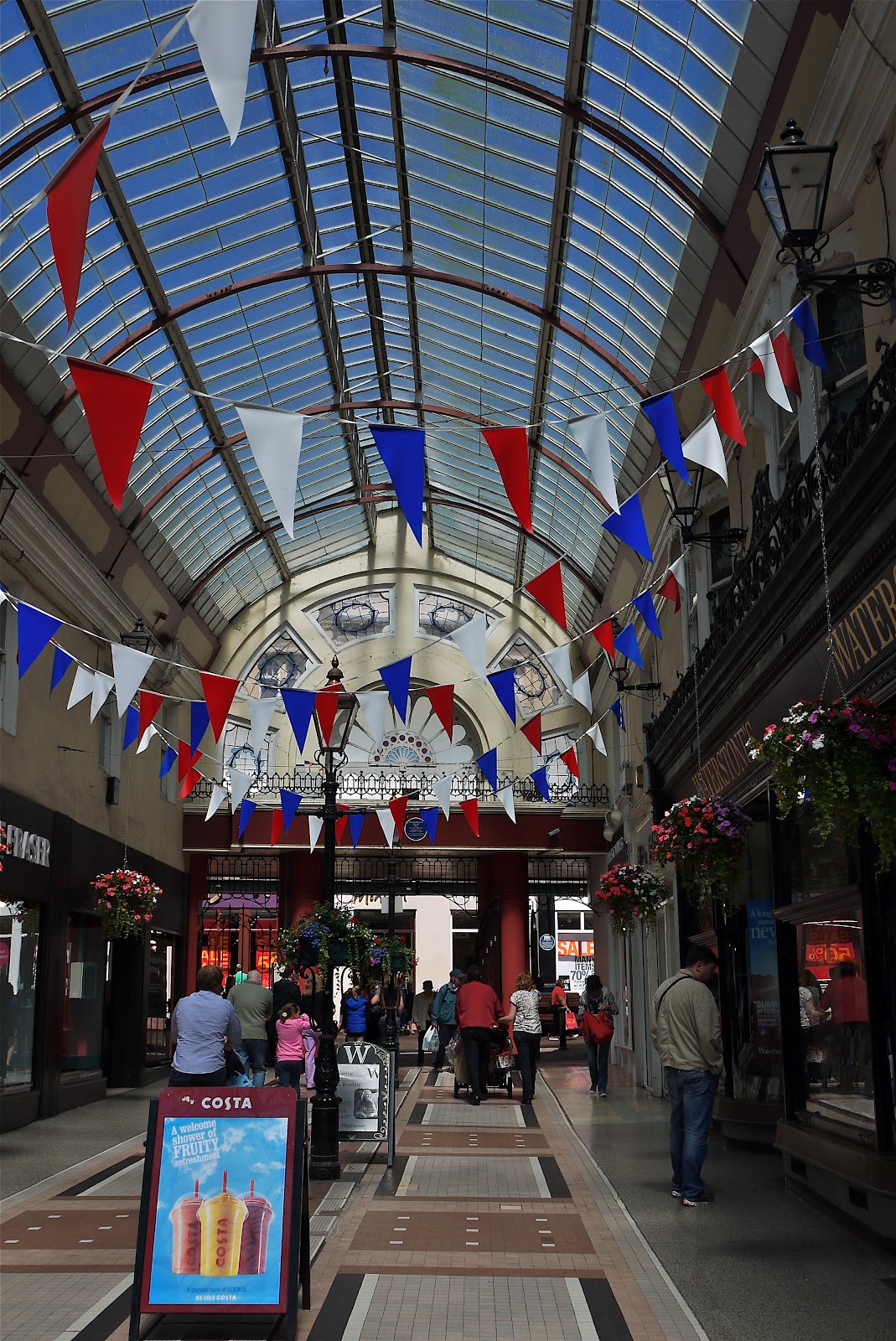
Now across the road into Gervis Place and right into Bournemouth Arcade. This was built in 1866 as two rows of shops and the glass roof was added six years later. It bears comparison with the arcades of Paris.


At the end, we turned left into Old Christchurch Road and admire two Victorian facades in a road to the right.


A bit further on we turned right into Richmond Hill, passing the 1932 Art Deco Echo building, the ground floor of which is now a restaurant.


Just up the hill is the ornate, Queen Anne style Granville Chambers (1885) and opposite is the wonderful Norfolk Royale Hotel, originally two separate hotels. The cast iron art nouveau verandas date from 1900.


We turned left into St Stephens Road to reach the church of the same name. Pevsner says that Bournemouth main architectural importance is its Victorian churches - a skim through the section on churches is a veritable roll-call of well-known Victorian architects. And of these "St Stephen's is the finest church in Bournemouth". It is the work of J L Pearson and was built 1881-98. We thought the overall impression was quite French.


Then left again to the front of the Town Hall. This is highly untypical of a civil building and looks more like a large hotel.


I discovered from Pevsner that this is for a good reason. It was built in 1880 as the Mont Dore: "an establishment for the reception of invalids, visitors and residents". He adds that it "hardly deserves a glance" and it is impossible to disagree.

We turned into Central Garden to return to The Square, and were delighted to spot Hampshire House on the left. This Art Deco block has some lovely details: painted capitals of the pairs of columns on the ground floor and coloured boat motifs higher up.


Distance: just under three miles.

Conditions: cloudy at first, but eventually hot and sunny.

Rating: three stars.


Reflections

Bournemouth effectively dates from 1810 and this selective tour of the town suggests that its current built character derives from significant building in the late 19th century and in the 1930s.

This is the second time I have developed a city walk from scratch - the previous one was around Warwick - and I must say it was an interesting and enjoyable process, and one which I will repeat. It adds greatly to the sense of discovery that you get from any deliberately undertaken town walk.

It is a bit surprising however that there is not an "official" one when near rivals like Poole and distant ones like Margate both have heritage trails. Obviously Bournemouth has less heritage being newer, but there is still lots to see. Maybe however it is too much to expect a heritage walk to take the place of crazy golf on a dull day.

Finally, I am conscious that we stayed close to the centre and didn't cover the cliffs or chines of the coast path or other areas like Boscombe. So perhaps there is a more comprehensive walk to be developed.

Sunday, 1 July 2012

Cambridge: Jesus to Queens

Jesus College

We were in Cambridge for a College lunch and afterwards we decided to work off the wine with a nice stroll around some of the colleges. I chose a route to complement the short Trinity to Corpus walk we did in January and the even shorter Round Church to Clare one we did in 2009.

We walked from St Johns along Jesus Lane to Jesus to start the walk proper. The gatehouse is set back an unusually long way from the road and makes an especially imposing entrance. The college was founded in 1497. Its founder, Bishop Alcock of Ely suppressed a nunnery and took over its buildings in a fashion that sounds like a rehearsal for Henry VIII's Dissolution 40 years later, but apparently there were only two nuns at the time, so it was not as harsh an act as it sounds.

We admired the proportions and calm of Cloister Court, the original core of the college, although later altered.


We should really have paused to visit the chapel with its Morris and Co stained glass (designed by Burne-Jones) and Pugin tiles and glass, but we were a bit limited for time. OK, I admit that there was a need to get back home in time for the final of Euro 2012. I am sure there will be another opportunity.
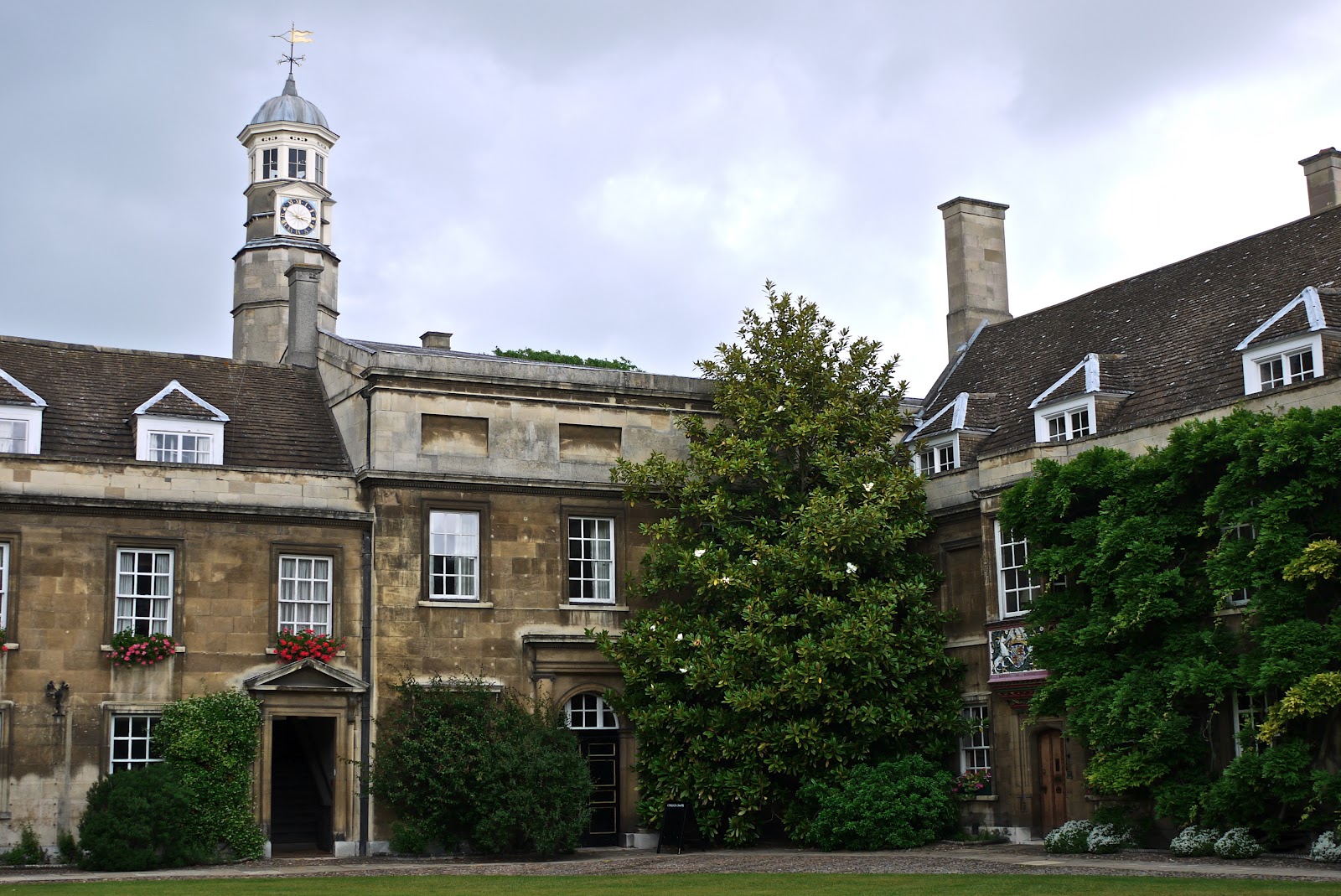
From Jesus we followed a backstreet route to Christ's College, founded in 1442. Through the fine gateway and into the splendid 16th century First Court.


An archway in one corner leads to the newer (19th and 20th century), and much less interesting, parts of the College, but it is adorned on both sides by cheerful painted plaster figures.


We retraced our steps and turned into St Andrews St to walk along to Emmanuel College, previously unknown to me, founded in 1584. We were transfixed by the view across Front Court to Wren's Chapel of 1666 with its adjoining colonade.


As with Christ's, we found the newer buildings to be of much less interest and headed back through the gate, turning right and then left into Downing Street.

At the end we turned right into Trumpington St and paused to admire the facade of Pembroke College, founded in 1347. The two oriel windows are original, according to Pevsner, but the whole range was covered with ashlar in the 18th century. The chapel, visible at the far end, is the first building of Christopher Wren, and was consecrated in 1665.


Now left into Silver St, with a look back to St Botolph's church, with its fine tower dating from about 1400. We were a bit disappointed by the whitewashed interior.


We now went into Queens', narrowly beating the 4.30 closing time. This is not in fact a misplaced apostrophe: the college was founded and re-founded three times in the 15th century and two of the founders were queens (Margaret of Anjou and Elizabeth Woodville).

The handsome gatehouse leads to Old Court with a, dare I say, striking sundial of 1733.


From here a passageway leads to Cloister Court and the half-timbered President's Gallery of about 1540. Pevsner describes it as "perhaps the most loveable of all Cambridge courts".


And next up is the famous Mathematical Bridge, here viewed from the Silver Street bridge.


It is widely believed that the bridge was built by Isaac Newton without nails, later disassembled by students or fellows and rebuilt with the bolts you see today because they could not match Newton's ingenuity. Sadly the truth is more prosaic: it was built in 1749 by James Essex to the design of William Etheridge and has always had bolts. The Queens' College website is remarkably scathing in debunking the "baseless" stories told about it.  

We turned right at the end of Silver St to then follow the backs to St John's where we had parked. What better way to end this post than with a picture of King's College chapel seen from across the Cam?


Conditions: mild and cloudy, with a threat of rain which resulted in one sharp shower.

Distance: about 3 miles.

Rating: four and half stars.

Note: This is my most recent walk in Cambridge. Earlier walks were from Round Church to Clare and from Trinity to Corpus Christi.

Friday, 29 June 2012

Henley-on-Thames

Henley Bridge

We had our friend Kathy staying and she expressed a wish to visit Henley, so here we are. As we were heading along the Twford to Wargrave road to Henley I was surprised by the amount of traffic - surely it couldn't be the Henley regatta in the same week as Wimbledon? It was (I thought the "season" was better planned than that) and so we had to park in a field on the Berkshire side of the Thames and walk in from there.

This meant that the first sight of Henley was the bridge of 1786, which really is the ideal place to start. We headed across, ignoring for the moment the regatta on the right and walked ahead into Hart St, with St Mary's church on the right.


Pevsner describes it having a "cheerful Late Gothic exterior". Two churches in nearby Reading have the same checkerboard pattern; I must see if there is any link.

Hart St is a wide street lined with shops and hotels and presents a mainly Georgian character. Just in front of the church is this handsome drinking fountain of 1885.


Pausing to look at it revealed that the churchyard housed a number of almshouses. It seems that they were endowed by John Longland, Bishop of Lincoln, in 1517 (who is also credited with building the church tower), but were rebuilt in 1830 in a Tudor style.

I am very fond of almshouses and although I know Henley reasonably well, I had never noticed these before. It it just further evidence for one of my principles of city walking: approach even places you know as if you were a stranger.


At the end of Hart St stands the Town Hall, with the market place behind. It dates from 1900 and was designed by Henry Hare in the Queen Anne style. A footnote in Pevsner reveals that its 18th century predecessor was moved to nearby Crazies Hill and converted into a house.


We continued further up the hill to reach Friar Park. I did not know of its existence until I did a bit of research to plan this walk. It is a fantastic late Victorian mansion set in a vast park. Pevsner describes it as "a bizarre folly .... a long sprawling building in unfashionable French Flamboyant Gothic style". It was built by a rich solicitor, Sir Frank Crisp, who probably also designed it. You can't see the house, but the gate and gatehouse give a flavour of the style. It looks fabulous.


Of course, nowadays, Friar Park is famous as being George Harrison's house - his widow Olivia and son Dhoni still live there. I knew about the big house near Henley and rows with the neighbours about having razor wire on the perimeter fencing, but I did not know its name and had not realised that the house was actually right in the town. You can see from the map that it accounts for a significant percentage of the area.

We walked back down the hill, past the Town Hall and turned into Bell St and then into New Street. On the right were more almshouses, Barnaby Cottages, originally given by William Barnaby in 1582 and several times restored.


Further along were Anne Boleyn's Cottage and the Tudor Cottage dating from the 15th century. The latter is less fancifully named!


The lower part of the street is dominated by the imposing buildings of the former Henley Brewery.


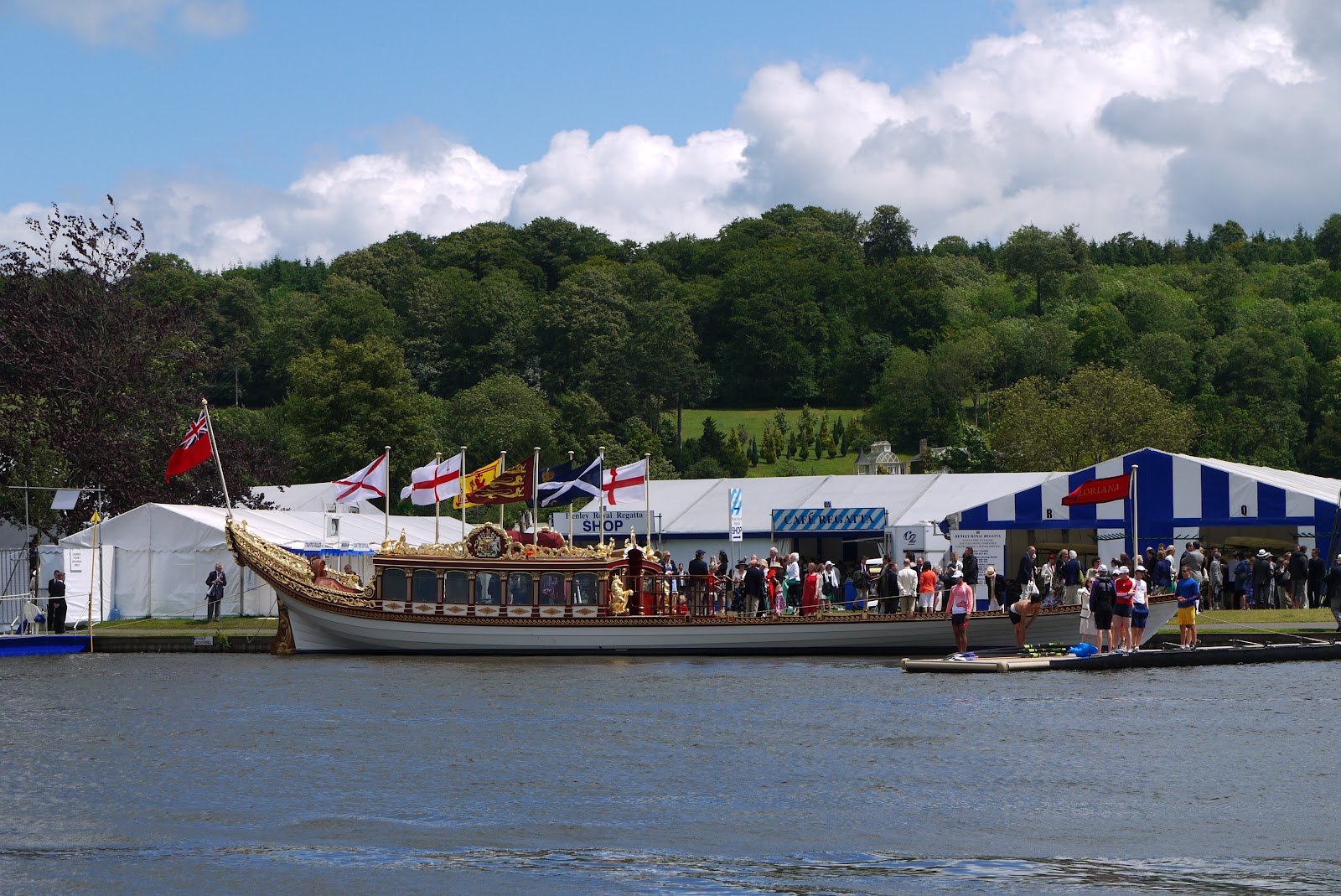
We turned right into Thameside to follow the river and on this occasion offered great views across to the regatta sight. For some, the sight of the Royal Barge, recently seen in the flotilla down the Thames in honour of the Queen's Jubilee, was a great delight.


On the town side of the street, I enjoyed the decorated gables of the former Little White Hart Hotel (c 1890).

For the final part of our walk, we crossed Hart St into Duke St and wandered down to the riverside to follow the promenade as far as Marsh Lock. All along there were Regatta-goers enjoying drinks and food in moored boats or cruising along the river. We were a bit envious. I was surprised however to see a man in a splendid rowing blazer sitting on a park bench eating fish and chips out of the paper.

The approach to the lock is impressive, with a lovely wooden bridge across the river.


There is also a weir and on the bridge a plaque describes the installation of a salmon ladder. We looked hopefully across the weir pool and - improbable as it sounds - immediately saw a salmon leaping, presumably in search of the ladder. We waited for some time but we did not see another - it seems now like a dream.

We retraced our steps and crossed the bridge for one last view of the regatta, with Remenham Hill behind.

Distance: almost 4 miles.

Conditions: Warm and sunny, though with a threat of rain.

Rating: four stars.


Sightings

Three years ago I saw an exotic duck on the river Blackwater. It turned out to be an Egyptian Goose. The RSPB, who kindly identified it for me, explained that it was probably an escapee. I was surprised to see this group of Egyptian goslings on the Thames, but at least I could confidently say what they were. At this rate they will soon be everywhere.