Monday, 15 May 2023

Ghent: Gravensteen (The castle of the Counts)

 Gravensteen, Ghent, photo: public domain. Ryc. 14. Gravensteen, Ghent,... |  Download Scientific Diagram

We enjoyed our walk around the Castle, but we found it difficult to work out how the various parts related to each other. It is much easier to understand from the photo above.

 Our first view, from outside was the moat with its innumerable small towers.

And this is the sight of people and trams in the area in front of the entrance to the Castle.

The Castle was built in 1180-1200 by Count Philip of Alsace. The cross in the upper part of the entrance celebrates Count Philip's return from the Crusades.

In the late 18th century, the Castle of the Counts was sold to private owners who later converted it into a factory complex. In 1807, the fortress in the heart of Ghent housed a cotton mill, and its outbuildings served as primitive dwellings for about fifty families of workers. When the mill and its workers left, the Castle of the Counts was in a state of complete disrepair, ready for demolition. Instead it was restored during the period 1893–1903.

Above is a close view of a different angle of the Donjon from the south.

We climbed the stairs inside the Donjon to reach the highest point which also gave us an idea of the number of towers there are to be seen in Ghent.

Descending to the very bottom we paused in the crypt.

Emerging, we went clockwise around the castle buildings to see them from a different angle .


The appearance is more romanesque.


This is the final angle in front of the Donjon.

Sunday, 14 May 2023

Villa Cavrois: An Art Deco masterpiece


Paul Cavrois was a textile industrialist from northern France who owned modern factories for spinning, weaving and dyeing cotton and wool. In 1920 he decided to build a villa in the countryside for his growing family. When he encountered Robert Mallet-Stevens he soon decided that he had found a suitable architect for his house. It was to be a complete work of art, or Gesamtkunstwerk, inspired by the ideas of Richard Wagner. Unfortunately, Mallet-Stevens had other commitments which meant that work could not start until 1929. 

Mallet-Stevens designed the house to have yellow bricks on a concrete frame and two red brick walls. Each piece of furniture was designed by Mallet-Stevens for its specific use. He also designed the layout of the grounds with its lawns and water features.

When work did finally start, it was completed in 1932. But only eight years later the Villa was taken over by German troops. The family resumed their occupancy in 1947 and this continued until 1986. Thereafter, the new owners let it fall into decline and it was bought by the state in 2001. The villa opened again to the public in 2015.

The Villa is surrounded by a grassy park. You follow the curved path to reach the centrally positioned entrance. 

The high ceiling  and black and white floor tiles set the tone for servants' area of the house.


Next, there is the main dining room. It is a vast space. Most of what you see now is a
replica of the original room.

 
This is the children's dining room which overlooks the park.


The duplex sitting room

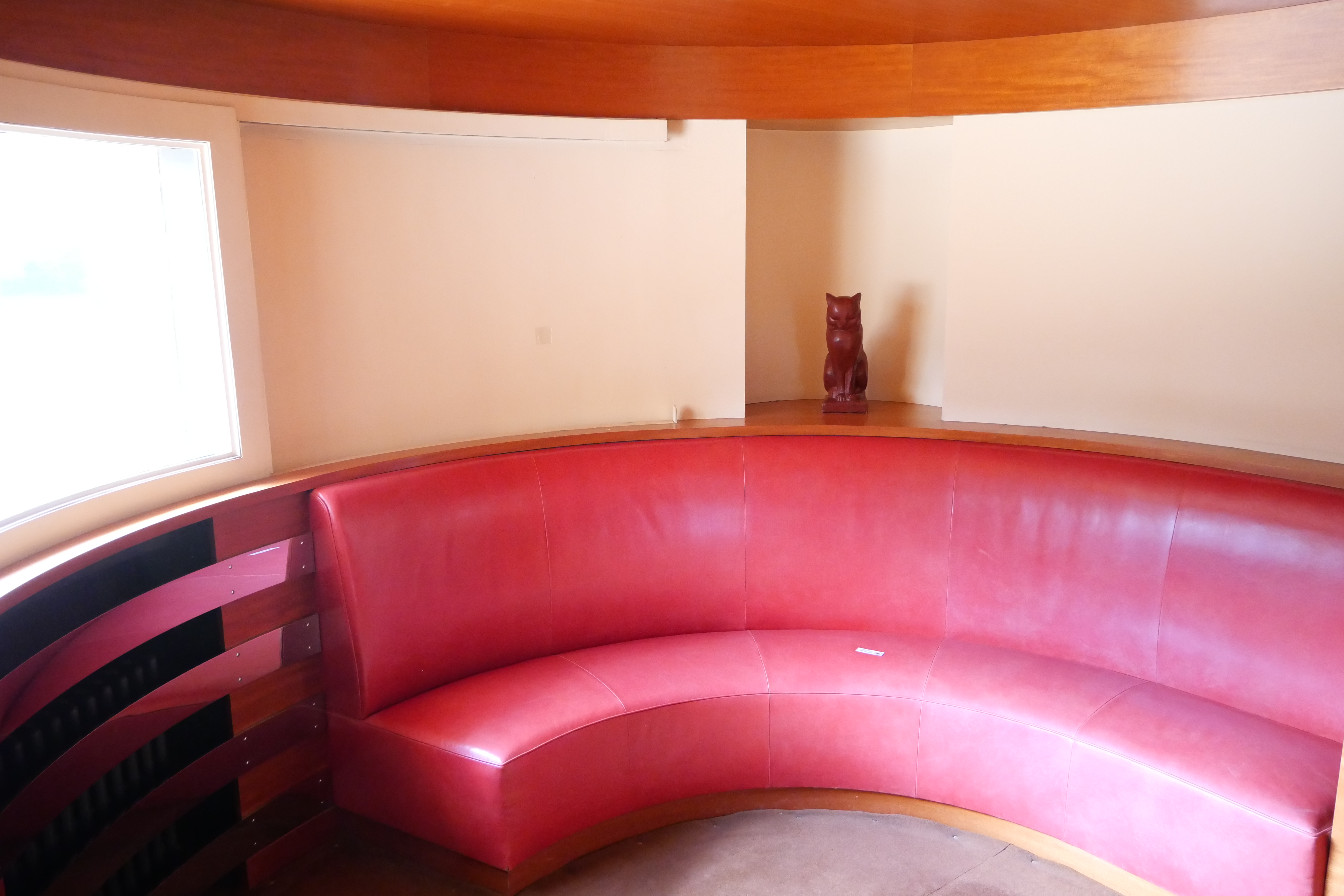
A corner of the Smoking Room


One of the many clocks. 
 
 
The rear view of the Villa with its stream and large grass areas.


Before restoration.


Saturday, 13 May 2023

Lille: The Old Town


This walk route is quite lengthy and varied. A copy of Irene Reid's "Strolling Around Lille" book is essential to get the full picture. My photos are quite selective.
 
The walk starts in the Place de St Hubert near to Gare Lille Flanders and Rue les Canonniers.  On the left (above) is the Le Maison de Vieux Hommes It has some affinity with the almshouses we have in England. The Porte de Roubaix at right angles.


This is the view from the other side: rather more elaborate and colourful. The two plaques one of which commemorates the gate's construction in 1621 and the other its restoration in 1875.


We walked towards this rather strange structure, Deborence Island. It is named after an ancient forest in Switzerland and is entirely enclosed as an experimental site to see which plants settle there without any external intervention.


A bit further on there is a memorial to Louise de Bettignies, who is said to have run the largest spy network in the First World War. She was caught and sentenced to 15 years hard labour, dying just 3 years later.
 

The next milestone was also concerned with war. The Musee des Cannoniers was originally a convent, but in 1667 and again in 1792 the Cannoniers saw active service in defence of the town.
 
 
We continued onwards to reach the Place Louise de Bettignies and quickly discovered the house of Gilles de la Boe, a 17th century spice and cloth merchant. It is one of Lille's oldest houses.


Turning into Rue de la Monnaie we turned into Rue de la, the oldest street in the city, with its fine houses.


Further along the street we saw the remains of an ancient watermill.


The imposing Museum of the Hospice of the Countess of Flanders in rue de la Monnaie is next.

 
The next major landmark is the Cathedral of Notre Dame de la Treille.  Irene Reid suggests that visitors will either love it or hate its unusual design. I thought it was great. It was begun in 1854, but not completed until the 1990s. The facade of the Cathedral is quite unlike the nave and transepts of the rest of the building.  The Rose Window surrounded by the modernist facade is totally out of the ordinary. Sadly,  I couldn't find a better picture.              

        Stained-glass rose window of the Lille Cathedral / Basilica ...       
 
The rather contorted statue shows Achille Lienart who was Bishop of Lille from 1928 and then Cardinal from 1930 to 1968.  He died in 1973.


On the left side of the Cathedral there are a group of colourful  houses. The narrow houses have a gangway over what was once a canal. The charming figurehead above the window is very entertaining.


Two final images: 
 
The Sphinx above the door into  the Headquarters of the Freemasons in Rue Thiers. They are still a force in France .... and ...


A lovely balcony in Rue Esquermoise

Friday, 12 May 2023

Lille: From south East quarter to the Place de Theatre

Arriving in Lille, we took a taxi to our hotel. It was a bit of surprise as it was previously the Faculty of Medicine and Pharmacology  It proved to be a spacious building with a couple of quirky features to greet us ...


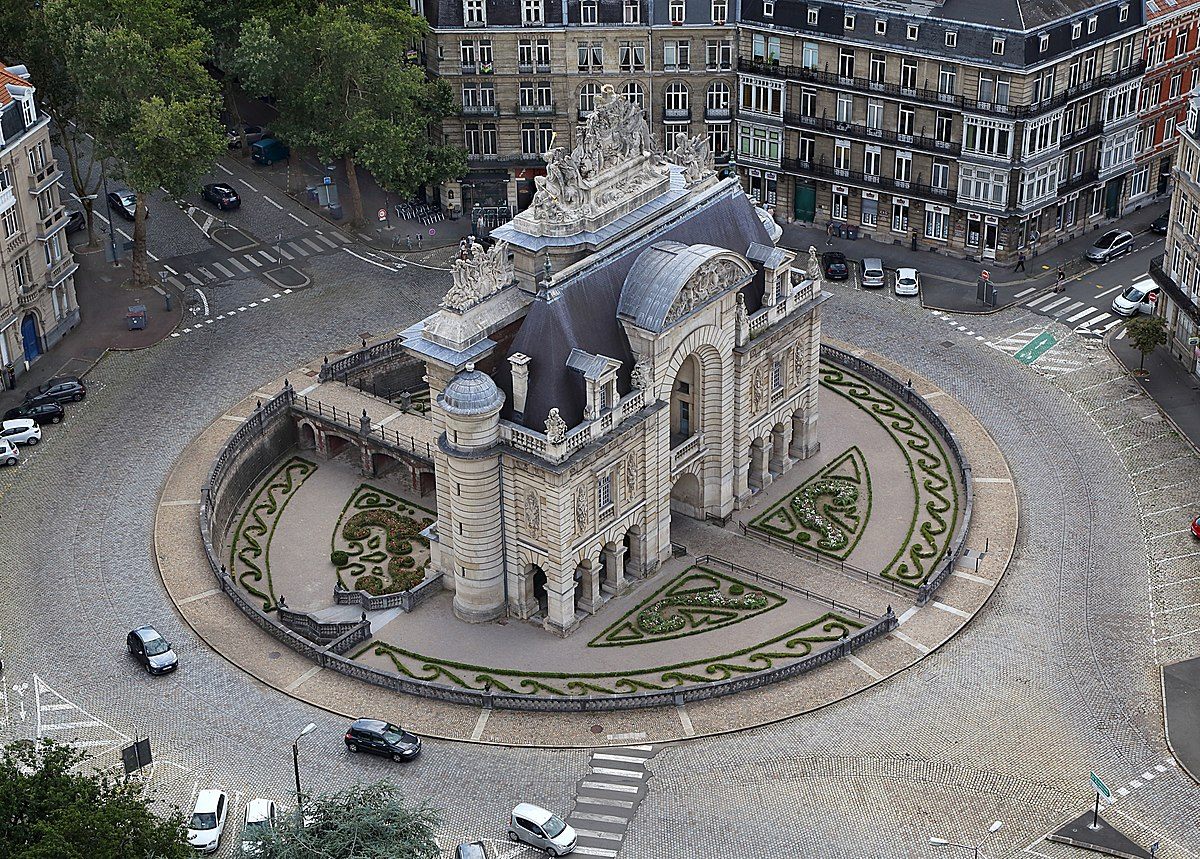
We began our exploration of the city by turning left out of the Hotel. Our first major sight was the beautiful Porte de Paris. It was built in the 17th century to commemorate Louis XVI's capture of the city.


This aerial photo gives a much clearer idea.


We headed towards the Town Hall, with its slender belfry in the art deco / Flemish style. It is 104m tall.
 

Sadly, it wasn't possible for us to get to the top, but we enjoyed this stonework at the bottom of the tower.

 
Over to the left was the Hospice Gantois founded by Jean de la Cambe  in 1462 and extended in 1664 and 1672. It remained a hospital until 1995. It is a 5 star hotel.

                        File:Lille hospice gantois.jpg

Heading away from the Hospice, we reached the imposing St Sauveur church.

Further to the east is the Noble Tour, a rather unprepossessing structure. It is what remains of of a fortification built during the 100 Years' War by Philip the Bold, Duke of Burgundy. When Lille became French in 1667, Vauban converted the tower into a half-buried powder supply depot. Within the three-metre thick walls, are two superimposed rooms; one has a vaulted ceiling with intersecting ribs, the other has a low dome of brick, illuminated by three small openings: they are reached by a staircase in a tower. 


From here, we eventually reached the Place du General de Gaulle. This is the Opera.


And here is the famous Morel et Fils. It was once a lingerie shop and later a bookshop. Nowadays it is a popular cafe.

Nearby, the CCI, The Chamber of Commerce of Lille is an important landmark in the city. The clock tower plays popular songs in the Theatre's square.

 
The final photo in this part of the city shows the Carlton hotel, where we stayed on a brief visit many years ago.

Finally, we passed the Palais de Beaux Arts on our way back to the hotel. Sadly we had run our of time to explore its delights including works by Monet, Rubens, Goya, Breughel, Van Gogh ....