We walked towards this rather strange structure, Deborence Island. It is named after an ancient forest in Switzerland and is entirely enclosed as an experimental site to see which plants settle there without any external intervention.
Saturday, 13 May 2023
Lille: The Old Town
We walked towards this rather strange structure, Deborence Island. It is named after an ancient forest in Switzerland and is entirely enclosed as an experimental site to see which plants settle there without any external intervention.
Friday, 12 May 2023
Lille: From south East quarter to the Place de Theatre
Arriving in Lille, we took a taxi to our hotel. It was a bit of surprise as it was previously the Faculty of Medicine and Pharmacology It proved to be a spacious building with a couple of quirky features to greet us ...
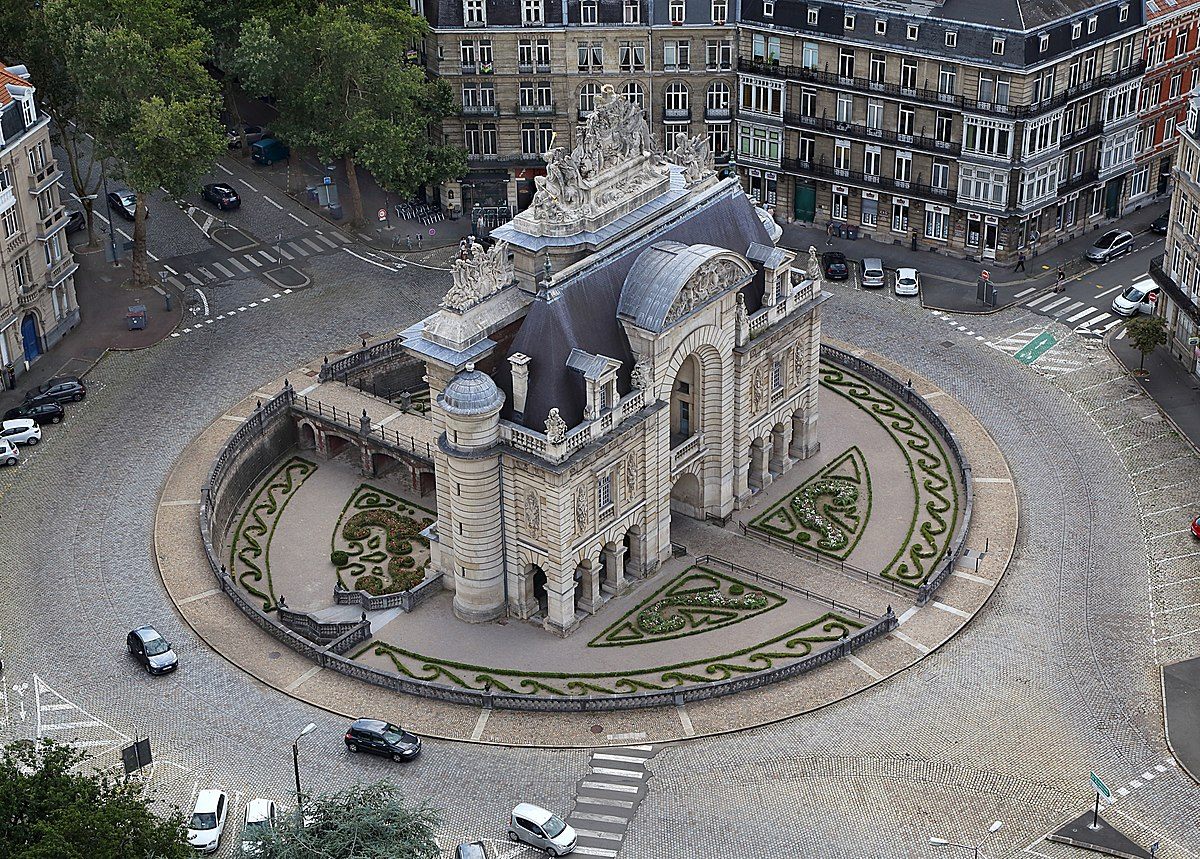
We began our exploration of the city by turning left out of the Hotel. Our first major sight was the beautiful Porte de Paris. It was built in the 17th century to commemorate Louis XVI's capture of the city.
Sadly, it wasn't possible for us to get to the top, but we enjoyed this stonework at the bottom of the tower.
![]()
Heading away from the Hospice, we reached the imposing St Sauveur church.
Further to the east is the Noble Tour, a rather unprepossessing structure. It is what remains of of a fortification built during the 100 Years' War by Philip the Bold, Duke of Burgundy. When Lille became French in 1667, Vauban converted the tower into a half-buried powder supply depot. Within the three-metre thick walls, are two superimposed rooms; one has a vaulted ceiling with intersecting ribs, the other has a low dome of brick, illuminated by three small openings: they are reached by a staircase in a tower.
From here, we eventually reached the Place du General de Gaulle. This is the Opera.
And here is the famous Morel et Fils. It was once a lingerie shop and later a bookshop. Nowadays it is a popular cafe.
Nearby, the CCI, The Chamber of Commerce of Lille is an important landmark in the city. The clock tower plays popular songs in the Theatre's square.
Finally, we passed the Palais de Beaux Arts on our way back to the hotel. Sadly we had run our of time to explore its delights including works by Monet, Rubens, Goya, Breughel, Van Gogh ....
Friday, 14 April 2023
Newbury's Almshouses (revised and updated)
St Bartholomew's Hospital
I thought it would be interesting to do an up to date blog of Newbury's numerous almshouses. So far as I am aware the town has the largest number of almshouses of any town in the country. Stamford would probably be the next highest. West Berkshire Museum published a book on The Almshouses of Newbury but it seems to be out of print. A useful Timeline of Newbury Almshouses derived from the book can be found on the website of a modern Almhouse charity, the Charity of Mrs Mable Luke founded in 1928.
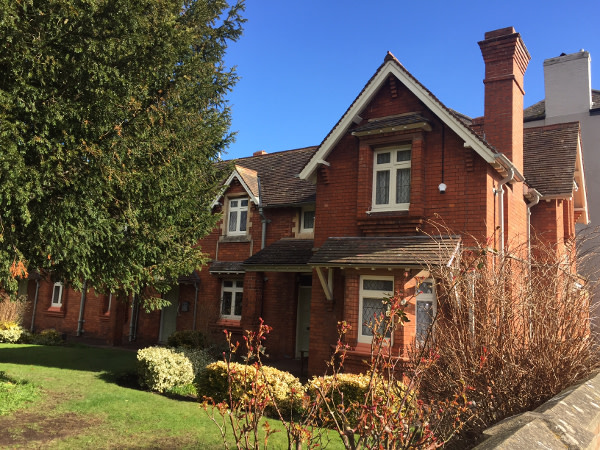
But what are Almshouses? They grew out of religious foundations, often called hospitals, which provided for the poor, the sick and also pilgrims. After the Dissolution of the Monasteries in the 1530s, almshouses were established funded by well-to-do benefactors to provide housing for the poor and needy. There were often eligibility criteria: age, health, living in the locality (often for a specified time), former members of trades and industries. And almshouses were not all secular: many would have a chapel.
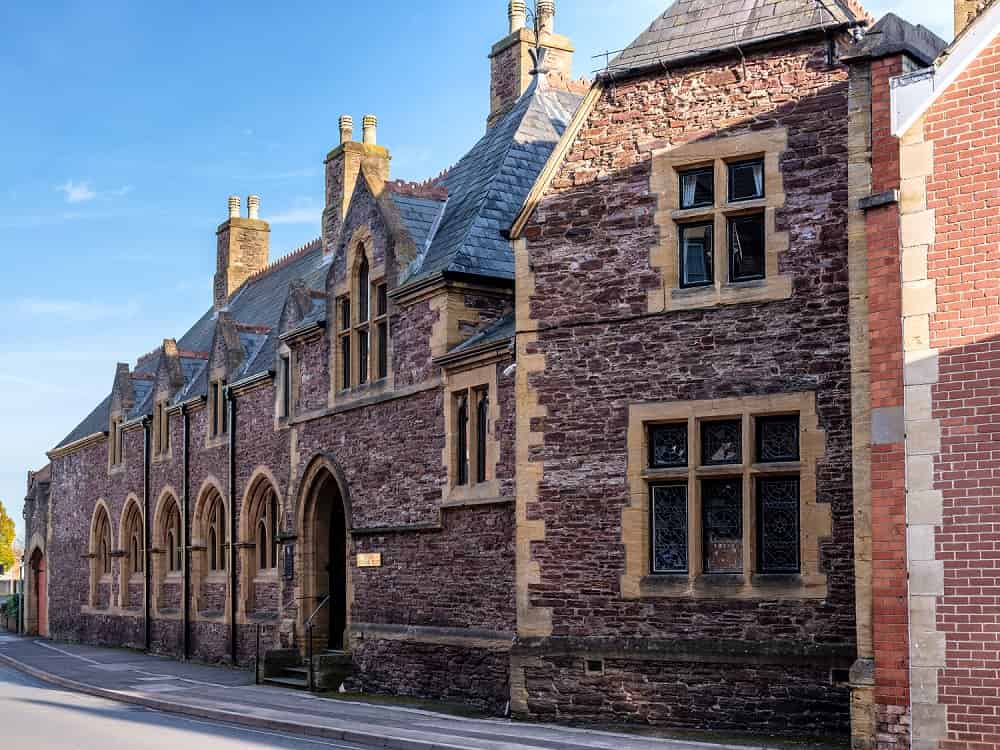
I started at St Bartholomew's Hospital in Argyle St. It is an almshouse originally founded in the 12th century, but whose current buildings date from 1698. It looks a little worse for wear and older photos show a clock above the stone plaque announcing its name.
Carrying on along Argyle St you come to the Essex Wynter Almshouses. Originally a farm, they became the Phillip Jemmet almshouses in 1670 (and his initials can be seen over the door) and were reconstructed by Dr Essex Winter (having become derelict) in 1926.
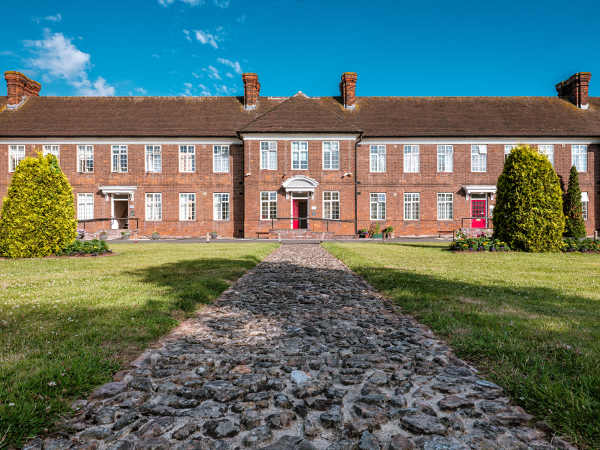
At the end of the road I turned left to pass the Upper Raymond Almshouses of 1826. They consist of a plain brick terrace, but with dramatically large
chimneys, gothick windows and a curious shallow stone arch stuck on to
the centre of the block. There are a couple of modern (1970) almshouses to the left, out of shot.
I turned right into Newtown Road for a few hundred yards to reach the Newbury Church and Almshouse Charity (described by Pevsner as Child's Almshouses). It is a pleasant U-shaped group dated 1879 and renovated in 1982.
I doubled back along Newtown Road to see the
very plain Lower Raymond Almshouses, bearing the date 1796. Another
range at right angles to this one was destroyed in by bombing 1943.
I carried on along Bartholomew Street to reach St Nicholas church and then cross the bridge and turning left down a narrow alley to Northcroft Lane where a splendid former almshouse can be found. There is a large white plaque over the doorway, but unfortunately it is almost impossible to read. It is just possible to read the foundation date: 1824.
Retracing your steps and turning right at the bridge brings you to West Mills. This area has several buildings which were once small Almshouses: the Hunt Almshouses at number 11 (1729, rebuilt 1817), Coxedd's Almshouses (1690) at number 15 and Pearce's Almshouses (1694) at number 18.
South of West Mills and off Kennet Road are Kimber's Almshouses (1939) very plain and built of chunky brick. They were originally founded in 1795 in Cheap Street.
I went along Kennet Road then Craven Road where some houses on the left had the classic almshouse appearance, albeit plainer and more modern. I can't find any reference to them in the Timeline of Newbury Almshouses.
The left into Rockingham Road to reach Enborne Road. Tucked away off to the right are the delightful Coxedd and Pearce's Almhouses. They are dated 1884 - although the beautiful sunflower motif might make you think they were a little later - and were built to replaced two of the small almshouses in New Mills referred to earlier. This is a bit out on a limb but you are still only 10 minutes from the station or 15 from the town centre going back along Enborne Road.
A footnote on the Charity of Mrs Mabel Luke: it is still involved in building new almshouses. A devlopment of flats has recently been completed in the centre of Newbury. It may lack the architectural features I so like, but it is wonderful that almshouse charities are still producing what we would now call social housing.
Almshouses of Bristol
In case you are wondering (as I was), the West of England Combined Authority (WECA) covers Bristol, South Gloucestershire, and Bath and North East Somerset. It has a population not far short of a million people. Its Headquarters are in Bristol. This post is concerned only with Bristol.
King Street, where the St Nicholas with Burton's Almshouses are to be found is on the corner with Queen Charlotte Street. They date from 1652 and were extended in the 19th century and restored in 1961. They are now student accommodation.
King Street is full of interesting buildings, including the Bristol Old Vic and at the far end is another fine almshouse: the Merchant Venturers of 1699, intended for seamen as the plaque suggests.
The front view is delightful although it was originally a square, partly destroyed by wartime bombing and further constrained by road realignment. It is now private accommodation.
At the top of Christmas Steps is the dramatic Foster's Almshouse. It was originally founded by a bequest from merchant John Foster in 1492. The present high Victorian buildings were constructed between 1861 and 1883 and are now private apartments.

Thursday, 13 April 2023
Almshouses of Taunton and South Somerset
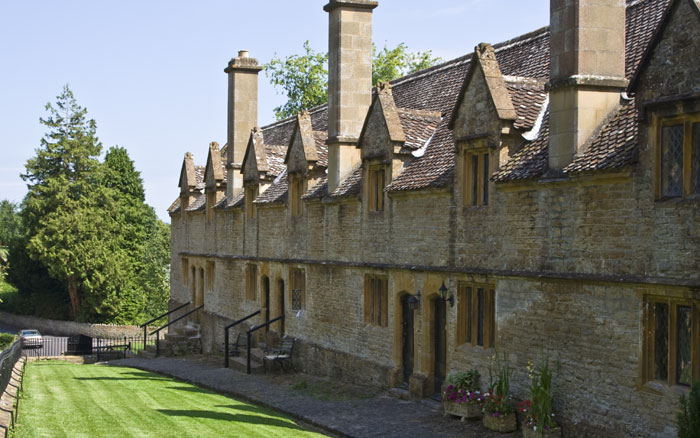
The Taunton Heritage Trust is rather like the The Exeter Homes Trust in that it covers several discrete almshouse buildings. The first and most impressive is Gray's Almshouses. They were founded in 1635 by the wealthy cloth-merchant Robert Gray, whose
monument survives in the Church of St Mary Magdalene. The building is
one of the oldest surviving in Taunton and is one of the earliest brick
buildings in the county (from Wikipedia).
Then we have the impressive Huish Homes. They are located in a Grade II listed building, built in 1868, that provides four flats, a laundry room and a communal garden. The offices of the Trust are also there.

The buildings of Leycroft Close in Hamilton Road were built in 1931 and consist of 328 flats.

The St James's flats, dating from 1845, consist of eight flats with a shared garden.

Finally, the Bernard Taylor homes date from1984. The accommodation is intended for single occupancy, but there is a large communal area.
The remaining Almshouses are the St Margaret's Almshouses. They began as a leper hospital - or Leprosaria - in the 12th century where diseased locals were isolated. The building is said to have featured secret underground tunnels to transport the dead to a nearby cemetery. The almshouses are now privately owned.
Finally, I discovered a relocated almshouse preserved by Taunton Castle in the Museum of Somerset .
To the south of Taunton there are Staple Fitzpaine with Portman's Almshouses.
These almshouses were founded by Sir William Portman and were restored in 1970.
To the east is the village of East Coker, famous for T S Eliot's celebrated poem. They were originally built in 1640 for 11 women and a man, and are still in use. A plaque in front of a large tree marks the site of a "plague pit", where 70 villagers were buried in 1645.

Nearby is the village of Bishops Lydeard. The
almshouses in the high street were originally built in 1616 by Sir Richard Grobham. They
were restored in 1854 and again in the mid 20th century.
Finally, there are Harvey's Almshouses. These almshouses were founded by an Exeter merchant called Richard Harvey in 1663. He was born in Chard. The original almshouses were demolished in the 19th century and replaced by the present building in 1841-42.