Wednesday, 18 September 2019

Mantua: Palazzo del Te


Visited at the end of a wonderful day on Mantua, the extraordinary Palazzo del Te deserves a post to itself. It was built between 1525 and 1535 as a suburban residence, to the south of his main base, the Palzzzo Ducale, for Federico II Gonzaga, Duke of Mantua.

The Palazzo is basically a hollow square. The main entrance was clearly in the middle of the range on the left, but nowadays visitors enter via a small doorway in the middle of the right hand range. The view through that doorway is lovely: you can see an archway on the opposite side (in fact part of a portico, and something else beyond it.


The facade is classical and just below the roof line you can even see the triglyphs (three vertical lines) and metopes (relief sculpture) of the kind you see on Greek temples.

The internal organisation is surprisingly simple: rooms the width of the building lead in to each other. First we see the Chamber of Ovid (or of the Metamorphoses), with a magnificent coffered ceiling.


Next there is the Chamber of the Sun and the Moon, with an entertaining panel in the centre of another elaborate ceiling (look closely at the charioteer on the right).


Next is the Loggia of the Muses, here seen from outside.


This is followed by a vast room, the Hall of the Horses, which was created in 1526-28.


Next up is the Chamber of Cupid and Psyche, said to be the most sumptuous in the whole palace.


At this point we are half way round the square, opposite where we came in. From this loggia the area behind the main building becomes fully visible. It is large space, laid mainly to grass, with at the end a lovely curving colonnade.
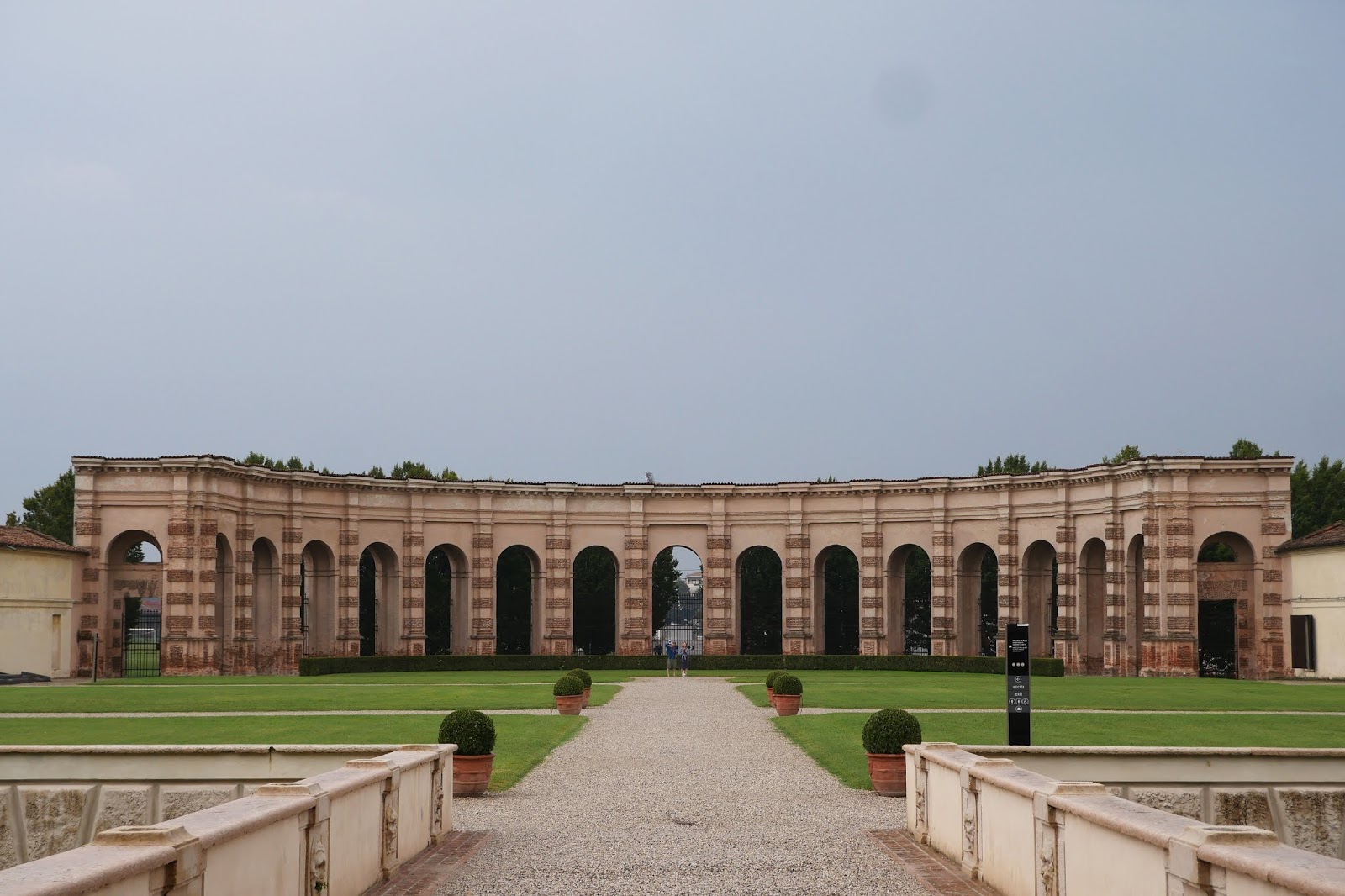


This is the view looking back to the Palace. 


 Over in one corner is a secret garden with a grotto.


Back inside the building the next room is the Chamber of the Stuccoes has a strongly Roman theme.


The next room is the last - the remaining ones were being refurbished for an exhibition - it was the Chamber of the Giants. It was the one room that we just hated: the giants on the ceiling were just about OK, but all the walls were painted with inflated versions of similar images. It called to mind Disney and felt totally out of place in this classical oasis. I couldn't bear to take a picture.

 Rating: five stars.

Mantua

Mantua from across the Lago Inferiore

Today we are on an outing from Padua to see the beautiful city of Mantua. Our first sight of the city is from the other side of the Lago Inferiore (Lower Lake). The old part of Mantua is surrounded by water on three sides, the result of a medieval project to create lakes where there was once only a stream. The other lakes are, reasonably enough, Lago di Mezzo (Middle Lake) and Lago Superiore (Upper Lake). Road causeways separate the three lakes.

Our first close up view of the city was of the rear of the group of buildings known collectively as the Ducale Palace. On the right is the medieval Castle of St George, built between 1395 and 1406. It is similar to the great castle of Ferrara, which we saw in 2013.


We walked around to the large square called the Piazza Sordello, where the entrance to the Palace can be found.


Only a limited amount of the massive castle is available to be viewed, but our first port of call was the Apartment of Isabella d'Este. The sixteen-year-old Isabella arrived in Mantua from Ferrara on 12 February 1490 to marry Frederic II Gonzaga. Only the frescoe on the ceiling remain.


We then had to leave this section of the palace and reenter to reach the Castle of St George via the lovely Piazza Castello.


The main thing to see in the Castle is the Camera degli Sposi, the Bridal Chamber. According to Wikipedia, This room would have been used for several different private and semi-private functions such as a bed chamber for Ludovico, a gathering area for family and close courtiers, and a reception room for particularly important guests. It has wonderful frescoes commissioned by Ludovico III Gonzaga from the celebrated painter Andrea Mantegna. The walls and ceiling were painted between 1465 and 1474.


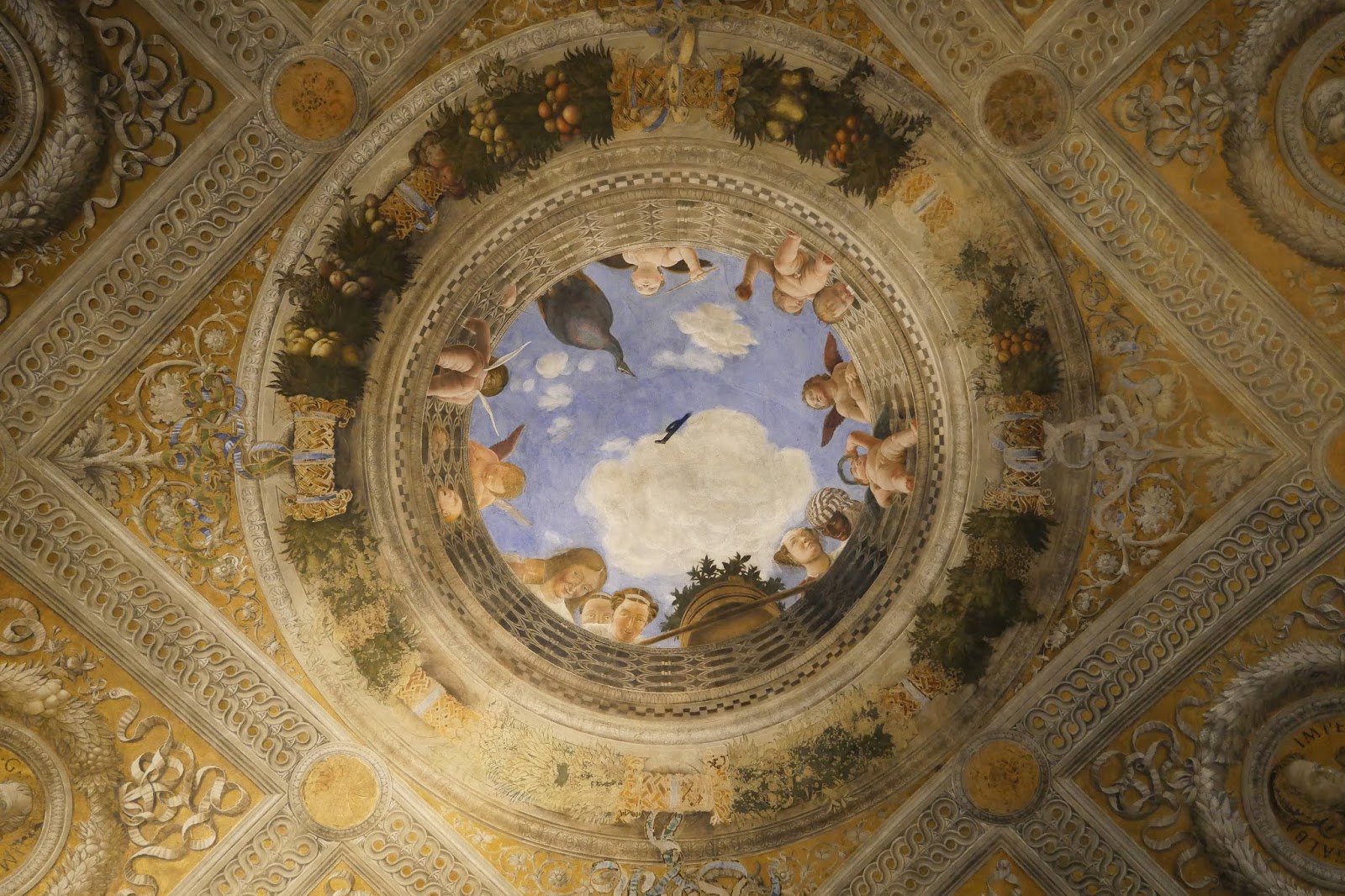
The ceiling is particularly memorable, as it is the first example of accurate perspective seen from below.


In one of the painted columns Mantegna has taken the trouble to include a small and inconspicuous self-portrait.


Returning to the Piazza Sordello, we passed the Cathedral with a Baroque facade, but rather entertaining sides featuring red bricks and triangular gables. The current church from 1756–61.


On the right is the Piazzo Castiglioni. You can also see the Torre della Gabbia, which allegedly has a cage still hanging from it where criminals were left to die (perhaps it be seen from another angle). On the extreme left is the dome of the massive Basilica di Sant'Andrea (see below).


We headed into the centre to find the wonderful astronomical clock on its splendid tower. It was constructed in 1472-3m and was one of the first mechanical clocks in Europe


Immediately to its right was the Rotonda di San Lorenzo, an exquisite round church. It was built in 1082, but in 1579 Duke Guglielmo I Gonzaga ordered it to be closed. The roof fell in and it was later surrounded by other structures. These were demolished in 1908, but its restoration, involving substantial rebuilding took place much later, I think after 2007.


Although de-consecrated, it is now a beautiful and atmospheric example of the round church.


Nearby is an unusual and very lovely Gothic merchant's house (the Casa del Mercanto of 1455) ...


... and not far away a lone, but very welcome, example of art nouveau.


In the same street, via Battista Spagnoli, is the handsome 19th century Grain Market


Our final sight was the Basilica di Sant'Andrea. It was begin in 1462 to designs by Leon Battista Alberti, but not finished until the 18th century - by then in a Baroque rather than Renaissance style. A bit over the top for my taste.


Conditions: largely grey.

Rating: five stars. A wonderful city.

Tuesday, 17 September 2019

Padua: walls

Porta Altinate

I read on the Padua Tourism website that the city has about 11km of walls and as an enthusiast for walled towns I thought we ought to investigate. The first discovery was that there are two substantial gates whose role was to protect the medieval city. The medieval Porta Altinate (above) is on the east side and dates from 1286.

On the north side of the centre along via Dante is the Porta Molino, with the Ponte Molino beyond it.


Having got this far we decided to walk to the outer walls and proceed clockwise to get a sense of what they were like. We had already done some sightseeing, so we weren't minded to tackle the whole 11km.

The outer walls date from the early 16th century. Padua was at that point part of the Venetian empire and in 1509, during the War of the League of Cambrai, was temporarily occupied by the troops of Maximilian of Austria. They soon departed but the Venetian Senate was galvanised into action to build new walls.

Beyond the bridge lies the 13th century Ezzelino Tower:  an external defense for the medieval walls.


Looking at the map we decided to head towards one of the northwestern gates, Porta Trento along via Beata Pellegrino. Sadly, there wasn't much left of the gate. We headed anti clockwise along via Raggio di Sole and were enchanted by this beautiful building of 1914 backing on to the walls.


 A bit further on, a long section of wall gave us a clear idea of the defences.


This section of wall ended at Porta Savanarola which dates from 1530. It is clear that there was a moat outside the walls. There is a modern breach in the walls next to the gate and this showed us their current thickness - about a metre.


We passed a couple of former bastions and walked along to the next gate, Porta Giovanni (1528). This wasn't much fun as a two lane road was on our left and there wasn't much of a path on the right hand side by the wall.  The gate was quite pleasing and was built in a similar style to the Porta Savanarola.


We felt we had gained a good sense of the walls now and ended the project at this point. There are other similar gates further round the walls and various bastions which look more dramatic viewed from outside the walls. 

We headed back in towards the city centre and ended with a lovely bonus: a view of  La Specola, the Astronomical Observatory. It was built by the Venetian Republic in 1767 on Torlonga, one of the ancient castle's towers, an imposing defensive structure of the early Middle Ages. On west side there is a third medieval gate. The waterway - which seems to need some tidying up - is the Tranco Maestro.
 

Conditions: warm, but hazy.

Rating: four stars.

Padua: city centre

The Palazzo della Ragione

We are staying a really nice hotel, in a slightly rough area, by the railway station. Our explorations of Padua begin by walking south towards the city centre and past the magnificent Scrovegni Chapel. The next notable building is the Cassa di Risparmio (Savings Bank) which we pass on our left. There is a hint of our beloved art nouveau.


We head into the main square, in fact two squares either side of the wonderful Palazzo della Ragione. At the head of this post is the view from the Piazza della Frutta - below is the view from the Piazza delle Erbe - both sides and the ground floor of the building house a daily market.


From the Piazza delle Erbe side you can climb the steps which lead to a beautiful terrace with a frescoed roof.


This gives entry to the Palazzo and the Salone (Great Hall). The building dates from 1218-19. You can make out a large black horse at the far end. It is tempting to think it some modern art installation, but in fact it dates from 1466 and was given the city in 1837 by the Capodolista family.


The walls are frescoed with an astrological cycle of events in month or zodiac sign.


When we had finished feasting our eyes on the frescoes and marveling at the sheer size of the hall, we returned to the Piazza delle Erbe and headed from there towards the Duomo (cathedral). It is the third such structure on this site and was started in 1551. It was notionally completed in 1754, but with the façade being left unfinished. This is not unique - there is a similar example in Bologna, for example.


The Baptistery to the right has fine frescoes, but they were unfortunately for us under restoration. At right angles to the lovely Palazzo del Monte. A rather fine gate stands beside it.


Turning left from the Palazzo, we spotted this fantastic piece of street art on a corner to our right. 


Soon we were in Palazzo dei Signori, a fine square lined with bars and restaurants. At one end is the Palazzo del Capitano, with its magnificent Torre dell'Orologio, an astronomical clock.

If you stand with your back to the Torre, you have on your right the Loggia della Guardia, which so far as I can ascertain dates from 1523. It is a very beautiful Renaissance building.


Conditions: rather grey unfortunately.

Rating: Four and a half stars stars.

Padua: the Scrovegni Chapel and the Erimetani Museum

The Scrovegni Chapel looking towards the west end

This is actually our second visit to the Scrovegni Chapel - we briefly visited Padua in 2003, when we were staying in nearby Castelfranco Veneto. In 2003 we just rocked up at the chapel, paid an entrance fee and wandered in to have a look (and did seemingly not take any photos!). Now you have to have booked a timed ticket in advance and start you visit by waiting for 15 minutes in a specially designed air conditioned ante-room (there is an excellent video about the chapel to keep you amused).

The chapel is fairly nondescript from the outside (and because of the surrounding trees, quite hard to photograph).


It was built in around 1300 as the chapel of a palace for the wealthy banker Enrico Scrovegni. The palace and chapel were built on the site of a Roman arena and a fragment of the arena can still be seen. The palace was demolished in 1827, but the chapel mercifully survived. It was covered in magnificent frescoes by the great artist Giotto between 1303 and 1305. This is the Chapel looking towards the altar and the apse.


All the surfaces of the chapel are frescoed. The side walls tell the stories of the life of Christ and the life of the Virgin Mary in a series of sequential panels. Below them are panels in grisaille showing the Vices and Virtues. Here are a couple of typical examples. Firstly, Christ entering Jerusalem in triumph on a donkey ...


... and then the virtues of Justice and Fidelity.


This was a particularly pleasing group at the altar end ...


 While at the end opposite the altar there is a splendid Last Judgement.


After 15 minutes you are shepherded out and the next batch of vistors are released from the ant chamber. Short of trying to photograph everything, 15 minutes turns out to be enough to get a strong sense of the Chapel and indelible memories to treasure.

We then went round the nearby Eremitani, the Civic Fine Art museum located in the former convent of the Eremitani. The content are based around the collection of a wealthy merchant, Nichola Bottecin, which was donated in the 1860s. 

There were a couple of small panels by the great Giorgione, but not in great condition. The highlights were some lovely pictures by a female artist whose name I was sure I would remember, but now cannot ...


 ... a pictures of angels presumably arranged as they once were in a chapel ...


... and a crucifix by Giotto.


But the real highlight was this beautiful painting by Andrea Mantegna.


Rating: five stars for the Scrovegni Chapel, four for the Eremiti.